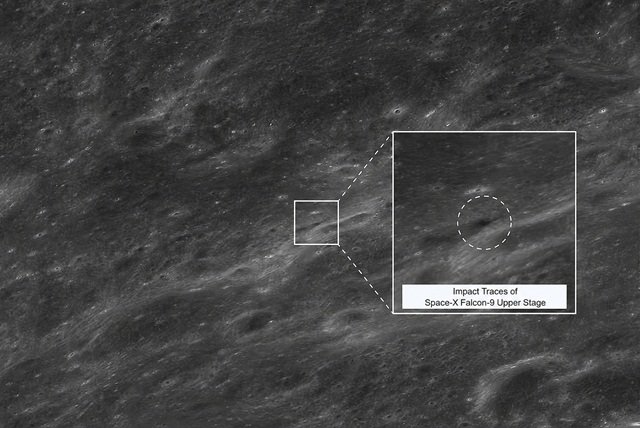
A discarded upper stage of a SpaceX Falcon 9 rocket has left a newly formed crater on the Moon after crashing into the lunar surface, with South Korea’s Danuri lunar orbiter providing the first official confirmation of the impact through before-and-after images of the crash site.
The Falcon 9 upper stage, belonging to Elon Musk’s SpaceX, impacted the Moon on Wednesday at 08:34 Spanish mainland time after spending more than a year drifting through space without sufficient fuel to return to Earth. Independent astronomers had already confirmed that the rocket’s trajectory made the collision inevitable, while SpaceX and NASA later verified the object’s course. Various observatories also detected indirect evidence of the event, but it was only on Thursday morning that official visual confirmation arrived through observations made by the Korea Aerospace Research Institute (KARI) and the Korea AeroSpace Administration (KASA) using the Danuri lunar probe.
According to the South Korean space agency, Danuri passed over the predicted impact zone and photographed the lunar surface both before and after the collision. The spacecraft began its observations around 30 minutes before the impact and conducted a series of orbital manoeuvres that enabled it to fly over the site several times, completing eight separate photographic sessions. These observations revealed visible changes to the terrain surrounding the impact point, including evidence of material ejected during the collision.
The agency said the data collected by Danuri would contribute to significant scientific research and would be combined with follow-up observations by NASA’s Lunar Reconnaissance Orbiter (LRO) as part of an international scientific collaboration.
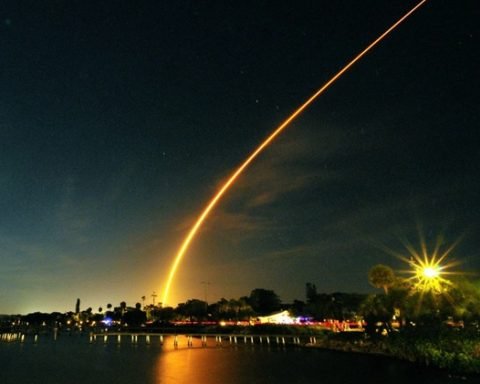
The rocket stage had originally been launched in January 2025 to deliver two privately developed lunar landers, Blue Ghost from Firefly Aerospace and Resilience from the Japanese company Ispace. After completing its primary mission, the upper stage remained in orbit but lacked sufficient fuel to perform a controlled return to Earth. It subsequently drifted through space for more than a year before ending its journey in a high-speed collision with the Moon.
Travelling at approximately 8,700 kilometres per hour, the four-tonne, 12-metre-long upper stage struck the lunar surface, creating a crater and throwing up a cloud of grey dust that was visible from Earth. Unlike the reusable first stage of a Falcon 9 rocket, which returns to Earth and lands on a recovery vessel after launch, the upper stage remains in orbit and is not designed for reuse.
The launch formed part of NASA’s Commercial Lunar Payload Services (CLPS) programme, an initiative within the wider Artemis programme aimed at supporting the return of astronauts to the Moon and establishing a sustained human presence on its surface. The programme enables private companies to transport scientific instruments and technology demonstrations to the Moon through partnerships involving the United States, Europe, Japan, Canada and other international collaborators.
NASA Administrator Jared Isaacman noted that spent rocket stages have intentionally been crashed into the Moon since the Apollo era to support scientific and seismic research. However, this incident differs from natural impacts because researchers possess detailed information about the object’s mass, speed, trajectory and angle of impact, allowing scientists to study the collision under unusually well-defined conditions.
Although meteorites strike the Moon every day because it lacks an atmosphere capable of slowing incoming objects, NASA said a meteoroid carrying energy comparable to that of the Falcon 9 upper stage impacts the lunar surface only about once every six days. The agency indicated that the Moon therefore routinely experiences impacts of similar force.
The incident has nevertheless prompted SpaceX and NASA to reconsider how future spacecraft are sent to the Moon, particularly as plans advance for establishing permanent lunar bases where uncontrolled impacts could pose greater risks.
The latest collision is not without precedent. In 2022, astronomers detected another uncontrolled object on course to strike the Moon. Initially believed to be another SpaceX Falcon rocket stage, it was later identified as a Chinese spacecraft launched in 2014 that had drifted through space for several years before colliding with the lunar surface in March 2022. That event marked the first known accidental impact of a human-made object on the Moon.