Elon Musk has unveiled a redesigned Tesla Roadster equipped with SpaceX-developed thrusters capable of propelling the electric sports car into the air, with production scheduled to begin in 2028, eight years after Tesla’s original delivery target.
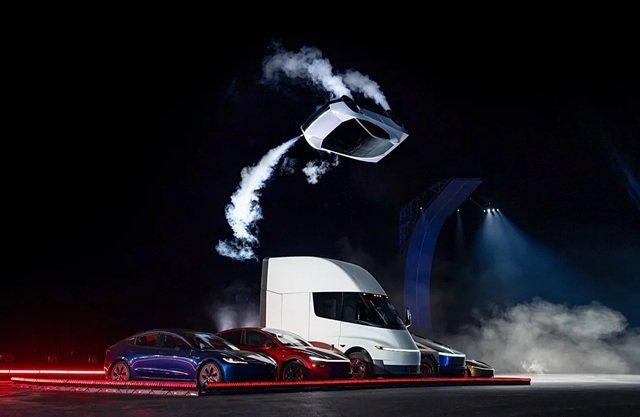
The two-seat vehicle was demonstrated on Thursday, 15 October, at SpaceX’s rocket test site in McGregor, Texas, near Waco. In a remotely operated demonstration, the white coupe climbed a curved ramp, remained upside down against its surface, launched into the air, rotated and landed on the pavement. It then cleared several Tesla vehicles, including a Cybertruck, Model Y, Model 3 and Tesla Semi.
The car was unmanned during the demonstration, with a Starman mannequin occupying the driver’s seat. Musk described the demonstration as “technically autonomous”. Spectators were kept several hundred yards away because the thrusters could damage hearing when operating at full output.
The vehicle combines suction fans that generate downforce with compressed-air thrusters housed in the rear diffuser. Tesla vice-president of vehicle engineering Lars Moravy said the fan system could generate up to two times the force of gravity, while the company reported more than 10,000 pounds of downforce during the stationary demonstration.
Two carbon-fibre-wrapped pressure vessels hold 600 litres of compressed air, which feeds ten thruster nozzles. The system produces a claimed 80 kilonewtons of thrust. Moravy said the car could replenish its compressed-air supply using power from its battery, rather than relying on fuel that must be burned.
Musk said the car could accelerate from zero to 60 miles per hour in less than one second and exceed 230mph. Tesla has not announced an official purchase price. The original second-generation Roadster prototype, unveiled in November 2017, was advertised with a 1.9-second acceleration time to 60mph, a range of 620 miles and a starting price of $200,000. Deliveries were initially promised for 2020.
Tesla’s reservation page now lists three versions. The Performance model seats two, includes the suction fans but excludes the thrusters, and claims acceleration to 60mph in under 1.6 seconds. It requires a $50,000 deposit, with $5,000 payable upfront and the balance due within ten days.
The Thrust version adds rear acceleration thrusters and claims a sub-0.9-second sprint to 60mph. Tesla demonstrated an acceleration time of 0.81 seconds during Thursday’s event. Reservations require a $250,000 deposit. The single-seat Rocket version features what Tesla calls a “full flight system”, claims acceleration to 60mph in under 0.59 seconds and is available by invitation only. Tesla says it is not approved for public-road use.
Musk cautioned that the Roadster was “not necessarily a safety-optimized car” and said he was “not sure it’s necessarily legal in all jurisdictions”. The company has not disclosed list prices for any version.
Tesla shares rose more than 4% in premarket trading on Friday following the unveiling. However, analysts expect the Roadster to contribute relatively little to the company’s overall business. Seth Goldstein of Morningstar forecasts annual sales of about 2,000 vehicles, describing the model as a flagship designed to showcase Tesla’s engineering capabilities.
Gene Munster, managing partner at Deepwater Asset Management, called the unveiling “an engineering flex with no commercial value beyond embarrassing traditional car makers”. Musk himself described the Roadster’s financial importance in 2023 as a “small potato situation” that would not “move the needle in a major way financially”.
The unveiling comes as Tesla shifts towards self-driving technology and robotics. The company stopped selling its Model S sedan and Model X SUV this year to free factory capacity for its Optimus humanoid robot, and has introduced the Cybercab, a two-seat robotaxi without a steering wheel or pedals. Musk said the Roadster would become the only manually driven car in Tesla’s future line-up.
Tesla is expected to report its third-quarter financial results on 21 October.