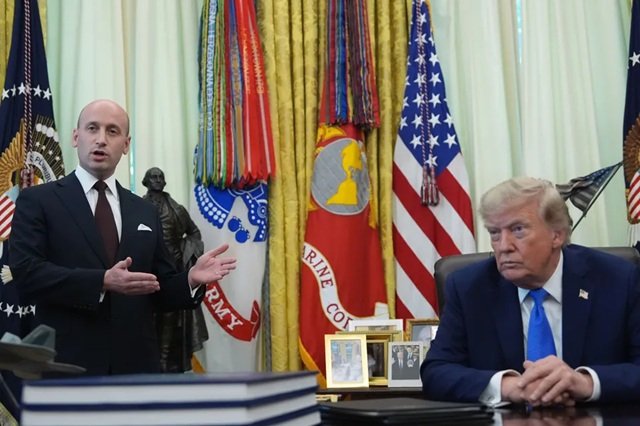
US President Donald Trump has renewed his campaign to restrict birthright citizenship by signing two executive orders that seek to limit the automatic acquisition of US citizenship in narrowly defined circumstances, despite a recent Supreme Court ruling reaffirming constitutional protections for children born in the United States.
The measures represent the latest attempt by the Trump administration to curb what it describes as “birth tourism” and to narrow eligibility for citizenship under specific historical exceptions recognised by US law. The White House argues that the orders are consistent with the Supreme Court’s recent decision and are designed to protect “the meaning and value of American citizenship”. However, legal experts and civil rights organisations are expected to challenge the measures in court, raising fresh questions over their constitutionality.
One executive order targets women who travel to the United States solely to give birth so that their children automatically acquire US citizenship. Under the new policy, children born to mothers who entered the country expressly for that purpose would no longer automatically qualify for citizenship.
Speaking after the orders were signed, Deputy Chief of Staff Stephen Miller said some foreign nationals enter the United States claiming to be visiting tourist destinations such as Disneyland, while their actual purpose is to give birth in the country. Miller, a principal architect of the administration’s immigration agenda, argued that the practice exploits American citizenship laws.
President Trump acknowledged that the initiative follows what he described as “a very unfortunate decision” by the Supreme Court regarding birthright citizenship. According to a statement released through the White House, the administration believes the Court recognised that certain historical exceptions to the Fourteenth Amendment remain valid and that these exceptions provide a legal basis for the new executive actions.
The administration has also issued a second executive order allowing US authorities to revoke citizenship if it was obtained through fraudulent or deceptive means.
In addition to addressing alleged birth tourism, the administration outlined several categories of children who it argues should not automatically receive US citizenship when both parents are foreign nationals. These include children born to members of organisations designated as terrorist groups, children of ambassadors, embassy and consular personnel or individuals employed by foreign governments, and children born in certain US territories where citizenship is not granted by federal law. The administration also identified births in overseas US territories, including Puerto Rico, Guam and the US Virgin Islands, as areas potentially affected should Congress amend existing legislation governing citizenship in those jurisdictions.
The latest executive actions follow a significant legal defeat for the administration at the end of June, when the US Supreme Court ruled that children born in the United States continue to acquire citizenship automatically, regardless of whether their parents are undocumented immigrants or are only temporarily present in the country. The Court held that such children are citizens from birth under the Fourteenth Amendment to the US Constitution.
The ruling reaffirmed the long-established principle of jus soli, or citizenship by birth on US soil, which has been guaranteed since the adoption of the Fourteenth Amendment in 1868. The constitutional provision states that all persons born or naturalised in the United States and subject to its jurisdiction are citizens of the United States.
In its judgment, the Supreme Court relied on both the historical background of the Fourteenth Amendment and the landmark 1898 decision affirming birthright citizenship. The justices also noted that the constitutional text contains no distinction based on whether parents are lawfully or temporarily present in the United States, rejecting language relied upon in the administration’s earlier executive order that the Court declared unlawful.
Despite that ruling, the White House argues it has identified a legal avenue allowing restrictions in narrowly defined circumstances. According to an official fact sheet, the administration believes the Court acknowledged historically recognised exceptions under which birthright citizenship does not apply.
The renewed effort has already prompted expectations of further legal challenges. Civil rights organisations are expected to contest the executive orders, meaning the dispute is likely to return to the Supreme Court for another constitutional review.
Alongside the citizenship measures, the Trump administration is also considering stricter visa screening procedures. According to reports citing internal government documents, applicants for additional categories of US visas, including foreign journalists, may be required to make their social media accounts publicly accessible as part of expanded security vetting. White House Press Secretary Karoline Leavitt shared a report outlining the proposal on social media without explicitly confirming its adoption.
Responding to media enquiries, a spokesperson for the US State Department said the department continually reviews visa procedures and that examining applicants’ online presence is intended to verify their eligibility under US law while ensuring they do not pose a security risk to the United States.
With fresh executive action and the prospect of another constitutional challenge, the debate over birthright citizenship—one of the defining principles of American nationality law for more than 150 years—appears set to return to the centre of US legal and political debate.