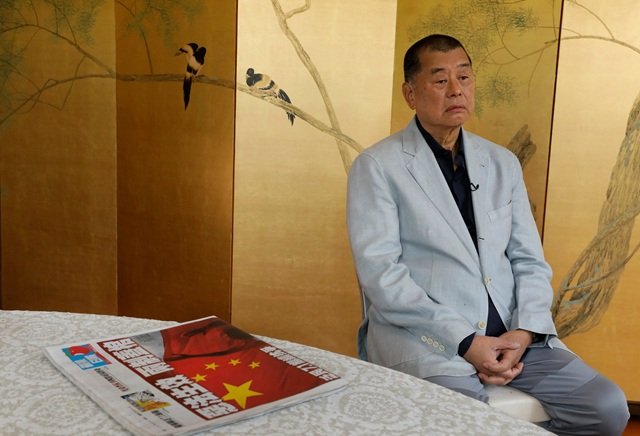
At Stanley prison, on the southern edge of Hong Kong Island, Jimmy Lai’s solitary confinement extends far beyond the walls of his cell. According to his family, the 78-year-old is held alone on an otherwise empty floor, watched by a single guard. The floors immediately above and below are also deserted, with empty cells and corridors surrounding him.
For six years, the pro-democracy media tycoon has lived in isolation. He spends 23 hours a day in his cell and exercises alone. In February, Lai was sentenced to 20 years in prison under Hong Kong’s national security law, imposed by China as its control over the former British colony has tightened. His family says the sentence amounts to a death sentence.
Now, notes, drawings and extracts from letters seen exclusively by The Observer provide a rare glimpse of Lai’s existence behind bars. They depict a prisoner whose health is failing, whose principal companionship has become a growing collection of more than 100 books, and whose religious faith has assumed an increasingly central place in his life.
Lai has immersed himself in Catholic theology, reading the works of St Augustine, Thomas Aquinas and Pope Benedict XVI. In prison notepads, he scribbles thoughts, writes letters and draws images of Christ on the cross. His writings repeatedly return to themes of endurance and sacrifice.
“Truth and justice must stand above our comfort and wellbeing,” he wrote in one letter. “Otherwise, our lives will be lived with ‘a millstone hung on our neck’.”
The letters also reveal the extent of his physical deterioration. In one account, Lai described becoming too weak to stand after sitting down in his cell. “I could not stand up after I sat back down in my cell. Two guards came in to help me stand,” he wrote.
His children raised concerns last year over dramatic weight loss, rotting teeth and nails that were turning green before falling out. The medical reports they had been receiving every few months were subsequently stopped after being redacted. His family now says it has little information about his current condition and fears that, without political intervention, he could die in prison.
The Hong Kong government has repeatedly rejected claims that Lai is being denied proper medical care. Authorities say he receives “adequate and comprehensive” treatment in custody, while correctional officers maintain that he undergoes frequent medical checks and reject allegations that his treatment is politically motivated. His family disputes that account, saying his health is deteriorating rapidly.
The 20-year sentence imposed in February was the harshest issued under the national security law. Lai, the founder of Apple Daily, the pro-democracy newspaper, was convicted of conspiring to collude with foreign forces and publishing seditious material during the huge protests that shook Hong Kong in 2019.
His imprisonment has made him the most prominent of hundreds arrested under the new law. To his supporters, his case has become a symbol of what they regard as the erosion of Hong Kong’s judicial independence and the dismantling of its once vibrant pro-democracy movement.
“Every day he’s in prison Hong Kong is creating an ongoing liability for China,” his son Sebastien Lai told The Observer. “He’s the purest form of a political prisoner and a prisoner of conscience. He has suffered great cruelty and injustice, and Hong Kong’s global reputation has been greatly damaged, with nothing to show for it.”
Lai’s case has also become a point of international diplomatic pressure. US president Donald Trump raised it with China’s President Xi Jinping during a trip to Beijing in May. Lai’s children have called on the UK prime minister, Andy Burnham, to do more to secure their father’s return. Keir Starmer was criticised for failing to secure Lai’s release during a visit to China earlier this year.
A UK government spokesperson said foreign secretary Ed Miliband had already raised Lai’s case with his Chinese counterpart, Wang Yi, in Manila last month.
“Jimmy Lai’s case continues to be a priority for this government… Direct engagement matters because it allows us to raise our strongest disagreements with the Chinese authorities and push for progress,” the spokesperson said.
“The UK continues to call for Jimmy Lai’s immediate release, for all necessary treatment and for full access to independent medical professionals.”
For Lai’s family, however, diplomatic engagement has not removed the immediate fear surrounding his health. “Every day is also a risk to his life. In my father you have an exemplary British citizen, a man whose sacrifice has reminded us of the value of a free world. We cannot allow him to die in prison,” Sebastien Lai said.
Lai’s life before prison was marked by a dramatic transformation. Born in mainland China, he smuggled himself to British Hong Kong as a 12-year-old boy. He worked as a child labourer before rising through the garment industry, eventually founding his own clothing brand and making his fortune.
Following the crushing of protests in Beijing’s Tiananmen Square in 1989, he became an outspoken critic of Communist China and a vocal pro-democracy activist. In June 1995, he founded Apple Daily, using the pro-democracy tabloid to criticise the authorities in Hong Kong and Beijing.
His opposition became more prominent after the British handover of Hong Kong to Chinese rule in 1997. The former British colony had been promised political freedoms not granted to the rest of China, including an independent judicial system, a free press and freedom of speech.
As China tightened its grip, Lai remained a prominent figure in opposition movements. He participated in the 2014 protests associated with the Umbrella Movement, which began after Beijing refused to permit free elections in Hong Kong. Five years later, he opposed a proposed extradition bill that would have allowed people to be sent from Hong Kong to mainland China. The ensuing protests lasted weeks, eventually becoming violent when protesters stormed the legislative council and police responded with teargas, water cannons and rubber bullets.
At the height of those demonstrations, Lai travelled to Washington, where he met then vice-president Mike Pence and secretary of state Mike Pompeo to discuss the threat to Hong Kong’s autonomy. That visit later became a central element of the case against him when he was arrested the following year and charged under the new national security law.
Hong Kong’s chief executive John Lee accused Lai of using Apple Daily to “poison the minds of the people of Hong Kong”. Lee alleged that the newspaper had been used to “create social conflicts, incite social antagonism, incite hatred, glorify violence and openly beg for foreign sanctions against China”. Prosecutors argued that the seriousness of Lai’s offences was comparable to murder.
His supporters, meanwhile, point to a decision they say defines his imprisonment: Lai had the opportunity to leave Hong Kong but chose to remain. About 170,000 Hong Kong residents have moved to the UK under visa rules introduced in 2021. Lai, who holds a British passport, stayed.
“Jimmy Lai did it deliberately. He had the means to leave. He has a British passport, but he chose to stay because he believes Hong Kong gave him everything,” one activist told The Observer.
His family has continued to seek international support. His wife Teresa and daughter Claire met Pope Leo at the Vatican before the trial verdict last year, although the Vatican, engaged in its own delicate negotiations with Beijing, has remained silent on Lai’s detention.
Claire Lai said her father’s writings and drawings reflected a deepening Catholic faith. “I think his letters and drawings attest to how he has grown in faith. His letters especially paint an image of a man journeying and deepening in his faith,” she said. Prison guards had previously refused to allow him to receive communion, according to his children.
Chris Patten, the last British governor of Hong Kong, sees Lai’s decision to remain as central to his significance. “One reason why the Chinese Communists hate Jimmy Lai so much is not just that he represents much of what was best in Hong Kong. But he was prepared to stand up for it, even when he could have left at any moment, and even when he knew that if he stayed, sooner or later, the police state would come after him,” he said.
“I think Jimmy Lai exemplifies what the Chinese totalitarian regime hates about freedom. This isn’t how history ends. It doesn’t end with a tyranny running everything,” Lord Patten added.
Patten argues that the national security law has fundamentally transformed the city. “People who think prosperity exists without the rule of law don’t understand how open societies work,” he said.
More than 400 people have been arrested under the national security law, while critics say its enforcement continues to expand. Last month, on the opening day of the city’s annual book fair, two independent bookshops were raided and five members of staff were arrested on suspicion of displaying seditious material. Pro-democracy activists say the boundaries of permissible expression continue to shift.
“The government says it does not want a banned-books list, but it wants to keep things vague, so no one knows what kind of books they can buy,” said one activist who did not want to be named. “It creates an overwhelming chilling effect on people who read.”
Eric Lai, a Hong Kong legal expert, said: “The enforcement of the national security law by security police is persistently expanding. It marks the loss of political impartiality and nonpartisan nature of a common law court in Hong Kong and becomes merely a tool for the government to crack down on people.”
The physical remains of Lai’s former media empire offer another measure of that transformation. In an industrial park in Hong Kong’s New Territories stands the abandoned headquarters of Apple Daily, once one of the territory’s most popular newspapers. The offices were raided twice after the national security law took effect before the paper finally closed in 2021. Its premises are now sealed, with the gates chained shut.
“The Hong Kong government wants to get rid of all voices which are different from or not aligned with it or the Beijing government,” said a former reporter from the paper who did not want to be named for fear of reprisal.
Inside Stanley prison, Lai’s world has narrowed to a cell, solitary exercise, letters, drawings and books on faith. Outside, his family continues to campaign for his release, while governments and international figures weigh the diplomatic implications of his case.
Sebastien Lai says his father understood the consequences when he decided to stay. “He knew exactly what he was giving up,” he said. “He chose to stand up for the freedom of others. A life of peace for a life of meaning.”