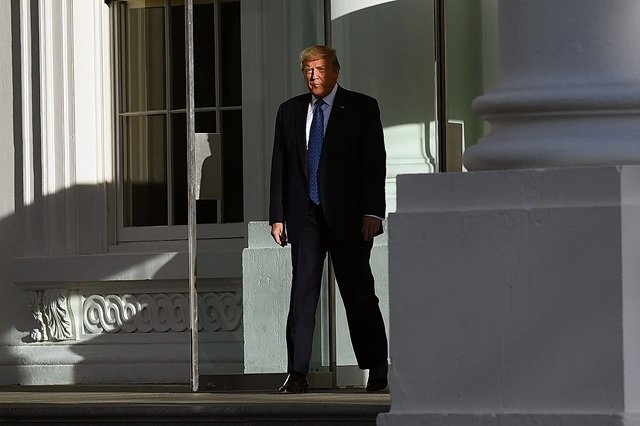
Sometimes political reality can resemble a badly scripted Hollywood film. On 8 July, after the NATO summit in Ankara, US President Donald Trump appeared to leave Turkey in the customary manner, boarding Air Force One. But, according to reports by The Washington Post and The New York Times, he subsequently left the aircraft secretly through a catering container attached to its side, before being driven to another US military aircraft for his return journey. The manoeuvre was reportedly prompted by concrete threats from Iran against the US president.
The episode raises questions that extend beyond the mechanics of presidential security. It also revives an older political question: what does it mean when rulers hide?
The German newspaper Die Zeit examined the incident through the long history of political concealment, noting that the practice can signify either authority or vulnerability. A ruler who disappears from view may be demonstrating that he is important enough to require extraordinary protection. But concealment can equally reveal that the ruler is sufficiently threatened that he cannot safely remain visible.
The political tradition of disguise and deception is hardly new. Niccolò Machiavelli’s The Prince established the idea that a successful political leader must be capable of deception, misdirection and the concealment of intentions. From that perspective, Trump’s secret departure might be interpreted as an effective security manoeuvre. But it can also be viewed as evidence of the vulnerability of the government he leads.
History offers striking examples of rulers using concealment to survive. In 1651, following the Battle of Worcester during the English Civil War, King Charles II hid from soldiers of Oliver Cromwell’s New Model Army in the crown of an oak tree. The tree subsequently became famous in Britain as the Royal Oak, with numerous pubs named after it. Charles eventually escaped to France before later returning to England.
Prince Metternich’s flight from Vienna in 1848 provides another example. The Austrian statesman narrowly escaped the revolutionaries and fled abroad. Contemporary caricatures portrayed him hiding in a laundry cart before he eventually reached London and later returned to Vienna.
Other attempts at concealment ended very differently. In 1791, Louis XVI and Marie Antoinette attempted to escape the violence of the French Revolution disguised as servants. They were discovered and subsequently guillotined.
Hiding, however, is not exclusively the tactic of rulers attempting to escape. It has also been used by political figures moving towards power. In 1917, Vladimir Lenin was secretly transported from Zurich to Russia in a sealed railway carriage travelling through Germany, Sweden and Finland. The operation brought back into Russia a Bolshevik leader who had almost abandoned his political ambitions and helped place him at the centre of a historical transformation.
The relationship between invisibility and power is perhaps even more striking in the case of Hirohito, Japan’s emperor. For much of his life, he remained secluded within imperial palaces, with contact with the outside world largely restricted to court officials and selected politicians and military figures. That absence helped make him appear larger than life. Until the end of the Second World War, Hirohito was officially regarded as divine in Japan, and his physical and vocal distance from ordinary people contributed to the extraordinary aura surrounding him.
That changed dramatically in August 1945, when Hirohito broadcast Japan’s declaration of surrender in the war against the United States. Few listeners could fully understand his words because he spoke in an archaic form of court Japanese. His decades of quasi-invisibility had ended. Although he remained nominally emperor, he lost his political power. Later, he could appear publicly without the same restrictions, including during a visit to Disneyland in California in 1975. His invisibility had first protected his power and subsequently helped shape his post-war survival.
The contemporary example of Iran’s Mojtaba Khamenei illustrates how much more difficult it can be for political invisibility to function as a source of authority. After the death of his father, Ali Khamenei, Mojtaba became Iran’s supreme leader. Since his appointment in March, he has scarcely appeared in public. The importance of his position, in this account, lies less in what he does publicly than in the fact that the position remains formally occupied, allowing the regime to project continuity.
But the public response has been different from that surrounding Hirohito. Questions about Khamenei’s health and whether he may have already died as a result of American-Israeli bombardments have grown. Iranian President Masoud Pezeshkian has reportedly said that it is currently “difficult” to communicate with him. Iran International reported that the president met Khamenei at a secret location where the supreme leader was inside a vehicle with darkened windows. Pezeshkian was reportedly not even certain that the voice coming from the vehicle belonged to Khamenei.
Modern leaders therefore face a paradox. They may need to disappear for security reasons, yet they must also appear sufficiently often to convince the public that they remain in control.
Presidential security itself routinely relies on controlled invisibility and deception. Since the assassination of John F. Kennedy in 1963, US presidential motorcades have included three identical armoured limousines known as The Beast, reportedly carrying identical number plates. The arrangement reduces the likelihood of a successful attack by making it more difficult to identify the president’s vehicle.
Vladimir Putin’s security practices provide another example. He is reported to have identical offices in three presidential residences — Novo-Ogaryovo, Valdai and Sochi — making it difficult to determine his location from the surroundings shown during televised addresses. For a leader reportedly deeply concerned about infection and poisoning, such measures can appear extreme. Yet their political meaning remains ambiguous: concealment can simultaneously communicate importance and expose vulnerability.
That ambiguity now surrounds Trump’s aircraft manoeuvre. The White House initially declined to confirm the operation and subsequently acknowledged it, suggesting that the political value of the episode was not straightforward. The administration could portray the switch as evidence that Trump and the Secret Service had successfully deceived potential Iranian attackers. Trump himself said he had simply followed Secret Service instructions, presenting the episode as part of a safety-first strategy.
Yet the symbolism is complicated by the aircraft involved. The Air Force One that carried Trump to Ankara was a gift from the ruler of Qatar. Known for its luxury as a “palace in the sky”, the aircraft is reportedly less well protected than previous presidential aircraft and lacks a missile warning and defence system. That raises the possibility that the secret transfer was necessary precisely because Trump’s aircraft was not sufficiently secure.
The imagery is particularly awkward for a president whose political style places considerable emphasis on spectacle, strength and luxury. Trump’s public persona has been associated with grand spaces, gold and displays of power. A US president concealed inside a catering container presents an entirely different image.
Die Zeit’s account therefore places the Ankara episode within a much larger history. From Charles II hiding in an oak tree and Metternich being caricatured in a laundry cart to Lenin travelling secretly in a sealed railway carriage, concealment has repeatedly accompanied moments of danger, transition and political transformation.
The symbolism can turn quickly. A hidden ruler may appear powerful because extraordinary precautions are necessary to protect him. The same concealment may simultaneously suggest weakness because the leader is unable to appear safely in public. That is the paradox at the centre of Trump’s secret aircraft switch.
A recent cartoon in The New Yorker captured that ambiguity by depicting suited men pushing a white-covered catering container across an airfield, representing Trump and his delegation. The image recalls the old caricatures of Metternich hiding in a laundry cart — an image of power reduced, if only briefly, to the need to disappear.
For rulers, hiding has never had a single political meaning. It can preserve authority, protect a government and frustrate an enemy. But it can also expose fear, insecurity and the limits of power. In Trump’s case, the significance of the catering-container episode may ultimately depend less on where he was hidden than on what the act of hiding came to represent: a demonstration of how much protection the most powerful political office in the United States now requires.