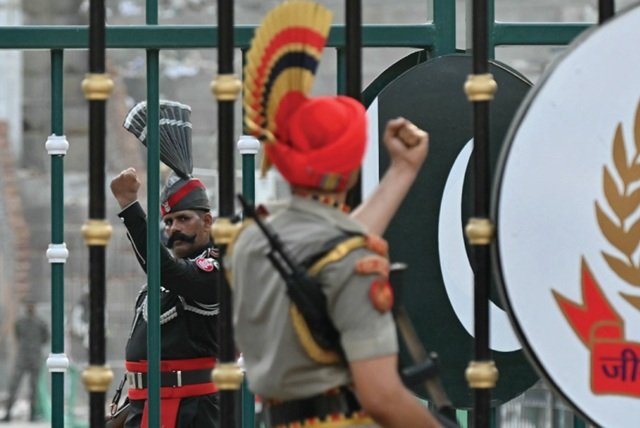
Nearly 80 years after the dissolution of British India produced the independent states of India and Pakistan, public opinion in both countries continues to be shaped by deep mutual distrust. A new survey by the Pew Research Center finds that most people in each country regard the other as their greatest geopolitical threat, while overwhelmingly unfavourable views of the rival country point to the persistence of an animosity that has endured across generations.
The survey, conducted among 3,566 adults in India from Feb. 8 to April 27, 2026, and 1,039 adults in Pakistan from April 8 to May 7, 2026, also reveals that the rivalry is embedded within sharply contrasting perceptions of the wider international order. Indians tend to view the United States and Russia favourably and identify them as their most important allies. Pakistanis, by contrast, are overwhelmingly favourable towards China and regard it as their leading ally, while expressing considerably greater scepticism towards the United States.
The depth of mutual hostility is striking. Roughly nine-in-ten Pakistanis have an unfavourable view of India, including 73% who describe their opinion as very unfavourable. The sentiment cuts broadly across demographic groups in Pakistan. In India, 78% of adults hold an unfavourable view of Pakistan, including 65% who say their opinion is very unfavourable. Another 15% did not answer.
For India, the hostility towards Pakistan is not a new development. Pew Research Center polling over more than a decade has consistently found overwhelmingly negative views, with no more than two-in-ten Indians expressing a favourable opinion of Pakistan since 2013. Earlier surveys in Pakistan, stretching back to the early 2000s, similarly recorded predominantly negative assessments of India, with favourable views ranging from single digits to a third.
The survey also exposes a reciprocal lack of confidence in the other side’s willingness to pursue better relations. Indians are generally convinced that their own government and people are committed to good bilateral relations, while a majority of Pakistanis believe that neither the Indian government nor Indian people share that commitment. The pattern is reversed in Pakistan. Most Pakistanis say their own government and people are committed to good relations, while most Indians believe the Pakistani government and people are not.
Within India, religion also shapes perceptions. Indian Muslims express somewhat more favourable views of Pakistan than Indian Hindus: 21% of Muslims hold a favourable opinion compared with 6% of Hindus. About a third of Indian Muslims, 34%, identify Pakistan as India’s greatest threat, compared with 57% of Hindus. Yet even among Indian Muslims, two-thirds express a negative view of Pakistan.
The two countries’ perceptions of geopolitical threats are similarly reciprocal. Pakistan is named as India’s greatest threat by 54% of Indians, while 43% of Pakistanis identify India as their greatest threat. For Indians, China is the next major threat, named by 21%. Pakistanis place Israel and the United States next, with each identified by 24%.
The alliances that people in the two countries identify are almost mirror images. Three-quarters of Pakistanis, 75%, name China as their country’s most important ally, while 12% identify Saudi Arabia. In India, 36% name Russia as their most important ally and 16% choose the United States. Roughly a third of Indians did not answer the question.
These contrasting alignments extend to public perceptions of the three major powers. Indians are considerably more favourable towards Russia, with 58% expressing a positive view, compared with 39% of Pakistanis. Confidence in Russian President Vladimir Putin stands at 51% among Indians and 32% among Pakistanis. Indians are among the most positive towards Russia and Putin across the 37 countries surveyed by the Pew Research Center this spring.
The divide is even sharper over China and the United States. Indians view the United States three times more favourably than Pakistanis do and also express greater confidence in President Donald Trump. Pakistanis, meanwhile, have overwhelmingly positive views of China, with 90% expressing a favourable opinion, while 83% have confidence in President Xi Jinping.
Only around a quarter of Indians view China or Xi positively. Indian Muslims are somewhat more likely than Indian Hindus to express favourable views of China and confidence in Xi, although their overall assessments remain negative.
The wider regional picture provides another layer to these divisions. Of India, Pakistan, Bangladesh and Sri Lanka, Sri Lanka is the only country viewed more positively than negatively by respondents in all three of the other countries surveyed. India receives particularly varied assessments: 79% of Sri Lankans view it favourably, compared with 42% of Bangladeshis and 7% of Pakistanis.
Sri Lanka is also regarded as an important partner by its neighbours. Sixty-three per cent of Sri Lankans identify India as their most important ally, while Bangladeshis and Pakistanis most often name India as their greatest threat. Pakistan itself receives favourable assessments from 57% of Sri Lankans and 54% of Bangladeshis, compared with just 8% in India.
The regional picture has shifted since 2024. Favourability towards India has fallen by 15 percentage points in Bangladesh while rising by 14 points in Sri Lanka. Positive views of Bangladesh have increased by 9 points in Sri Lanka but declined by 10 points in India. Views of Pakistan have warmed significantly in Sri Lanka and Bangladesh, rising from 44% to 57% in Sri Lanka and from 40% to 54% in Bangladesh. In India, by contrast, favourable views of Pakistan remain among the smallest recorded.
Age and education also produce differences, although they do not overturn the broader patterns. More educated respondents in Bangladesh, India and Pakistan tend to view Sri Lanka more favourably, while more educated Sri Lankans are more favourable towards each of the other three countries. Younger Sri Lankans are also more positive towards the regional countries than those aged 50 and older. In India, 54% of people under 35 express a favourable view of Sri Lanka, compared with 43% among older Indians. Views of Pakistan remain overwhelmingly negative across Indian age groups, although younger Indians are slightly more favourable than those aged 50 and older, at 9% compared with 5%.
The surveys were conducted during periods of significant regional and international developments. The Pakistan survey began as peace negotiations between the U.S. and Iran were starting in Islamabad. Notably, Pakistan was one of the few countries where views of the U.S. became more positive during the 2026 survey field period. The India survey, meanwhile, preceded recent “cockroach” protests over irregularities in nationwide university entrance examinations and youth unemployment.
The findings portray two neighbouring societies whose perceptions of each other remain overwhelmingly negative, while their assessments of the major powers increasingly point in different directions. India leans towards a more favourable view of the United States and Russia, while Pakistan places China at the centre of its conception of international partnership. Yet the most persistent division remains closer to home: each country largely trusts its own commitment to better relations while doubting the sincerity of the other.