



This article is adapted and abridged from a speech delivered by the author at the Sarmaya Art Foundation, Mumbai, on 8 August 2026. The text is based on the author’s two books Indus Basin Uninterrupted: A History of Territory and Politics From Alexander to Nehru, Penguin Random House 2021; and Trial By Water: Indus Basin and India-Pakistan Relations, Penguin Random House, 2025.
History demands to be looked at twice. The first gaze recovers the compulsions, calculations, fears and constraints within which decisions were made. The second is analytical. What does that history tell us about the present?
The Indus Waters Treaty, signed in Karachi on 19 September 1960, deserves precisely such a double gaze. It is often remembered as an unusually durable water-sharing agreement between two adversarial states. But the circumstances in which it was negotiated tell a more complicated story.
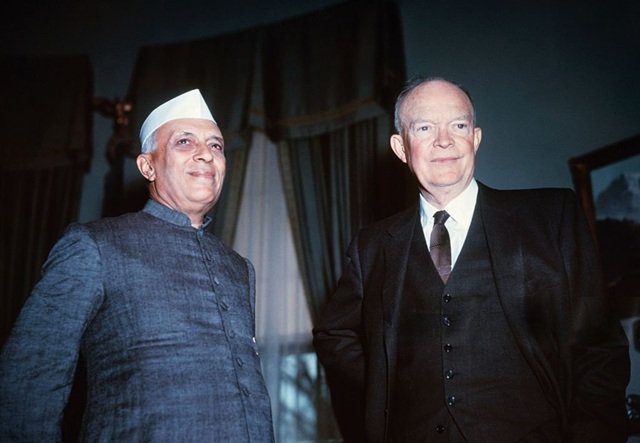
There is, in fact, a small detail from the day of the signing that captures something of the ambiguity surrounding the Treaty. Jawaharlal Nehru arrived in Karachi wearing his familiar white achkan and the rose that had become his personal emblem. Yet when he sat down at the polished teak table to sign the Treaty, the rose was gone from his buttonhole. Whether accident or coincidence, the missing rose makes an evocative image. At the very moment Nehru committed India to an agreement involving significant concessions and costs, the familiar symbol associated with his public persona had disappeared.

From left to right: Jawaharlal Nehru, Prime Minister of India; Mohammed Ayub Khan, President of Pakistan; and William Illiff, World Bank vice president [World Bank]
The Treaty was far more than a technical settlement over rivers. It was shaped by a particular geopolitical moment in which the Cold War was transforming South Asia. India sought to preserve strategic autonomy while Pakistan increasingly anchored its security to the United States. Washington, meanwhile, saw the Indus Basin as part of a broader effort to use development, economic assistance and diplomacy to stabilise a strategically important region in the wider contest with communism.
At the centre of this interplay stood three very different leaders, Jawaharlal Nehru, Field Marshal Ayub Khan and President Dwight D. Eisenhower, each bringing a distinct conception of security, sovereignty and regional order to the negotiations.
Nehru and Ayub: Two Visions of Security
Nehru’s approach to Pakistan in the 1950s cannot be understood simply through the lens of today’s India-Pakistan relationship. He had emerged from Partition with a deep awareness of the human and political consequences of permanent hostility. His instinct was to prevent disagreements from escalating into strategic confrontation. Yet by 1959, India’s security environment was becoming considerably more complicated.
The timing of Nehru’s first face-to-face meeting with Ayub Khan is revealing. On 1 September 1959, Ayub’s aircraft made what was described as a “fuel halt” at Palam airport. Time magazine had already described the proposed encounter as a “Baby Summit Meeting” in the context of “Asia’s own cold war.” It was to be the first personal meeting between Nehru and Pakistan’s military ruler.
But even as Nehru prepared to receive Ayub, he was confronting an extraordinary civil-military episode at home. The previous day, General K. S. Thimayya, India’s Chief of Army Staff, had submitted his resignation following differences with the government, including disagreements concerning Defence Minister V. K. Krishna Menon. On 2 September, Nehru told Parliament that he had been surprised by Thimayya’s decision and that the General had subsequently withdrawn his resignation. Yet Nehru used the occasion to reaffirm a principle he regarded as fundamental: “Under our Constitution and our practice, the civil authority is, and must remain, supreme. But that civil authority should pay due heed to the expert advice that it receives.”
The coincidence is striking. At the very moment Nehru was preparing to receive a military ruler from across the border, he was dealing with a public assertion of disagreement from the head of his own army. It would be difficult to establish that the Thimayya episode directly altered Nehru’s approach to Ayub. But it reveals the unusually complex security environment in which the meeting took place. Nehru was simultaneously managing civil-military relations at home, dealing with a military-led Pakistan and responding to a rapidly changing regional order.
Ayub, meanwhile, had assumed power in Pakistan in 1958 and was publicly advocating a settlement with India, including the possibility of joint defence of the subcontinent. But India’s strategic environment was deteriorating rapidly. China had consolidated its control over Tibet and was repeatedly encroaching across India’s northern frontier. In 1959, Chinese forces occupied nearly 12,000 square miles of territory in Kashmir and claimed another 39,000 square miles along the northern frontier. New Chinese outposts at Nyagzu and Dambuguru in Ladakh further underscored the growing threat. Nehru therefore faced a strategic paradox: Pakistan remained an adversary, but the rising Chinese challenge made a less hostile relationship with Pakistan increasingly desirable.
The Palam meeting was deliberately understated. Nehru had instructed officials not to dictate when Ayub should arrive or even whether he should have breakfast or lunch at the airport. He did not want the diplomatic corps formally invited. The informality was itself significant: political space was being created without making the encounter appear to be a summit.
The conversation was equally restrained. Nehru later told Parliament that no subject had been discussed in detail. Kashmir was mentioned only once, when Ayub suggested that all outstanding problems, including Kashmir, could be settled peacefully. Nehru agreed.
Yet beneath this apparent informality lay a profound strategic calculation.
For Ayub, Kashmir and water were increasingly connected. Pakistan’s vulnerability as a downstream state had been exposed by the canal-water crisis of 1948. Control over the upper reaches of the western rivers was therefore not simply an agricultural matter. It was a question of national security.
For Nehru, the calculation was different. Water was one of the few issues on which a durable settlement might be insulated from the larger political dispute. The Indus negotiations offered a way to separate the water question from the intractable Kashmir issue.
The Cold War Enters the Basin
The broader international context shaped the contours of the settlement. Washington’s strategic interest in South Asia was unmistakable. For the United States, the region was an important frontier in its global contest with the Soviet Union. Pakistan was firmly entering the American security orbit, while India’s insistence on non-alignment prevented Washington from approaching New Delhi simply through military alliances. Economic assistance, technical expertise and development diplomacy therefore acquired wider strategic significance.
The World Bank’s intervention provided an important institutional vehicle. In 1951, David Lilienthal proposed that the Indus problem be approached through engineering and development rather than political confrontation. Eugene Black, then President of the World Bank, subsequently offered the Bank’s good offices. A deeply political dispute was thus reframed as a problem of hydrology, infrastructure and economic development.
But engineering alone could not produce a settlement. The division of the river system required a massive programme of infrastructure to enable Pakistan to replace the waters it would lose from the eastern rivers allocated to India. The Indus Basin Development Fund brought together the United States, United Kingdom, Canada, Australia, New Zealand and West Germany, alongside India and Pakistan. The associated assistance and financing exceeded a billion dollars.
The Treaty, therefore, represented development diplomacy as much as water diplomacy.
This was consistent with President Dwight D. Eisenhower’s wider outlook. His administration viewed technological and developmental cooperation as instruments of peace and strategic stability. The language of “water for peace” and “atoms for peace” captured the optimism that technological capacity, economic development and international cooperation could reduce the conditions generating conflict.
Eisenhower’s December 1959 visit to India brought these strands together. His conversations with Nehru reflected notable strategic warmth despite India’s non-alignment; addressing a joint session of Parliament, Eisenhower received fifteen standing ovations. Nehru, anxious to reduce the possibility of future conflict with Pakistan, pressed for a joint declaration committing both countries to settle disputes without force or war. He also sought American support for India’s civilian nuclear programme.
Nehru faced a strategic paradox: Pakistan remained an adversary, but the rising Chinese challenge made a less hostile relationship with Pakistan increasingly desirable.
A revealing detail comes from Homi J. Bhabha’s letter to Nehru on 12 December 1959, immediately after Eisenhower’s visit. Bhabha noted that senior American Atomic Energy Commission officials had been impressed by India’s work at Trombay and urged Nehru to raise the subject with Eisenhower, whom he described as “keenly interested in the peaceful uses of atomic energy.” Bhabha explicitly linked this interest to Eisenhower’s “Atoms for Peace” initiative and the possibility of further cooperation in India’s civilian nuclear programme.
The connection is significant. In the Eisenhower-Nehru moment, water, nuclear technology and economic development were seen as instruments of both national transformation and peace. Nehru similarly believed that Pakistan’s economic development could reduce its incentive for war. The Indus settlement thus formed part of a broader peace calculus in which development, technological cooperation and material interdependence could encourage political restraint.
Eisenhower himself understood the emerging settlement in these terms. On 7 September 1960, before the Treaty was formally signed, he called it “one bright spot in a very depressing world picture.” Asked whether the agreement might help resolve Kashmir, he replied that this was certainly the hope.
A Bargain Between Unequal Fears
The Treaty is sometimes judged today by asking whether India was too generous or Pakistan too demanding. But India’s parliamentary debate of November 1960 shows that these questions were already being asked at the time.
Indian parliamentarians objected to the financial burden imposed on India (62.06 million pounds sterling), questioned concessions to Pakistan and expressed scepticism about entering a major agreement with a military ruler. Some feared that Pakistani leaders might interpret Indian generosity as weakness.
Nehru’s response reveals how he understood the settlement. The Treaty, he argued, had to be assessed in its broader context rather than through individual concessions. International agreements necessarily involved give and take. In effect, he saw the settlement as purchasing peace.
This is perhaps the most useful way to understand the Treaty. India was not merely allocating rivers; it was seeking predictability in a relationship marked by deep distrust. Pakistan was not simply securing water; it was seeking protection against the possibility that an upstream India might exercise geographical advantage coercively. The World Bank was not merely mediating a political dispute; it was financing the infrastructure that made the division possible. And the United States was not simply supporting development; it was using development assistance and diplomacy to contribute to regional stability.
Nehru in Karachi: The Last Moment
On 19 September 1960, Nehru travelled to Karachi to sign the Indus Waters Treaty with Ayub Khan. He arrived in his familiar white achkan, the rose in his buttonhole—a visual signature that had accompanied him through decades of public life. Yet when the Treaty was signed, the rose was missing.
It is tempting to read symbolism into the detail. The rose may simply have fallen away. But as an image, it captures the ambiguity of the moment. Nehru was signing an agreement that involved difficult compromises, substantial financial commitments and the acceptance of a river settlement that many in India considered unequal. The missing rose becomes an accidental metaphor for the burdens that accompanied the bargain.
The signing would also be Nehru’s last visit to Pakistan. He had not solved Kashmir, nor had he established political trust with Pakistan. But he had encouraged an institutional arrangement that might prevent water from becoming another instrument of conflict.
Yet only months later, Ayub was in Washington, sitting with a new American president, John F. Kennedy. There, the connection between Kashmir, territory and water appeared again—but in a markedly different strategic language.
Ayub and Kennedy: When Water Became Strategy
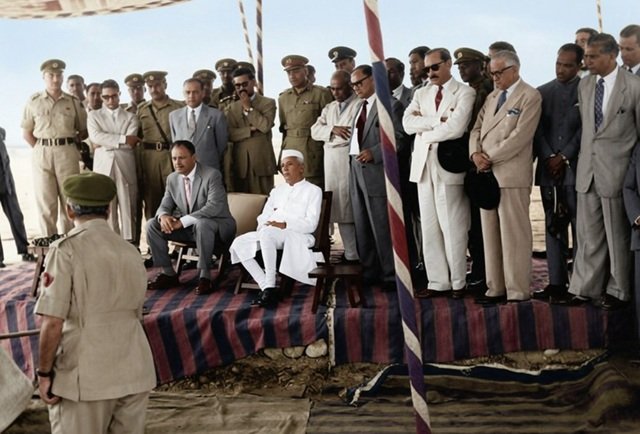
Ayub travelled to Washington in July 1961, less than a year after the Treaty was signed. The visit was designed as a major state occasion. At Jackie Kennedy’s suggestion, the state dinner was held on the east lawn of Mount Vernon, overlooking the Potomac—the first American state dinner held outside Washington, D.C. Ayub was being received not merely as Pakistan’s leader but as an important American strategic partner.
In his toast, Kennedy told Ayub that Mount Vernon stood for the United States “in the past, the present, and we hope the future.” The symbolism was unmistakable.
But the most revealing moment occurred away from the ceremony.
After dinner, Kennedy and Ayub withdrew for a private walk. According to the account, the two leaders managed to reach an understanding. Ayub agreed to reopen American airbases, while Kennedy promised that no military equipment would be supplied to India.
The conversation continued in the Oval Office. Ayub laid out maps to explain Pakistan’s security concerns. He connected Kashmir directly with Pakistan’s water resources and argued that, even if India retained Jammu, Pakistan would need “some miles” on the other side of the Chenab River to secure its water resources.
Then came the crucial question. As the discussion drew to a close, Ayub asked Kennedy whether the United States would support Pakistan. “Yes,” Kennedy replied.
The episode provides a revealing window into Ayub’s strategic thinking. For him, Kashmir was not simply a territorial dispute. It was tied to the geography of the Indus Basin. Territory, water and national security were inseparable.
This was fundamentally different from Nehru’s attempt to compartmentalise water from the larger political dispute. The Treaty had separated the management of the rivers from Kashmir. Ayub’s conversation with Kennedy demonstrated that, in Pakistan’s strategic imagination, the two could never be entirely separated.
The contrast between Eisenhower and Kennedy is revealing. Eisenhower saw development and institutional cooperation as means of moderating conflict. Kennedy viewed the same region through the harder strategic logic of the Cold War. Nehru sought to reduce the sources of conflict with Pakistan. Ayub sought to secure Pakistan’s water future while keeping Kashmir central.
The Treaty emerged from these competing visions. Its durability was not built on trust, but on what might be called institutionalised mistrust. Each side could accept cooperation because the arrangement addressed a fundamental fear without requiring political reconciliation.






Always a pleasure to read ur thoughts Sir….Simple, Apt & On the Target everytime..
Thank u so much!