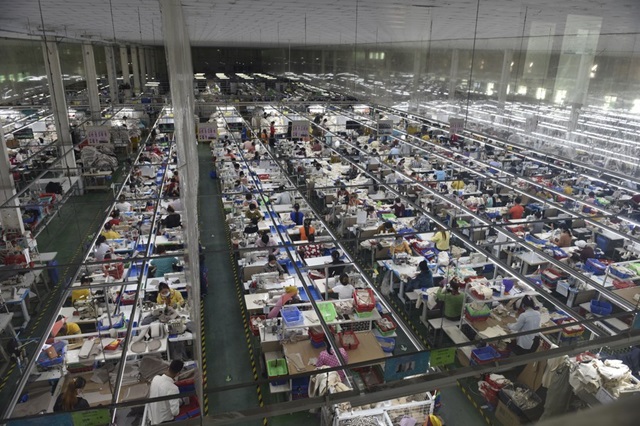
The departure of hundreds of thousands of Cambodian workers following last year’s border conflict has exposed how heavily parts of Thailand’s economy depend on migrant labour from neighbouring countries. Industries ranging from agriculture and construction to manufacturing, tourism and services have been affected, while efforts to replace the workers have highlighted the limits of Thailand’s existing labour model.
Thailand has attempted to ease the disruption by retaining migrant workers already in the country, particularly those from Myanmar. But figures from the International Labour Organization (ILO) and warnings from employer groups point to a deeper structural problem: a workforce built around geographical proximity, familiarity and relatively low travel costs cannot easily be recreated through extensions of existing work permits.
The precise scale of the Cambodian exodus remains disputed because different estimates use different methods. Thailand’s Department of Employment recorded 495,271 authorised Cambodian workers last March. That figure was considerably smaller than the number of Myanmar nationals, who accounted for 2.27 million of the 3.14 million legal workers from nine Southeast Asian countries. A Labour Ministry analysis published six months later cited a Cambodian estimate of 780,000 returns, including undocumented migrants and family members.
For employers, however, the more important question is how many workers remain available. Wiboon Suphakarnpongkul, vice-chairman of the Thai Chamber of Commerce, said in May that the number of Cambodian workers had fallen from 550,000 to 194,000, according to Reuters.
The Joint Standing Committee on Commerce, Industry and Banking (JSCCIB), which brings together the Thai Chamber of Commerce, the Federation of Thai Industries and the Thai Bankers’ Association, warned that labour shortages were affecting seasonal agriculture, manufacturing, construction, tourism and services. It highlighted potential consequences for fruit harvesting, rice-export logistics and factory production.
The group called on the government to extend work permits, reduce registration costs and simplify procedures, resolve problems with the electronic work permit system and accelerate recruitment agreements with Sri Lanka, Bangladesh and Indonesia.
Thailand has since moved to retain more of its existing migrant workforce. The cabinet extended work permissions for eligible Myanmar, Laotian and Vietnamese workers until December 11, 2027. The measure may help prevent further disruption, but it also highlights the country’s reliance on workers who are already inside its borders.
ILO figures show that Thailand had 4.04 million documented migrant workers in May. Only 545,153 had entered through bilateral memorandums of understanding, including 179,787 Myanmar nationals, while another 836 were registered under the border employment scheme. More than 3.5 million migrants were working under cabinet resolutions granting or extending permission to stay and work, including nearly 3.3 million Myanmar nationals.
Labour analysts say permit extensions can provide short-term stability but cannot fully replace workers who have left. They may help factories, farms and service businesses avoid another shock, but do not necessarily fill vacancies in eastern border areas where Cambodian labour has disappeared.
The Migrant Workers Rights Network (MWRN) said the latest measures did not provide a legal pathway for workers whose four-year contracts had expired or for new arrivals who had entered through informal routes. For undocumented workers without legal options, the organisation said it could not directly assist with regularising their status and could only advise them while they waited for the government to open another registration period.
Thailand has also sought alternative sources of labour. Last August, reports said the government had approved the recruitment of an initial 10,000 workers from Sri Lanka. By February, the Sri Lankan embassy said negotiations had been completed, but a planned ministerial-level signing had not taken place.
Recruiting from farther away also creates costs that are largely absent from migration across Thailand’s land borders. The ILO said sourcing workers from neighbouring countries would be more advantageous from Thailand’s perspective because long-distance recruitment adds airfare costs. Although such costs should not be passed to workers from Sri Lanka, employers may be reluctant to absorb them.
Myanmar remains Thailand’s most important source of both existing and potential migrant labour. On August 6, Thailand and Myanmar signed an updated memorandum on labour cooperation and an agreement on the employment of workers. MWRN, however, said the agreement “holds no real meaning” for Myanmar nationals because of tighter controls and scrutiny over overseas employment.
The route from Myanmar to Thailand has also become more expensive and hazardous. Workers have increasingly travelled by air because of insecurity along land-border routes, while those unable to use formal channels have turned to brokers for irregular crossings. MWRN said fees for such crossings start at about 30,000 baht (US$1,000), while broker and agency charges can begin at about 8 million kyat (US$2,000), depending on whether workers also require job placement or registration assistance.
Myanmar’s military conscription law also restricts men aged 18 to 35 from leaving the country, further narrowing Thailand’s potential labour pool.
The ILO said previous research found that migrant workers in Thailand typically paid about two months’ wages in recruitment fees and related costs. It has not yet assessed whether the latest restrictions and rising costs have increased indebtedness or forced-labour risks, but identified air travel and Thailand’s complex Thai-language regularisation process as factors likely to make migration more expensive.
The agency said the regularisation system provides eligible migrant workers with an opportunity to obtain documentation, but warned that it did not appear to be sufficiently regulated from a recruitment perspective.
The Cambodian exodus has therefore exposed a vulnerability extending beyond a single labour shortage: Thailand’s ability to sustain key sectors depends heavily on a migrant workforce whose supply is shaped by border access, recruitment costs, legal restrictions and regional instability. Retaining workers already present may ease the immediate pressure, but replacing those who have left remains a far more difficult task.