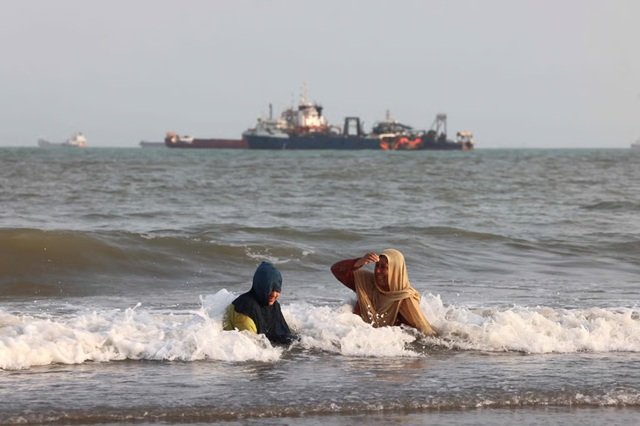
Fishermen in Bandar Abbas are returning to the strategically vital Strait of Hormuz after months of fighting between Iran and the United States left boats, equipment and livelihoods damaged, with many now saying financial hardship has left them little choice but to risk returning to waters still littered with war debris.
Aboard his boat moored along the strait, 47-year-old Iranian fisherman Mohammad Amin was repairing a torn fishing net after a long day at sea. His return to fishing came less than a month ago, after months in which the threat of strikes made it impossible for him and many others to work. During that period, he exhausted his modest savings while worrying that his small boat, anchored alongside dozens of others on the Bandar Abbas waterfront, could be destroyed.
“We had been idle for more than three months; it was simply impossible to go” out to sea, he said. “It’s been about 20 days that we have been going back to sea,” adding that they could wait no longer. “If we don’t [go], we will die of hunger and I have three children.”
The dangers have already carried a heavy human cost. Iranian media reported that nearly a dozen fishermen were killed off Bandar Abbas and nearby southern islands, while 17 others from neighbouring Sistan-Baluchistan province south of Hormuz went missing during the months of fighting.
The waterfront in Bandar Abbas, where modest cafes provide residents with relief from the sweltering summer heat, was repeatedly struck during nearly 40 days of intense fighting and sporadic clashes that followed, despite a ceasefire sealed on April 8. For fishermen, however, remaining ashore offered little protection from economic hardship.
“They used to strike this place every day; it had become normal … but there was nowhere else to keep the boats,” said 53-year-old Hossein, who returned to sea as soon as the fighting eased, although many other fishermen remained ashore.
The scale of the losses has been substantial. More than 2,000 fishermen from southern Hormozgan province lost their fishing equipment during the fighting, the Iran Daily reported in late July, while hundreds of fishing and trade boats were damaged, according to ISNA news agency.
For 39-year-old Bagher Abbaszadeh, the destruction of his boat would have affected not only his own family but four others who depend on it. “If they [the US] had hit the boat, that would have been it for us,” he said while repairing a damaged net.
The fishermen now face another problem beneath the surface. Mohammad Amin said his nets increasingly become caught on wreckage from vessels damaged during the fighting and other debris, forcing him to replace equipment he can scarcely afford. “We have replaced four nets so far [since we returned] … the sea was dirty before and now it has become even worse with the wreckage of these ships,” he said.
Hossein said it was often impossible to identify what was trapping the nets. “Several ships were hit and one of them was near the shore … but you cannot see what’s under water, the net gets caught on rubbish and pieces of metal below the surface,” he said.
The uncertainty extends beyond the immediate risks at sea. Iran insists it will retain control of the Strait of Hormuz, requiring vessels to seek permission and pay transit service fees, a move opposed by Washington and several regional countries. With diplomats from Iran and Oman continuing efforts to reach an arrangement over the strait, fishermen say they know little about the negotiations.
For them, the immediate question is whether they can continue earning a living. Hossein said he would return to sea even if fighting resumed. “We have no choice but to go back to sea. If we didn’t work, where would we get money?”
Abbaszadeh said he remained worried about another outbreak of fighting. “We are definitely worried about it [the war] starting again … whatever happens in the end, I hope it is in the interest of the ordinary people,” he said.
Mohammad Amin was less hopeful about an end to the conflict. “This war is not going to end,” he said. “No side is willing to come to an agreement with the other.”