by Our Correspondent in Colombo
A special discussion on plans to introduce a passenger drone service in Sri Lanka was held at the premises of the Ministry of Ports and Civil Aviation under the leadership of Minister Anura Karunathilaka.
Deputy Minister Janith Ruwan Kodithuwakku, Ministry Secretary W.W.S. Mangala, Director General of the Civil Aviation Authority Damith Rambukwella and senior officials of the authority took part in the meeting. The Chinese delegation was led by Mr. Conor Yang, Chief Financial Officer of E-Hang, and Ms. Xiao Na Lee, General Manager of Operations.
During the meeting, the minister said the proposed passenger drone service could be used to promote tourism, support emergency disaster services and meet maritime requirements. The safety of passengers and the responsibilities associated with operating the aircraft were also discussed.
Sri Lankan authorities stressed that commercial passenger drone operations cannot begin without formal approval from the Ministry of Ports and Civil Aviation and the relevant Sri Lankan civil aviation authorities. Before any operation is authorised, issues including aviation safety, the regulatory framework, air traffic control, emergency operations, cyber security, data protection and landing locations will need to be addressed.
The proposed project would also require coordination with a range of government and regulatory institutions, including the Ministry of Defence, Sri Lanka Air Force, Telecommunications Regulatory Commission, Board of Investment (BOI), Port City Commission, Sri Lanka Tourism Development Authority and Airport and Aviation Services Company, in addition to the aviation authorities.
Officials also highlighted the need for telecommunications-related approvals because the aircraft rely on remote control and communications technology. E-Hang representatives subsequently provided an extensive explanation of the technology behind the proposed passenger drones.
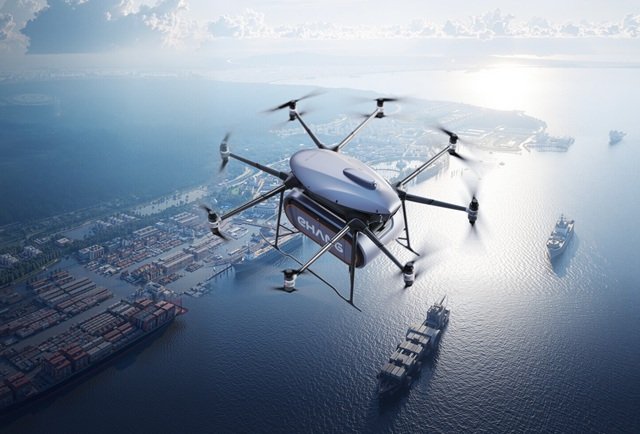
The aircraft are described as eVTOL, or electric Vertical Takeoff and Landing aircraft, meaning they can take off and land vertically while operating on electric power. According to the information presented at the meeting, less than 900 square metres of space would be required for take-off and landing. A passenger aircraft capable of carrying two people operates with 16 propulsion fans, while four fans would be sufficient for landing in an emergency.
The aircraft would be operated autonomously from a central control room using AI technology. They are equipped with 12 battery packs and three flight-control systems, designed to help maintain stability and safety in the event of an emergency or technical failure.
The meeting also examined potential applications in tourism, including the possibility of using the aircraft to provide access to elevated historical sites such as Sigiriya and Pidurangala. Their use for tourists travelling within Port City and Colombo was also discussed, with proposals emerging to establish a demonstration zone for the aircraft within Port City.
E-Hang officials said a tourist travelling from Katunayake Airport to a hotel in Colombo would face a cost of between US$20 and US$30 for a single journey.
The discussions mark an initial examination of how passenger drone technology could potentially be introduced into Sri Lanka, while making clear that any commercial operation would depend on regulatory approval and coordination across multiple authorities.