The political fight over Islam in Spain is no longer confined to mosques, immigration or religious clothing. It has reached school canteens, border debates and the language of “national priority”, as political parties increasingly place Muslim identity at the centre of arguments about national culture and security.
The account, reported by El País, describes a pattern that extends beyond Spain. Politicians promoting “national priority” argue that Spain is losing its identity, while others oppose the construction of mosques or demand bans on the niqab and burka. During the current crisis in Ceuta, the debate over the border has also been used to raise claims about an alleged “Islamisation of Spain”.
The latest controversy has concerned halal meals in school canteens. José María Llanos, Vox spokesperson in Les Corts of Valencia, said: “Adiós al menú halal en nuestra casa. El menú lo decidimos nosotros, no los invitados”. The dispute illustrates how questions about religious practice and everyday life can become part of a much broader political argument over who belongs within the national community.
Such rhetoric, according to the material published by El País, is not new. Increasingly, political parties have incorporated anti-Muslim discourse into their agendas. In Europe, various far-right parties have for years presented Islam as a symbol of a threat to national identity. Javier Cortés, Vox spokesperson in Andalucía, recently said: “Queremos parar el proceso de islamización creciente que estamos sufriendo de manera descontrolada por la invasión masiva”, while expressing opposition to a mosque project in Sevilla.
Zakariae Cheddadi, a doctor in sociology and specialist in Islam and a researcher at the University of the Basque Country, describes the phenomenon as part of a wider process of political globalisation. He argues that religion is being reconsidered within the public sphere internationally as competing values become increasingly politicised.
For Cheddadi, religion has become part of the political offer of the radical right and of what he describes as a global agenda whose central promise is the “supremacía cultural de Occidente”. He points to the influence of US President Donald Trump’s political discourse, which frequently invokes Christianity and traditional values, as well as the influence of the group of technooligarchs around him. Among the examples he cites is Elon Musk’s support for Alternativa por Alemania, which Cheddadi describes as an “islamófobo” party. Musk owns Tesla, SpaceX and the social network X and previously held a position in Trump’s government.
Cheddadi argues that this is the type of politicisation used by Vox in Spain. He says the party instrumentalises coexistence for electoral advancement and turns Islam into a scapegoat, presenting it as a source of Spain’s problems. He argues that the party is not interested in constructing an Islam capable of dialogue but instead uses Muslims for its own electoral gains, because incidents such as those in Torre Pacheco can have political resonance.
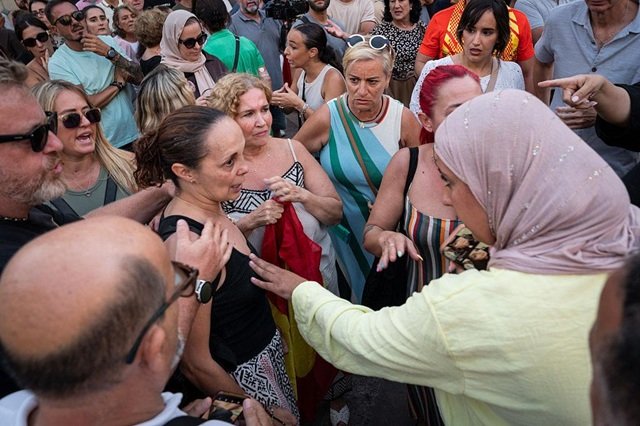
Torre Pacheco, in Murcia, became the site of a pursuit by far-right groups of young North African immigrants following an assault on an elderly man. The episode forms part of the wider political debate described by El País. According to 2024 data from the Asociación Marroquí para la Integración de Inmigrantes, 47.5% of Spain’s Arab population had felt discriminated against in housing, healthcare, education, employment or technology.
The pattern is not limited to Spain. France’s Agrupación Nacional, led by Marine Le Pen, has campaigned against Islam and proposed restrictions on religious symbols. Alternativa por Alemania has adopted rhetoric against Muslim immigration, while Italy’s La Liga has promoted a vision of a culturally homogeneous country and linked Islam with insecurity.
Cheddadi, however, does not place responsibility solely on Vox. He argues that the integration of Spain’s Muslim community remains an unresolved task. He also criticises what he describes as the left’s reluctance to address radicalisation and says that the central government sometimes uses migrants to distinguish itself from the radical right, thereby contributing to immigration becoming an element of political polarisation. “La islamofobia no solamente es por acción, sino también por omisión”, he says.
Laura Mijares, professor in Arab and Islamic Studies at the Universidad Complutense, goes further, arguing that there is an “estrategia intencionada” designed to create a social problem that does not exist in order to win votes through an “islamófobo” and “racista” discourse. She points to the Congress’s decision this year to establish a subcommittee to study the use of the burka in Spain, despite there being no evidence that the garment is widely used in the country.
Mijares argues that Vox uses what she calls a “retórica de salvación” as an electorally profitable strategy. She also says that other political forces have entered the debate, including parts of the left and certain “liberales o mainstream” feminist organisations. In such debates, she warns, Muslim women can be constructed either as victims or as threats. She argues that Muslim women should themselves be included in discussions over what women should or should not wear rather than leaving such decisions to men.
The geopolitical dimension adds another layer. Moussa Bourekba, a researcher at the Barcelona Centre for International Affairs, points to the 1979 Islamic Revolution in Iran as an important starting point for understanding the relationship between geopolitical developments in Muslim countries and the emergence of Islamophobia.
He identifies three major contemporary factors: the growing visibility of Islam in Europe through immigrant populations, demands for equality in rights, and, above all, jihadist terrorism. Events including 11 September in the United States, 11 March in Madrid and the attack on the Bataclan concert hall in Paris have, he argues, reinforced stereotypes linking Muslims collectively with terrorism.
“el islam tiene esta peculiaridad de que representa un enemigo exterior y, al mismo tiempo, un enemigo interior”, Bourekba says.
He rejects the idea that religion alone should explain individual behaviour, arguing that people’s actions must not automatically be attributed to their being Muslim rather than to other factors of human behaviour. He also says that the political discourse is effective because it connects identity with security, making restrictions on freedoms easier to justify in the name of greater security.
For Bourekba, criticism of Islam is legitimate, and even necessary, within a democratic context. The concern arises when criticism is reduced to simplistic and reductive narratives that become a means of validating discrimination against Muslims. “Así como la homofobia no es una opinión, la islamofobia tampoco debería serlo”, he argues, adding that such an attitude can constitute a hate crime.
As the debate moves from religious clothing to school menus, mosques, borders and national identity, the reporting by El País presents a political contest in which Islam has become both a question of religion and a symbol around which wider disputes over identity, security, immigration and belonging are being fought.