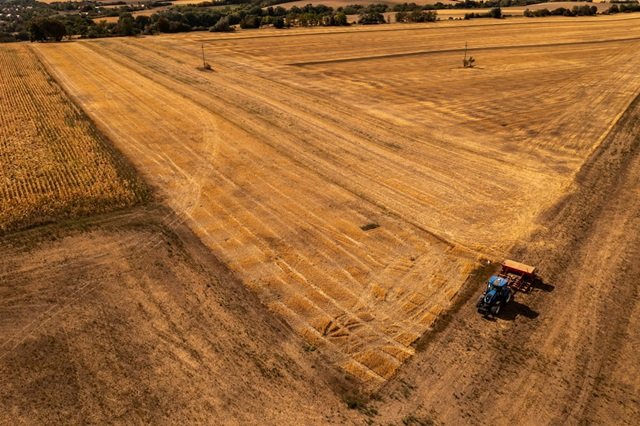
Farmers across Romania and Hungary are struggling to grow maize as prolonged drought and extreme temperatures undermine harvests, forcing agricultural businesses to seek heat-resistant seeds, invest in irrigation or switch to crops that require less water. The crisis is disrupting production in two countries that have long been important contributors to Europe’s grain supply, while forecasts point to a sharp decline in maize output across the European Union.
In north-western Romania, Dan Corbut, who operates Agroind Cauaceu across 3,500 hectares in Bihor county, said the latest growing season had produced almost no maize. “We have barely harvested any maize this year; it has been a drought unlike anything I have seen in more than 30 years,” he said, describing the situation as a catastrophe.
From August 2025 to August 2026, rainfall on his land amounted to about 250 litres per square metre, compared with the usual 500 to 600 litres per square metre, approximately the average recorded in recent years in eastern Romania. The shortage has left farmers confronting conditions that threaten both their immediate harvests and the viability of established cultivation practices.
Romanian authorities expect the country’s maize harvest to reach about eight million tonnes in 2026. Although Romania escaped the worst of this year’s European drought, that forecast remains more than 50% below production levels in 2018 and 2019. The country’s maize exports have also fallen sharply, declining to between 2.2 million and 4.7 million tonnes annually from 2023 to 2025, compared with more than seven million tonnes at the beginning of the decade, according to European Commission data.
Cezar Gheorghe, of the agricultural consultancy AGRIColumn, identifies climate change as a major factor behind the reduction in land devoted to maize. Farmers have increasingly shifted towards autumn-sown crops, while small producers have been particularly exposed to repeated failures. “Since 2020, they have been sowing maize and harvesting nothing,” he said, pointing to the intensity of the drought’s impact on crops.
The changing conditions are also reshaping demand for agricultural inputs. Mirela Veres, director of Agrocentrum Maramures, a company specialising in agricultural supplies, said farmers were seeking maize varieties better suited to increasingly hot and dry summers. This year, she said, air temperatures remained between 34C and 39C at their daily maximum for almost two consecutive months, while temperatures at ground level felt higher than 40C.
“Climate change is obvious, and nobody can deny that this phenomenon is happening,” Veres said. “Under these conditions, everything becomes more complicated, so maize growers are looking for producers and seed suppliers offering varieties that can adapt easily to the current climatic conditions.” Farmers, she added, would have to adapt despite the difficult circumstances.
For some, adaptation means abandoning maize altogether. Cosmin Popa, a maize farmer in central Romania, said some producers had switched to sunflower because it required less water. Poor harvests in previous years had also pushed farmers to invest in irrigation systems, but such expenditure offered no guarantee of success.
“You can buy sprinklers, pumps, pipes and irrigation equipment, but without water they are useless. Without it, all these investments are worth nothing,” Popa said. His assessment reflects the central constraint facing farmers across the region: irrigation can protect crops only when sufficient water remains available.
Across the border in Hungary, repeated droughts, extreme temperatures and chronic water shortages are prompting an even more dramatic reassessment of agricultural production. Hungarian authorities expect the country to become a net importer of maize this year, with a projected harvest of 2.5 million tonnes representing less than a third of its usual production.
The decline marks a major reversal for a country that, for decades, ranked among the European Union’s leading maize producers alongside France, Romania and Poland. Hungary’s Agriculture Minister, István Nagy, described the situation as “unprecedented”, with losses affecting almost every agricultural sector.
Farmers are increasingly considering sunflower and other crops better suited to dry conditions. Tamas Petoházi, president of the Hungarian Cereal Growers Association, said some producers had stopped farming, while others had sought second jobs because their family holdings could no longer support them.
“We need a paradigm shift,” Petoházi said. He warned that the lack of rainfall was pushing Hungary towards what he described as a “semi-desert climate”. Water scarcity has also affected infrastructure beyond agriculture: falling levels of the Danube in August forced the suspension of several nuclear reactors in Hungary and Romania, according to the account.
The European Union’s overall maize production outlook reflects the scale of the problem. The European Commission’s forecasts at the end of August put this year’s harvest at 50.1 million metric tonnes, close to the lowest level in two decades and about 20% below the average of the previous three years.
The consequences extend well beyond grain producers. Much of Europe’s maize is used as animal feed, particularly for cattle, pigs and poultry. When domestic harvests fall, livestock farmers must seek supplies elsewhere, whether by purchasing grain from other producers or importing it. Reduced availability can therefore increase pressure on feed costs and affect the wider livestock supply chain.
France, another major European maize producer, is also experiencing substantial losses. Agreste, the statistical service of the French Agriculture Ministry, forecasts that production of maize for animal feed will decline by 26% compared with 2025. The harvest of maize intended for grain is expected to reach about nine million tonnes, its lowest level since 1980.
French farmers are testing heat-resistant varieties and adjusting sowing dates in an effort to protect yields. Irrigation remains another option under consideration, but its effectiveness depends on the availability of sufficient water. Across the region, farmers are being forced to reconsider the crops they grow and the resources required to sustain them as conditions increasingly diverge from those for which their agricultural systems were developed.