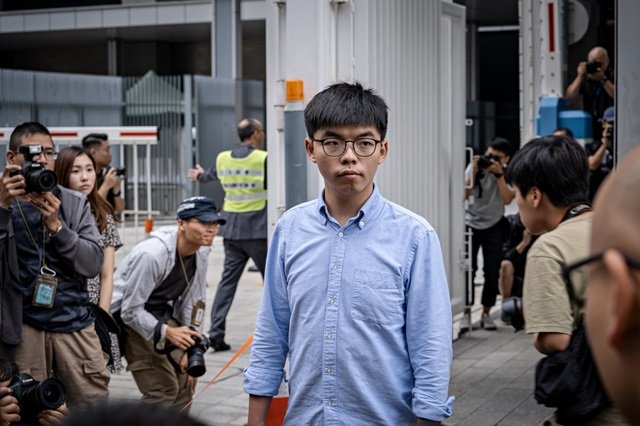
Prominent Hong Kong pro-democracy activist Joshua Wong pleaded guilty on Wednesday to conspiracy to collude with foreign forces to endanger national security, in his second prosecution under a Beijing-imposed law that has reshaped the city’s political and civic life.
Wong, 29, entered his plea at the High Court in Hong Kong over allegations that he conspired with self-exiled activist Nathan Law and others to seek foreign sanctions, blockades or other hostile measures against Hong Kong or China. The offence carries a prison term of three to 10 years, and potentially life imprisonment if it is deemed to be “of a grave nature”.
Wong, who wore a navy shirt and thick black-rimmed glasses, appeared thinner as he was led into the dock before 10am. Judge William Tam said the charge would be read out because of the high level of public interest in the case. Wong then pleaded “guilty” in a clear voice after the charge was read out by a court clerk.
He is expected to be sentenced later. While a guilty plea could typically result in a reduced sentence, the conviction could extend his time behind bars significantly.
Wong is already serving four years and eight months for conspiracy to subvert state power in the landmark national security case involving the “Hong Kong 47”. He was among 45 prominent campaigners convicted in 2024. He has been behind bars since November 2020 and had been expected to complete his sentence in 2027.
The fresh case centres on allegations concerning Wong’s international lobbying activities before and after the national security law came into effect in June 2020. Prosecutors said Wong and Law had pursued the concept of “democratic self-determination” through Demosisto, the pro-democracy party they co-founded in 2016.
According to the prosecution, Wong and Law had agreed years earlier to pursue international lobbying strategies to obtain foreign attention and support. Following the 2019 protests and unrest, they allegedly sought sanctions and other measures against Hong Kong or China. Prosecutors said Wong requested that the US introduce the Hong Kong Human Rights and Democracy Act in 2019 and urged other Western countries to adopt Magnitsky-style sanction programmes.
After the national security law took effect, prosecutors said Law and others who had left Hong Kong continued their activities overseas by meeting foreign politicians and organising petition drives. Wong, remaining in Hong Kong, allegedly supported the campaign through foreign and social media, including by sharing Law’s posts.
Prosecutors also pointed to Wong’s sharing of an online petition on Facebook urging digital forensic companies to stop co-operating with police. One company subsequently announced that it would stop selling digital intelligence offerings to customers in Hong Kong and China, they said. Wong confirmed that he agreed with the details presented by the prosecution.
The case follows the introduction of Beijing’s national security law in 2020 after a year of mass pro-democracy protests. The legislation criminalised subversion, secession, collusion with foreign forces and terrorist acts, while granting police sweeping new powers. Its implementation led to hundreds of arrests and the disappearance of dozens of civil society groups.
The authorities have defended the law as necessary to restore stability and peace, while critics have said Wong’s prosecution reflects a broader effort to silence prominent dissidents and freeze civic activism. Beijing regards Wong as an anti-China figure and considers support for Hong Kong independence a red line.
Wong first rose to prominence in 2012 as a high school student leading protests against national education in Hong Kong schools. He later became a prominent figure in the 2014 Occupy Movement and helped seek overseas support for the democracy movement during the 2019 protests.
Demosisto announced its disbandment on the day the national security law came into effect. Law remains wanted by Hong Kong national security police, with a HK$1 million bounty issued for information leading to his arrest.
Before Wednesday’s hearing, a supporter shouted “Hang in there” to Wong. A friend said Wong had been reading books, studying, learning guitar and exercising in prison, and hoped to see him outside prison as soon as possible.