The World Cup semi-final in July was more than a football match for many Argentinians. When their national team defeated England 2-1 after a nerve-racking contest, two of Argentina’s leading players displayed an impromptu banner carrying the words “Las Malvinas son Argentinas” — the Malvinas are Argentine.
The slogan, familiar across Argentina on walls, shirts, public transport vehicles and in popular songs, was transformed that night into a global political statement. Thousands took to the streets to celebrate what many regarded as a profound symbolic victory. Even after Argentina lost to Spain in the final, some supporters argued that the real triumph had already come in the semi-final, when their country’s territorial claim had been broadcast around the world.
The moment revived an issue that has remained deeply embedded in Argentina’s national consciousness since the 1982 Falklands conflict. That war followed the decision of Argentina’s military dictatorship to seize the islands and was met by a powerful military response from the government of Margaret Thatcher. Argentina was defeated, but its claim to the islands did not disappear. Instead, it has continued through political rhetoric, public symbolism and diplomatic efforts, without producing any significant shift in the territorial dispute.
For years, however, the issue appeared unlikely to become a defining priority of President Javier Milei’s foreign policy. Since taking office in 2023, the far-right libertarian has radically altered Argentina’s international orientation. The regional unity associated with previous populist governments has given way to an unprecedented closeness to the United States and Israel, which Milei has placed at the centre of his foreign policy, sometimes even where that alignment has appeared to conflict with national interests.
His position on the Falklands, or Malvinas, has consequently attracted particular attention. In 2024, Milei told the BBC that he “admired” Thatcher and regarded her as “brilliant” — a striking position given the continuing importance of the 1982 war in Argentina’s political memory.
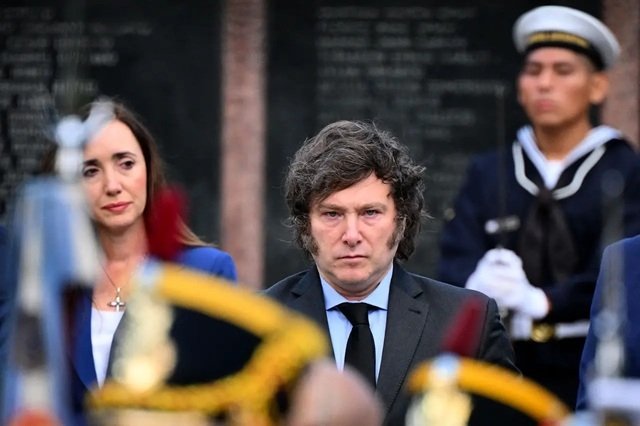
But the tone changed sharply on Thursday night, when Milei made a rare nationwide broadcast. “The Malvinas are Argentine by history and by right,” he declared. He went further, arguing that the islanders, “being an implanted population in a usurped territory”, did not possess a legitimate right to self-determination and that arguments based on referendums held on the islands were invalid.
The declaration was followed by a package of measures that moved the dispute beyond symbolism. Milei announced plans to improve Argentina’s national defence budget, continue construction of a naval base in the country’s southernmost province and toughen sanctions against companies involved in the Sea Lion project, which plans to begin oil extraction in 2028 in a zone almost 140 miles (225km) north of the islands.
The economic dimension may prove particularly significant. Argentina regards the Sea Lion project as an illegal exploitation of resources in territory and waters it claims as its own. The project is operated by Britain’s Rockhopper Exploration and Israel’s Navitas Petroleum, placing the dispute directly into the sphere of international business and investment.
Argentina’s foreign minister, Pablo Quirno, said on local radio on Friday that the measures would not damage the country’s relationship with Israel “in the slightest”. Navitas, meanwhile, said it did not expect Milei’s comments to affect the project’s development.
“The partnership operates pursuant to valid petroleum licences lawfully granted to it by the government of the Falkland Islands, a self-governing UK Overseas Territory, and with the full and ongoing support of the UK government,” the company said.
That response captures the fundamental divide at the heart of the dispute. For Britain and the companies involved, economic activity around the islands rests on licences issued by the Falkland Islands government. For Argentina, those same activities represent the exploitation of resources in territory and waters it considers its own.
According to the Observer UK, the significance of Milei’s latest measures lies less in an immediate diplomatic or military confrontation than in the possibility of using economic pressure. By targeting companies associated with the oil project, his government could increase the perceived costs for investors considering involvement in the British-Israeli venture.
That approach would represent a shift from the largely symbolic and diplomatic pursuit of Argentina’s sovereignty claim. Vaca Muerta, the vast Patagonian shale oil and gas formation, has become one of Milei’s principal pitches to international investors and a major focus for companies involved in mining and oil. The president’s government is therefore pursuing a dispute over offshore resources while simultaneously seeking international investment in Argentina’s own energy sector.
“It’s a shift in his foreign policy,” said Alejandro Frenkel, an Argentine foreign policy analyst. “His stance, until now, did not increase the costs of the British occupation in Malvinas.”
The timing is also significant. Growing popular sentiment around the islands has coincided with renewed uncertainty over Britain’s relationship with the United States. Donald Trump has recently said he may “review” his support for the UK because of his dissatisfaction with the country’s behaviour during the Strait of Hormuz conflict, particularly its lack of naval support.
For Milei, the renewed focus on the Malvinas has also been interpreted as an effort to regain control of the political agenda amid recent corruption scandals and a declining perception of his government’s effectiveness in managing the economy.
Yet the strategic importance of the issue may ultimately depend less on domestic politics than on Washington. Frenkel argues that the United States remains central to Argentina’s sovereignty claim. If Trump were to back Argentina’s position, he said, Milei would have the support of the United States, China and Russia.
“He would then have the support from the United States, China and Russia,” Frenkel said. “To Milei, the United States is crucial for the sovereign claim over the islands.”
The football banner in July transformed an enduring national slogan into a moment of global visibility. Milei’s subsequent measures have taken that sentiment into a more consequential arena, where sovereignty, energy investment, international alliances and economic pressure intersect.
More than four decades after Argentina’s defeat in the Falklands war, the dispute remains unresolved. What has changed is the arena in which the claim is now being pursued: from stadiums and diplomatic statements to oil licences, investment decisions and the strategic calculations of major powers.