
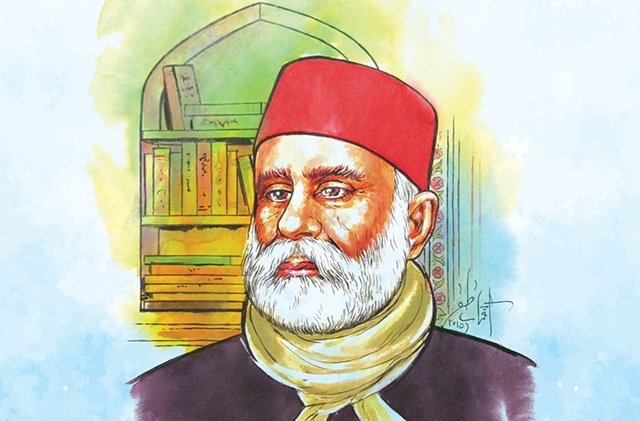
The year 1874 marks a silent turning point in India’s freedom struggle—not through political uprisings, but through cultural awakening. While historians often trace organised nationalism to the founding of the Congress in 1885, the mid-1870s witnessed the germination of a new consciousness. At its heart stood Maulana Altaf Hussain Hali, a poet whose pen became a weapon for national regeneration and communal harmony.
The Political Awakening of 1874
The early 1870s saw British colonial rule consolidating after 1857, yet beneath this imperial stability, organised resistance was emerging. In Calcutta, figures such as Surendranath Banerjee laid the groundwork for the Indian Association (1876), seeking to transcend religious divisions in pursuit of common political rights. This was Hali’s political landscape—but whereas others worked through petitions, Hali understood that true freedom required moral and intellectual regeneration.
Hali: The Poet of Regeneration
Born in 1837 in Panipat, Hali witnessed the devastation of 1857 firsthand. His journey from obscurity began in Lahore, where he worked at the Government Book Depot from 1871 to 1874—a position that exposed him to Western literature. The turning point came when Sir Syed Ahmad Khan invited Hali to compose a poem diagnosing Muslim decline. The result was the Musaddas-e-Madd-o-Jazr-e-Islam (1879), a masterpiece that remains Hali’s most enduring contribution.
Sir Syed’s praise was extraordinary: “If God asks me what I brought with me, I will say: ‘Nothing but that I got Hali to write the Musaddas!'” The poem achieved unprecedented popularity, running into multiple editions and being recited at public gatherings nationwide.
A Vision of Hindu-Muslim Harmony
Hali’s message of unity found powerful expression in the couplet: “Tum agar chahte ho mulk ki khair, na samjho kisi humwatan ko ghair” (If you desire the nation’s welfare, do not consider any compatriot a stranger). This verse encapsulates Hali’s vision of composite nationalism.
His poem Hubb-e-Watan (Patriotism) invoked both Hindu and Islamic traditions, citing Prophet Muhammad’s migration from Mecca to Medina, Lord Ram’s longing for Ayodhya, and Hazrat Yusuf’s yearning for Canaan. Hali argued that love for one’s homeland transcends religious boundaries, urging Indians to recognise each other as equals and to treat sister faiths with fundamental respect.
Reformist Contributions
Hali’s Muqaddama-e-Shair-o-Shairi laid the foundations of Urdu criticism, arguing that poetry should serve moral and social purposes. He broke with convention—deprecating courtesan-love themes and urging natural, national, and political subjects in poetry. Beyond literature, Hali advocated women’s education and condemned dogmatism while emphasising dissent and reason.
The Literary-Political Legacy
Hali’s influence extended to Muhammad Iqbal, who acknowledged his debt to Hali and carried his vision forward. While some scholars associate Hali’s Musaddas with early articulations of “two-nation” theory, his poetic corpus consistently champions Hindu-Muslim unity and national solidarity.
Conclusion
The 1870s marked a crucial transition from post-1857 despair to organised nationalism. Maulana Hali’s contribution lay in recognising that political freedom required spiritual and intellectual renewal. Through poetry invoking both Hindu and Muslim traditions, he called upon compatriots to rise together: “Yahi hai ibadat, yahi deen-o-iman, ki kaam aaye duniya mein duniya ke insan” (This is worship, this is faith—to serve all humanity in this world). His vision of composite nationalism remains relevant today, reminding us that “na samjho kisi humwatan ko ghair”.