Dear Rahul Gandhi Ji; I am writing to you as a young Kashmiri who has spent nearly twelve years listening to, standing with and speaking for Kashmiri students. I write with the concerns of a generation I have known closely, young people preparing for examinations, looking for jobs, trying to build independent lives and, above all, trying to believe that there is still a place for their aspirations in the India. I also write because I have spent years travelling, meeting and speaking to young people across the country. Their anxieties are often different in their details, but there is something common in what they ask for: a fair chance, dignity, opportunity and the confidence that the institutions they depend upon will treat them fairly. That is why I am writing to you today.
This is a letter of collective aspiration of the systematic marginalization of Kashmir; a persistent habit of reducing our voices to a footnote in India’s larger political battles. I want the legitimate concerns of Kashmir’s young people who have been pushed to wall. Students, whose future depends more on state mercy than merit. Job aspirants, who have been reduced to mere figures in newspapers, and our families that remain under the constant fear of state repression. I write this today to remind you that they shall remain firmly intact within the national conversation you represent and are committed to lead.
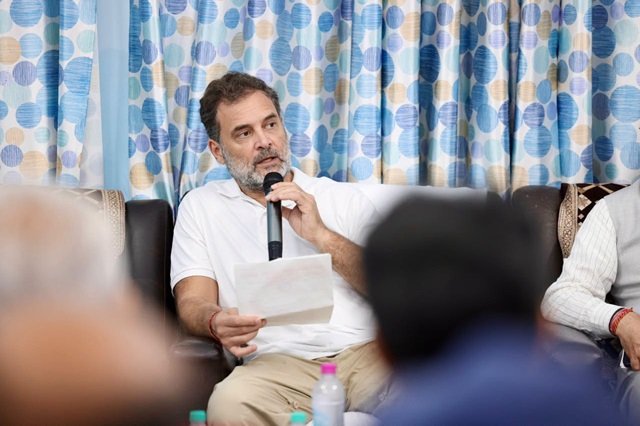
I remember meeting you in Srinagar in August 2024, during your visit to Kashmir. I also remember our interaction in the aftermath of the barbaric Pahalgam attack in 2025, when concerns about the safety of Kashmiri students across the country came sharply into focus. On both occasions, what stayed with me was your thoughtfulness and the genuine concern you showed towards the people of Kashmir. You understood, or at least tried to understand, the complicated circumstances in which an entire generation of Kashmiri youth has grown up. You listened to our concerns and spoke about them alongside the concerns of young Indians elsewhere. For many of us, that mattered. At a time when young people in Kashmir were looking for reassurance, empathy and some reason to hope, you gave us your time and your word that our concerns would not be forgotten. I have carried that assurance with me.
Over the years, I have learned that people do not always expect political leaders to have an immediate answer to every problem. Sometimes, what matters first is knowing that someone is willing to listen and, having listened, is willing to carry that concern forward. That is what your engagement with us in Srinagar meant to many of us. I have also watched your journey across the country with interest — the meetings with students, workers, young people and communities that often feel ignored by those in power. In a country as diverse as ours, the willingness to listen is itself important. It speaks of an India that Mahatma Gandhi dreamed of, that Babasaheb Ambedkar imagined through equality and constitutional dignity, and that Maulana Abul Kalam Azad understood as a shared inheritance. India has always been strongest when it has found a way to hold different voices, identities and experiences together.
But as you have travelled across India and spoken about the problems confronting its young people, I have often wondered where Kashmir fits into this conversation. I hope you will not leave Kashmir behind. Many of the questions you are raising nationally — about paper leaks, recruitment fraud, institutional capture, procedural manipulation and the erosion of public trust — have already left deep scars in J&K. Our young people have watched one recruitment examination after another become embroiled into controversy. The Jammu & Kashmir Police Sub-Inspector recruitment controversy remains one of the most painful examples. The Finance Accounts Assistant examination, the Fire and Emergency Services recruitment, the Junior Engineer recruitment, The Lecturer recruitment of School Education Department, Civil Judge recruitment and controversies surrounding several other examinations have similarly left thousands of aspirants wondering whether their hard work and merit count for anything at all.
For a young person in Kashmir, a government job is often much more than a career option. In the absence of statehood, and with limited opportunities in the private sector, it can represent financial independence, the ability to support one’s family and the possibility of finally building a stable life. Behind every aspirant is a family that has invested years of hope, money and emotional energy in that person’s future. When an examination is cancelled or compromised, the consequence is not simply that another recruitment cycle has to be conducted. Another year is lost, another attempt is lost, plans are put on hold, families wait and young people begin preparing all over again, often without knowing whether the next examination will be fair. When this happens repeatedly, something deeper begins to break. It becomes harder for a young person to believe that merit will be rewarded, that institutions will protect their effort, or that the promises made by the Republic apply to them in the same way they apply to everyone else.
This is why the national debate on examination integrity and recruitment must include Jammu and Kashmir. A conversation about paper leaks and recruitment irregularities across India cannot look past what has happened here. The demand for accountability in Kashmir cannot remain unanswered simply because the national political conversation has moved elsewhere. But there is an even larger reason I am asking you to raise this issue. When the pain and aspirations of Kashmiri students are absent from a national conversation about India’s youth, the loss is not theirs alone. It creates a distance between Kashmir and the rest of the country. A Kashmiri student whose examination has been cancelled does not experience it as an abstract administrative failure. He or she experiences it as a setback to a life that has already been lived with uncertainty. When that experience is repeatedly ignored in the larger political conversation, Kashmir becomes something that India talks about rather than a part of India that gets to speak for itself. That is a distance democratic politics should be trying to close.
I say this to you with respect, but also with a sense of expectation. If you are demanding transparency and accountability from institutions across the country, that demand must extend to Kashmir too. The fight against paper leaks, recruitment fraud and institutional failure cannot stop at the places that receive the most political attention. This is not a request for special treatment but for an inclusion of a community that has been excluded by circumstances they didn’t create for themselves. The youth of Jammu and Kashmir are asking for the same things that young people elsewhere in India are asking for: a fair opportunity to compete, a credible recruitment system, institutions they can trust and the ability to plan their lives without constantly wondering whether the rules will change beneath their feet.
Our people have already lived through conflict, uncertainty and disruption. We have seen schools and universities shut, examinations disrupted, opportunities narrowed and aspirations postponed. After the constitutional changes of August 2019, we were promised a new chapter of development, opportunity, transparency and accountable governance. Whatever one’s political position on the events of 2019, there is surely one point that should not be controversial: the youth of Jammu and Kashmir deserve institutions that work. They deserve to know that when they spend years preparing for an examination, their effort will be respected and the process will be fair.
Sir, you have been raising many of these questions frequently. Let that conversation reach Kashmir too. When you speak about examination integrity, speak about the Kashmiri students who have faced its absence. When you speak about institutional accountability, remember the recruitment controversies that have affected thousands of young people here. When you speak about India’s youth, make sure that the young people of Jammu and Kashmir can see themselves in that conversation. Our concerns are not uniquely Kashmiri. Our desire for fairness, anxiety about employment and frustration with the institutions is not uniquely Kashmiri. Our aspiration to live a dignified life is no different from that of millions of other young Indians.
That is why I am not asking you to speak for Kashmir as an act of charity or political favour. I am asking you to include Kashmir because Kashmiri students are citizens of this country, and because their faith in its institutions matters as much as anyone else’s. We are not asking for sympathy or special treatment. We are asking for the same fair chance that young people everywhere deserve, a fair chance to compete, a fair chance to be heard, a fair chance to secure employment through merit and a fair chance to believe that the institutions of this Republic will not fail us.
I remember what you told us during the Bharat Jodo Yatra, that you felt our pain, that the suffering of Kashmir was your suffering too, and that you wanted to build a lifelong relationship with the people of Kashmir. Those words stayed with us. Perhaps that is why I feel entitled to remind you of them today. The youth of Jammu and Kashmir are once again dealing with a deep sense of uncertainty and injustice. We do not expect you to solve every problem. We know that no political leader can. But we do expect you to listen. We expect you to speak when our voices are missing, to ask questions when institutions fail us and, most importantly, to continue standing beside young Kashmiris even when Kashmir is not at the centre of the national political moment.
Your meeting with us in Srinagar gave many of us hope. I am writing this letter because I do not want that conversation to become just another memory. I want to invite you back to Kashmir — to sit with our students, to listen to those preparing for examinations, those waiting for recruitment, those whose attempts have been lost and those who are beginning to wonder whether their hard work will ever be enough. You have often spoken about walking with people across India. Today, I am asking you to walk a few steps with the young people of Kashmir too. We remember your words, and we still believe in them. Please do not let that faith go unanswered.
I write all of this not out of cynicism, but because I still believe in the possibility of an India in which Kashmir does not have to repeatedly remind the rest of the country that it belongs in the conversation. I hope you will carry Kashmir with you on your journey across India — not merely as a place whose problems need to be raised, but as a generation of young Indians whose pain, aspirations and hopes are part of the country’s story. The idea of India cannot be complete if its young people in Kashmir feel that they are heard only when the national political moment requires them. They should be heard because they are citizens, because their aspirations matter, and because the strength of a democracy is ultimately measured by whether those who feel unheard can still believe that it belongs to them. That is the India I hope you will continue to fight for, and that is the India in which I hope Kashmir, and its young people, will never again feel like an afterth ought.
Yours sincerely,
Nasir Khuehami is a doctoral scholar and the National Convenor of the Jammu & Kashmir Students Association (JKSA)