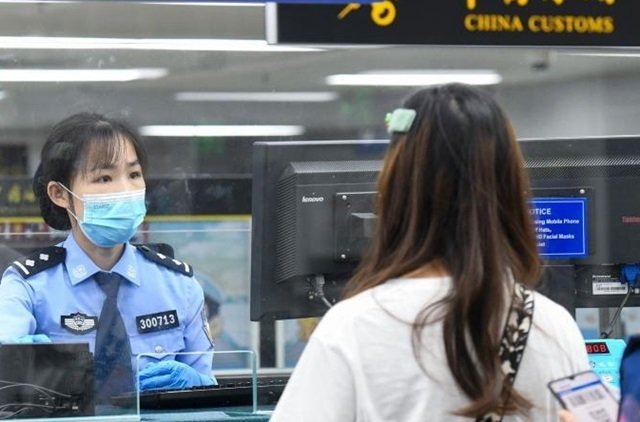
China has tightened its legal framework governing who can enter and leave the country, introducing new rules that explicitly connect international travel with national security, industrial interests and technological controls. The regulations, which took effect on Tuesday, allow authorities to prevent Chinese citizens from leaving the country in circumstances ranging from alleged threats to national security to violations of technology import and export regulations.
Chinese authorities insist that the measures are not intended to restrict the movement of ordinary citizens. A government “rumour-refuting” platform, Piyao, said last week that the rules “do not restrict the travel of ordinary citizens, but rather serve as a preventative measure against high-risk destinations and individuals with unusual travel patterns”. The government has said the regulations are intended to “safeguard national sovereignty and security” and address problems including people being deceived into travelling abroad or becoming involved in illegal gambling and scam activities.
Yet the new framework has attracted concern because it formalises powers that can affect not only individuals accused of wrongdoing, but also people involved in politically sensitive activities and strategically important industries.
Under the new rules, Chinese citizens who are deemed to have “harmed” China’s national security or interests while overseas can be prevented from leaving China for up to three years after returning. Those who violate technology import and export regulations that “may endanger national industrial or technological security” can also face exit bans lasting from six months to an indefinite period.
The issue is not entirely new. According to BBC Chinese, some Chinese citizens have reported facing opaque restrictions on international travel for years. One 26-year-old citizen, identified by the pseudonym Pipi, said his passport application was rejected in 2023 after he had attended pro-democracy protests in Hong Kong in 2019. He said he had been interviewed by Hong Kong media during the demonstrations and questioned by state security police after returning to mainland China.
Pipi told BBC Chinese that an immigration official said he could not obtain a passport “because of the Hong Kong issue”, although he received no written explanation. “If they have given me an official document, I could apply for administrative reconsideration. But all they said was one sentence: ‘You can’t go,’” he said. He said he feared escalating the matter because he might “end up in prison”.
The difficulty of challenging such restrictions is compounded by the lack of a system through which citizens can independently determine whether they are subject to exit controls. According to publicly available information cited by BBC Chinese, people generally discover that they have been restricted only when applying for travel documents or attempting to leave the country. China’s Administrative Licensing Law says authorities should explain in writing why an administrative licence has been refused, but people interviewed by the BBC said that requirement was not always enforced.
Data supplied to the BBC by rights group Safeguard Defenders points to a sharp expansion in exit bans. China’s supreme court database contained only 89 records mentioning exit bans in 2016, compared with 188,760 by last year. The percentage of civil verdicts dealing with exit bans also rose more than 30 times between 2019 and 2025, from around 0.23% to 7.3%. The actual number of cases is believed to be higher because of an increasing number of withheld judgments.
The restrictions extend beyond political activism. Some civil servants and employees of state-owned enterprises have long faced limits on overseas travel. A Beijing employee at a state-owned financial institution, identified as Xiao Wang, told BBC Chinese that colleagues have been required to surrender their passports and obtain approval before travelling abroad. He said managers had verbally warned that “sensitive countries such as Japan are definitely off-limits”. Some of his civil servant friends, including museum employees, had reportedly been told they could not directly apply for passports because of their jobs.
Professor Tom Kellogg, Executive Director of the Center for Asian Law at Georgetown University, told BBC Chinese that the restrictions represented “another tool designed to control what Chinese citizens do and say overseas”. He also said that, in some cases, state security authorities had directly refused to issue passports to people who criticised the Chinese government overseas or engaged in rights advocacy.
The new rules are also becoming increasingly relevant to the technology sector. Nikkei Asia reported that Chinese authorities have recently used exit restrictions in cases involving sensitive commercial and technological interests. Last year, Beijing banned a Wells Fargo foreign employee and a U.S. government worker from leaving the country. Earlier this year, Chinese authorities reportedly imposed exit restrictions on two founders of AI startup Manus as they sought to block a potential acquisition by Meta.
The Manus case has reportedly made technology founders operating internationally more cautious about travelling to China for work. As the U.S.-China technology race intensifies, industries including AI, semiconductors and advanced manufacturing are receiving particularly close scrutiny. Beijing has stressed technological self-sufficiency, while authorities have broad oversight of exports of rare-earth materials and have tightened rules governing outbound investment.
Lawyers cited by Nikkei Asia said many of the powers contained in the new regulations already existed under earlier laws and national security measures. The significant development, they argued, is the increasing formalisation of the system. Dan Harris, founder of law firm Harris Sliwoski, said people barred from leaving China are now supposed to receive written reasons, the legal basis for the decision and information about what they can do to challenge it. “China has started to become more legalistic,” he said.
For companies operating in strategically sensitive sectors, that legal framework could translate into more extensive compliance procedures. Johnny Choi, a partner at DLA Piper, said companies should treat export-control and exit-entry compliance as connected issues, with greater pre-travel screening of individuals as well as associated entities and relationships.
The new rules also place greater scrutiny on foreign nationals entering China, including requirements concerning the accuracy of visa applications and the declared purpose of visits. Lawyers told Nikkei Asia that the changes do not materially alter the risks for most foreign nationals leaving China, but that scrutiny of entry applications has increased, particularly for people connected to sensitive industries.
At the same time, Beijing is extending its oversight beyond China’s borders through tax enforcement and reporting requirements affecting wealthy individuals and entrepreneurs with overseas assets. Tax compliance issues can result in exit restrictions, while holding a foreign residence permit or passport does not necessarily end Chinese tax residence where an individual’s family, habitual home and economic interests remain centred in China.
For Kellogg, the expansion of travel restrictions evokes an earlier period in China’s history when the country was largely cut off from the outside world under Mao Zedong. International travel became a normal part of life for Chinese citizens only in the 1990s, following reforms and opening up. The current system, he told BBC Chinese, “bring back memories of that painful era”.
China’s new border regime therefore extends beyond the question of who is permitted to cross a border. It places international movement increasingly within a framework of national security, technological control, political sensitivity and economic regulation. For ordinary travellers, much of the system may simply formalise existing practices. But for citizens, executives and professionals connected to sensitive political or technological interests, the rules create a more explicit legal mechanism through which the state can determine when leaving the country is permitted — and when it is not.