by Luxman Aravind
Last weekend’s separate political rallies exposed something far more significant than the spectacle of an opposition attempting to rediscover its political voice. The so-called collective opposition organised its own mobilisation, while the JVP separately organised its own political rally, and President Anura Kumara Dissanayake subsequently took the extraordinary step of organising a rally of his own to counter the opposition mobilisation. They exposed, perhaps for the first time in a visible and unmistakable manner, the growing political rupture inside the broader coalition that brought the National People’s Power to power.
The NPP was presented to the country as something larger and more inclusive than the JVP, an umbrella capable of attracting moderates, professionals, minorities and voters who would never ordinarily have identified themselves with the JVP’s traditional ideological inheritance. That was the genius of the electoral formula. It allowed the JVP to become electorally acceptable without necessarily abandoning the organisational and political machinery that had brought it this far.
The extraordinary achievement of Anura Kumara Dissanayake was to transform a party once regarded as politically marginal or ideologically threatening into the central vehicle of national political power. But precisely because that transformation depended upon a coalition broader than the JVP itself, the question now confronting the government is whether the NPP can remain a genuine political coalition or whether it will gradually become a sophisticated electoral façade around an increasingly dominant JVP core. That distinction may determine the political future of Sri Lanka more profoundly than any parliamentary debate currently taking place.
The rallies also demonstrated another uneasy reality. The opposition, despite being fragmented, organisationally weak and without an immediately compelling alternative political project, still possesses sufficient political energy to force the President himself back onto the political stage. That is a remarkable development at a moment when there is no immediate presidential or parliamentary election requiring such mobilisation. Why would a government that possesses such an extraordinary electoral mandate feel compelled to respond so visibly to comparatively weak opposition demonstrations? The answer may be less flattering than either the government or its supporters would like to admit.
Political confidence is not measured merely by parliamentary numbers. It is measured by the ability of a government to allow opponents to speak, protest and organise without feeling compelled to personally demonstrate that everything remains under control. Dissanayake’s repeated attempts to place himself at the centre of the government’s political narrative suggest that he understands this distinction very well. He is attempting to evolve from being an exceptionally successful political campaigner into something much more difficult, the nucleus of a governing order. The problem is that the rest of the government has not necessarily made the same transition. Ministers who once appeared energetic, articulate and politically distinctive increasingly risk becoming supporting characters in a political drama whose central figure is the President himself. Even Harini Amarasuriya, whose intellectual credentials and image once gave the NPP a distinctive reputation among educated and urban voters, has struggled to retain the political visibility that accompanied the early phase of the government.
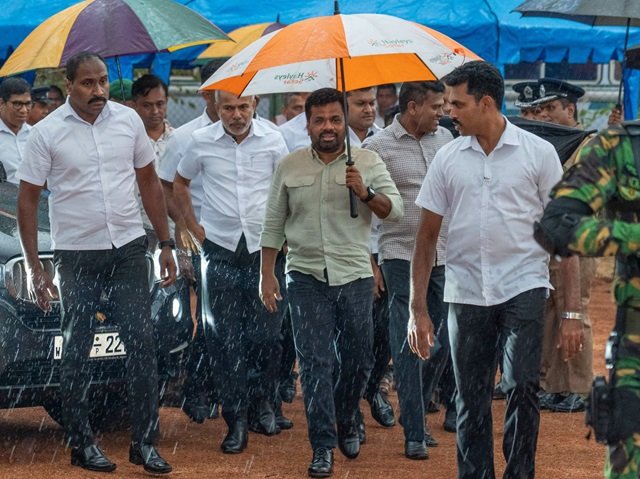
There is, however, another reason Dissanayake remains politically effective. He has understood something about the Sri Lankan electorate that many political elites habitually misunderstand. His carefully cultivated image of personal simplicity is not merely an aesthetic choice. The sweating President standing before a crowd, wearing the same clothes for hours, speaking in the language of ordinary people and refusing the visual symbols of presidential luxury is itself a political message. Critics may interpret this as amateurish, theatrical or even calculated populism. They may be correct. But political communication is not judged by the sophistication of the critic; it is judged by whether the audience believes the performance.
In a country where political leaders have for decades been associated with extravagant lifestyles, privilege, corruption and distance from ordinary citizens, visible discomfort can become a political asset. The President understands that an apparently uncomfortable leader can appear more authentic than a perfectly dressed politician surrounded by ceremony and privilege. This is not uniquely Sri Lankan, nor is it necessarily a reflection of some inherent national appetite for suffering, as simplistic cultural explanations might suggest. It is a sophisticated reading of a political culture in which authenticity is frequently communicated through proximity to hardship. Dissanayake has recognised that appearing ordinary can be more politically valuable than appearing presidential.
But behind this carefully maintained simplicity lies a much more conventional political ambition. There is little reason to believe that Dissanayake is governing merely for the present term. The construction of a second-term political architecture has almost certainly already begun, even if it is not being publicly described in those terms. His greatest political advantage is not simply that he remains personally popular. It is that he has progressively separated his personal political brand from the collective performance of his government. When the government succeeds, the President can claim ownership of the achievement. When ministers fail, responsibility can be distributed across the administration. That is an extraordinarily powerful political arrangement. It allows the President to remain the principal national symbol of change while individual ministers absorb the costs of unpopular decisions. The danger for the NPP is obvious. A coalition that originally depended upon collective credibility can gradually become dependent upon one individual’s credibility. Once that happens, the government may remain politically strong while the political movement surrounding it becomes institutionally weaker.
This is where the opposition’s current weakness becomes an advantage for Dissanayake. Sajith Premadasa remains the most obvious alternative presidential figure, but his political position is complicated by the continuing shadow of Ranil Wickremesinghe. The relationship between the two represents one of the unresolved strategic wounds of the last presidential election. Wickremesinghe’s decision to contest separately rather than support Premadasa divided the anti-NPP vote and contributed significantly to Dissanayake’s victory. Whether Premadasa can politically forgive that decision is almost irrelevant. What matters is whether the broader opposition electorate can forget it. Ranil remains an exceptionally sophisticated political operator, but his political instincts have always been strongly connected to power, institutions and the political networks surrounding him. It is difficult to imagine him simply disappearing from the political equation or accepting a subordinate role in another leader’s project. That makes a durable Premadasa-Wickremesinghe accommodation extraordinarily difficult.
The emergence of Namal Rajapaksa as a more visible opposition figure creates an additional complication for Premadasa. If Namal can attract even a modest segment of the electorate that previously supported the Rajapaksa political machine, he does not necessarily have to win an election to alter its outcome. He merely has to prevent those voters from consolidating behind Premadasa. That is the central mathematics of Sri Lankan opposition politics. The most dangerous opponent is not always the politician capable of winning the largest number of votes; sometimes it is the politician capable of preventing another opposition politician from assembling the coalition necessary to defeat the incumbent. In that sense, the political significance of Namal’s legal troubles cannot be separated from the wider opposition struggle, although any assertion that his arrest was deliberately engineered for electoral purposes would require evidence rather than political inference. The political consequence, however, is easier to observe. Every major confrontation involving a Rajapaksa has the potential to revive the Rajapaksa political brand, energise its supporters and fragment the opposition further.
This is precisely where Dissanayake’s political strategy appears particularly sophisticated. He does not necessarily need to destroy his opponents. He needs them divided. A fragmented opposition allows him to occupy the political centre while retaining the ideological machinery of the JVP behind him. The transformation of the JVP into the NPP was therefore not simply a rebranding exercise. It was an electoral innovation. The JVP discovered that it could retain its organisational discipline while placing a broader, more moderate and more electorally attractive identity in front of the electorate. The genius of that arrangement was that voters could support Dissanayake without necessarily feeling that they were voting for the old JVP. The question is whether the reverse process is taking place, whether the NPP is gradually becoming less a broad coalition containing the JVP and more a governing structure dominated by the JVP.
Dissanayake’s political history suggests that he understands factional competition extremely well. His rise within the JVP was not an accident. He emerged through a highly disciplined political organisation in which leadership, ideological authority and organisational control mattered enormously. That experience has inevitably shaped his understanding of power. He knows that political movements do not merely collapse because they lose elections. They collapse when alternative centres of authority become stronger than the leader. Consequently, the most effective political strategy is often not to confront every opponent directly but to ensure that no single opponent becomes sufficiently powerful to unite everyone else against you. This logic has particular relevance in Sri Lanka because the opposition has historically been extraordinarily vulnerable to personality conflicts, rival ambitions and competing political dynasties.
The more interesting element of Dissanayake’s strategy, however, is his simultaneous effort to prevent the consolidation of Sinhala-Buddhist political opposition while maintaining strong support among minority communities. This is perhaps the most politically delicate component of his electoral formula. His government can afford to take positions that are unpopular among sections of the Sinhala-Buddhist electorate because he appears to have established a degree of credibility among minority voters that previous Sinhala-majority political leaders struggled to achieve. His willingness to engage directly with criticism from senior Buddhist institutions, including influential religious establishments, demonstrates that he is not necessarily frightened by every challenge from the traditional Sinhala-Buddhist establishment. But this should not automatically be interpreted as ideological confrontation. It may instead represent political calculation. Dissanayake appears to understand that Sinhala-Buddhist electoral sentiment can be highly volatile and can change dramatically during the final weeks of an election campaign. A government can therefore absorb considerable criticism during the middle of a political cycle and attempt to repair its relationship with the majority electorate when an election approaches.
The minority vote presents a different calculation. Minority political support cannot be manufactured at the last moment with slogans alone. It requires accumulated credibility, political reassurance and tangible commitments. Dissanayake appears to understand this distinction. His government can risk temporary friction with sections of the Sinhala-Buddhist constituency because it believes it has established a relatively durable relationship with minority voters. If that calculation is correct, the electoral mathematics become formidable. Divide the traditional Sinhala opposition, retain minority support, maintain a personal image of integrity and simplicity, and prevent any single opposition figure from becoming the undisputed alternative to the President. That is not an ideological strategy. It is an electoral strategy.
And that is precisely why the opposition should be worried. The NPP does not need to become universally popular. Dissanayake does not need every Sri Lankan to believe that his government has transformed the country. He merely needs to ensure that those who oppose him cannot agree on whom to support instead. The greatest threat to his second-term ambitions is therefore not necessarily public dissatisfaction. It is opposition consolidation. If Premadasa, Rajapaksa, Wickremesinghe and the other competing political forces remain trapped in mutual suspicion, personal rivalry and competing claims to leadership, Dissanayake can continue to appear larger than the sum of his government’s achievements.
The real question, therefore, is not whether Anura Kumara Dissanayake is politically clever. He plainly is. The real question is whether the opposition is clever enough to understand the game he is playing before the next election begins. If the opposition waits until an election is formally announced, it may already be too late. Dissanayake’s political architecture is being constructed now, through appointments, public imagery, institutional relationships, minority outreach, management of Sinhala-Buddhist sensitivities and, above all, the fragmentation of potential opponents. The opposition is still behaving as though its principal task is to attack the government. Its real task is considerably harder. It must construct an alternative coalition capable of surviving its own rivalries.
Sri Lankan politics has repeatedly demonstrated that governments rarely lose power simply because they govern badly. They lose power when an alternative becomes more compelling, more united and more credible than the incumbent. Dissanayake appears to understand this better than his opponents. He does not need to prove that every member of his government is successful. He needs to persuade the country that he personally remains the safest political vehicle for change. If the opposition continues to fight among itself, if the old political personalities continue to dominate its imagination, and if every potential challenger is allowed to become another source of division rather than a component of a larger political coalition, Dissanayake’s second-term project may become considerably easier than his first. The irony is that the President’s greatest political achievement may eventually have less to do with the performance of his government than with the inability of everyone outside it to agree on what should replace it.