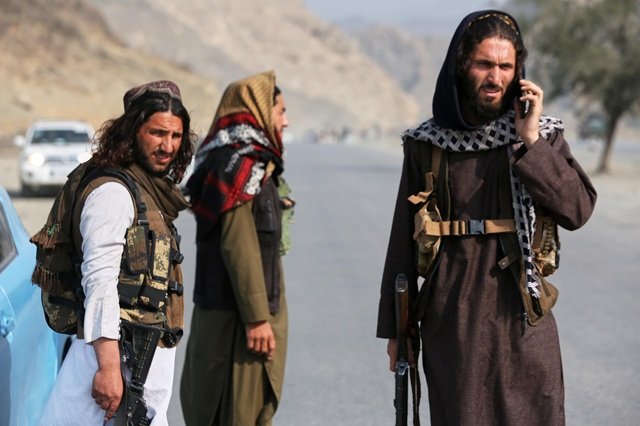
Five years after returning to power, the Taliban controls Afghanistan more firmly than many expected. Yet territorial control has not translated into the elimination of militant networks operating from Afghan soil.
That contradiction is becoming one of the region’s most consequential security problems.
A September 2026 Atlantic Council assessment described the Taliban’s inability to deter or prevent terrorist groups from operating inside Afghanistan as the largest counterterrorism challenge facing Central Asia. United Nations monitoring has similarly documented the continued presence of Islamic State-Khorasan Province (IS-K), Tehreek-e-Taliban Pakistan (TTP), al-Qaeda, the Eastern Turkistan Islamic Movement/Turkistan Islamic Party (ETIM/TIP), Jamaat Ansarullah and other armed groups.
The issue is not that the Taliban refuses to fight terrorism altogether. Its counterterrorism is selective.
The Taliban has aggressively targeted organizations that directly challenge its authority, particularly IS-K, while maintaining relationships with, tolerating or failing to constrain other groups whose principal targets lie beyond Afghanistan.
The result is a dangerous paradox: stronger regime security inside Afghanistan can coexist with worsening insecurity outside it.
The Taliban’s selective counterterrorism model
The Taliban’s campaign against IS-K has produced tangible results. UN assessments acknowledge that sustained pressure has reduced the group’s freedom of movement and pushed it toward smaller cells rather than allowing it to openly challenge Taliban territorial control.
But Kabul’s relationship with other militant organizations is markedly different.
UN monitoring has continued to report ties between the Taliban and al-Qaeda, including contacts involving training, logistical assistance and ideological cooperation. International assessments have also placed TTP strength in Afghanistan in the thousands and repeatedly documented fighters and senior figures in provinces close to Pakistan.
That distinction matters.
A government can suppress one terrorist organization while allowing an enabling environment to persist for others. Counterterrorism cannot be judged solely by how effectively the Taliban fights IS-K if organizations with regional or international agendas continue to find sanctuary, relationships or operational space.
Al-Qaeda today is far weaker than it was before September 11, 2001, and most Afghanistan-based militant organizations lack its former global reach. But sanctuary matters because it buys time: time to recruit, rebuild leadership structures, establish partnerships and develop external capabilities.
The strategic danger lies not only in what these organizations can do today, but in what a permissive environment may allow them to become.
The Taliban’s approach is therefore better understood as selective threat management rather than comprehensive counterterrorism. The emerging pattern suggests that groups threatening Taliban rule are treated as enemies, while organizations whose principal targets lie outside Afghanistan can face a markedly different strategic calculation.
Pakistan and Central Asia face the consequences
Pakistan is already experiencing the most immediate consequences.
TTP has become one of the central sources of tension between Islamabad and Kabul. International monitoring has repeatedly documented TTP fighters and leaders operating from Afghanistan, while Pakistan argues that Afghan territory is being used to plan, facilitate or sustain attacks across the border.
Taliban authorities reject many of Islamabad’s accusations. Yet continuing international reporting on TTP’s presence has made the issue increasingly difficult to dismiss as a purely Pakistani domestic security problem.
A militant-sanctuary dispute has gradually evolved into a state-to-state security confrontation. TTP is now not only a counterterrorism challenge but an important driver of deteriorating Afghanistan-Pakistan relations.
Central Asia faces a different but increasingly internationalized threat.
IS-K has recruited Central Asian nationals, particularly Tajiks, and international monitoring has described Afghanistan as an important center for recruitment and facilitation. Some recruits have travelled into Afghanistan for training, while networks associated with IS-K have been linked to attacks or plots extending far beyond South Asia.
Atlantic Council assessments have highlighted cases involving Tajik IS-K recruits in Europe, the Philippines and the United States, underscoring how Afghanistan-linked militant networks can acquire an international dimension.
ETIM/TIP adds another layer. UN assessments have documented its presence in Afghanistan and relationships with TTP, the Islamic Movement of Uzbekistan and Jamaat Ansarullah. These connections matter because militant organizations do not need identical objectives to benefit from shared sanctuary, personnel, training infrastructure or logistical networks.
For Pakistan, Central Asia and China, the strategic danger lies not in any single organization but in the militant ecosystem itself.
Groups with different enemies and agendas can coexist, exchange expertise and develop transnational connections. An organization focused on one neighboring state today may become part of a wider network tomorrow.
That ecosystem is what makes Afghanistan’s security environment more consequential than the capabilities of any individual militant group.
Afghanistan’s terrorism problem does not stop at its borders
The Taliban frequently presents the restoration of territorial control as proof that Afghanistan is secure.
That argument confuses regime security with regional security.
The Taliban may face no serious conventional threat to its control of the country, but that does not mean militant networks operating under, beside or against its authority have disappeared. International monitoring has repeatedly challenged Taliban denials regarding the presence of several armed organizations.
IS-K demonstrates the external danger most clearly.
Despite sustained Taliban pressure, the organization has retained cross-border recruitment networks and aspirations for external operations. International assessments have previously identified facilitation routes linking Afghanistan and Central Asia with Türkiye and Europe.
This does not mean Afghanistan has already returned to its pre-9/11 role as the center of global jihadist plotting. Such a conclusion would overstate both the current capabilities of militant organizations and the freedom they enjoy.
The more credible warning is subtler.
Afghanistan has again become an environment in which multiple militant organizations can retain sanctuary, rebuild capabilities and cultivate cross-border networks while the Taliban confronts some groups but tolerates, maintains relationships with or fails to restrain others.
That may strengthen Taliban regime security, but it does not produce regional security.
Groups given sanctuary, time and operational space do not need to pose an immediate global threat to become strategically dangerous. Their significance lies in the opportunity to regenerate, recruit, cooperate and gradually expand their reach.
The question is therefore no longer whether the Taliban controls Afghanistan. It clearly does.
The question is whether a regime practicing selective counterterrorism can prevent the territory it controls from becoming a platform for threats against Pakistan, Central Asia and other neighboring states and eventually countries much farther away.