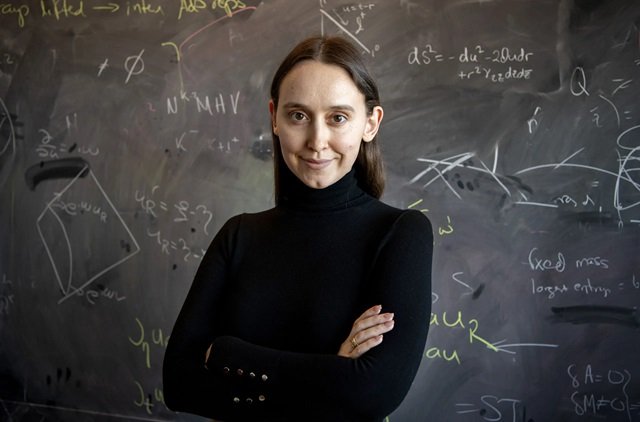
At 14, Sabrina González Pasterski built her own aircraft and learned to fly it. At 22, she wrote a paper on gravitational memory and black holes that was subsequently cited by Stephen Hawking. Now, at 33, the American physicist is working at Canada’s Perimeter Institute for Theoretical Physics on celestial holography, a field that could contribute to one of physics’ most difficult questions: how to reconcile Einstein’s general theory of relativity with quantum theory.
In an interview with El País, Pasterski described a research programme that reaches beyond the conventional use of artificial intelligence. Her ambition is not simply to use AI as a faster machine for producing answers, but to develop a representation of physical knowledge capable of revealing connections between theories and generating new questions.
Pasterski was born in Chicago and is proud of her Cuban roots, although she acknowledges that she does not speak Spanish. “Although speaking Spanish is something I would like to change,” she said. Her experience of growing up close to a migrant family has contributed to the different perspective she brings to her work, according to the interview. Her early fascination was with engineering and with the limits of what could be built. “As a child I was interested in engineering, the limits of what it was possible to do. Later I learned to appreciate the impossible, the complexity of trying to understand the structure of the universe.”
Her route eventually took her to the Massachusetts Institute of Technology, where she became one of the first women to graduate in physics with the highest possible score. She later moved towards high-energy physics and, at 22, wrote a paper on gravitational memory and black holes that was cited shortly afterwards by Hawking.
The trajectory from constructing an aircraft to studying the mathematical structure of the universe is not merely an unusual biographical detail. Pasterski herself sees a connection between the two activities. Her early experience helped her enter MIT and encounter researchers in the field in which she now works. But she stresses an important distinction between building something and understanding it. “When you build something, what matters is that it works. As a physicist, on the other hand, you want to understand the laws that govern the system.”
That distinction has become particularly significant as artificial intelligence enters scientific research. Pasterski is developing tools that could move between understanding physical laws and constructing systems capable of representing that knowledge. She has also experimented with an intentionally playful version of the idea. In her office sits a small pinball machine, alongside a robotic system featuring an animatronic figure and a physical “brain” based on the knowledge system being developed at the institute. Her aim is to turn it into a robot representing a physics researcher. For now, she says, it is simply something she does “to troll, to have fun”.
Behind the humour is a serious scientific ambition. One of the areas associated with Pasterski’s work is gravitational memory, in which gravitational waves can leave a permanent trace in space-time. When an object accelerates, it emits radiation. In the case of gravitational waves, that radiation can leave a lasting effect: objects observed from a great distance can undergo a permanent relative displacement after the wave has passed.
Spin memory is related but concerns angular momentum. Gravitational waves generated, for example, by the merger of two black holes can involve the loss of angular momentum from the system, producing a signal that can be observed from a great distance. The significance lies partly in the ability to extract information about events occurring in gravitational systems by studying radiation received far away.
For Pasterski, the deeper fascination is the universality of the mathematical structures involved. Physicists frequently seek mathematical structures that remain universal across different descriptions before testing how far those structures can be generalised. In this case, an observable physical imprint can lead researchers towards the broader mathematical structures that explain it.
Yet gravitational spin memory, by itself, does not provide a theory of quantum gravity. Instead, Pasterski sees it as part of a broader research programme. One idea being explored is that a quantum theory of gravity should possess a holographic description — effectively, a description in two dimensions. The symmetries under investigation could help explain how such holography might operate in a flat space-time.
This is where celestial holography enters the picture. Pasterski cautions against the popular shorthand that the universe is simply a hologram. “The analogy that the universe is a hologram may sound very good, but it is misleading.” Celestial holography is instead a mathematical framework for describing the universe. It seeks a holographic description of gravity in a flat space-time resembling, approximately, the universe in which we live. The proposed description places the relevant physics on what is known as the celestial sphere — the imagined surface created when we look outwards in every direction across the sky.
The obstacles remain considerable. One difficulty is that researchers understand particular parts of the relevant duality very well, while finding it difficult to construct a complete and concrete formulation in flat space-time. More broadly, the problem repeatedly returns to a fundamental question: what can actually be calculated, and can the theory under examination describe the real world?
Pasterski does not expect a single researcher to solve that problem. Instead, she wants to help build the infrastructure required to explore mathematically consistent theories. Her current work brings together people from different disciplines, including AI specialists and mathematicians, to develop tools for examining which physical theories are possible and how they connect.
That approach also reflects her concern about the changing relationship between science and artificial intelligence. AI may allow researchers to formulate questions about the universe at a level beyond conventional scientific inquiry, she argues, but there is a risk that academic research could be left outside that transformation. Her own experience across engineering and physics, she believes, may help her navigate the space between building powerful tools and understanding what those tools reveal.
For Pasterski, the purpose of fundamental physics cannot be reduced to technological usefulness. A better understanding of quantum gravity might never produce a direct practical application. “For me, physics is about understanding.” The objective is not merely to obtain an answer from a machine or calculate something needed for an application, but to identify the simplest descriptions of a theory, understand what can be deduced from them and discover how far those descriptions can take us.
That philosophy sits uneasily alongside the media attention that has followed her career. Some outlets have called her the “new Einstein” or the “Latin Einstein”. She initially found the comparison uncomfortable. She did not consider it an appropriate comparison. But her attitude has changed. Rather than rejecting the attention, she now sees an opportunity to use it to bring physicists and other researchers into the development of new scientific tools.
“I used to be embarrassed when they called me that,” she said. “Now I think, screw it, let’s have a little fun and get attention.”
The provocative line captures a broader shift in her approach. The physicist who once built an aircraft as a teenager is now interested in building something considerably more abstract: an intellectual infrastructure in which artificial intelligence does not merely answer questions that scientists already know how to formulate, but helps expose relationships between theories and generate questions that researchers have not yet asked.
For Pasterski, the ambition is not to replace the physicist with the machine. It is to build machines capable of helping physicists understand what remains unexplained.