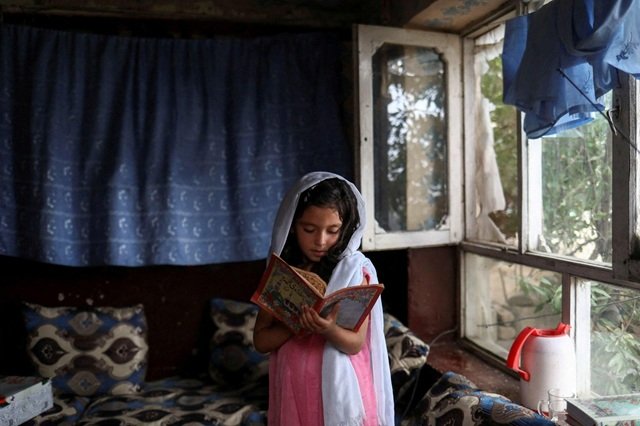
Sakina knew the risks. In the final days of her pregnancy, she was living in Pas Kuran, a village in Kuran wa Munjan, one of the most remote districts in northeastern Afghanistan. The nearest health centre was beyond a 30-kilometre stretch of steep, unpaved road. There were no vehicles in her village, and the journey had to be made on foot or by pack animal, taking several hours and becoming even more difficult when winter snow covered the route. The cost of reaching the health centre—5,000 afghanis, about 66 euros—was beyond what her family could afford.
Sakina therefore gave birth at home. She was fortunate to have help. Mah Jan and Saifura, two women from the village, came to assist her. Mah Jan, who had been helping women give birth in Pas Kuran for years, took responsibility during the night while Saifura observed and learned. The delivery went smoothly. For Sakina, however, the outcome could easily have been different. “If they hadn’t helped me,” the 32-year-old mother of five says, “my baby and I might have died.”
Her experience illustrates a wider crisis in Afghanistan, where 521 women die for every 100,000 births. In Kuran wa Munjan alone, 32 women died in childbirth last year, according to Baz Mohammad, head of the district’s only health centre. Only three of those women managed to reach the clinic. The others died at home or during the journey to medical care.
The crisis is unfolding as the country’s already fragile health system faces shrinking international support. Afghanistan was among the countries most dependent on official development assistance. In 2019, international grants financed more than 75% of public spending, according to World Bank data. The consequences of declining support have become visible in healthcare: 422 primary healthcare centres closed in 2015, leaving more than 3.3 million people without care, while 295 health facilities were suspended or closed between January and June 2026 because of funding gaps.
Badakhshan, where Pas Kuran is located, is among the hardest-hit provinces. For women living in isolated communities, the loss of health facilities is compounded by the shortage of qualified female healthcare workers. Restrictions imposed by the Taliban on women’s education and employment have cut off the training pathway for female doctors, nurses and midwives, further reducing an already limited workforce.
The consequences are particularly severe in childbirth. Mah Jan never attended school and cannot read or write. She learned how to assist deliveries from her mother, who had learned from her own mother. Now Mah Jan is passing that knowledge to Saifura. She has assisted with more than 20 births in the community since she began delivering babies about 10 years ago.
“Since there are no doctors or midwives here, I am forced to help women during childbirth. I teach women and young girls so they can prevent maternal deaths in the future,” she says.
The informal network is a response to necessity rather than a substitute for professional medicine. Residents of Kuran wa Munjan told EL PAÍS that women pass basic childbirth skills and traditional midwifery knowledge from one generation to another because trained professionals are not available nearby. The UN Population Fund estimates that Afghanistan needs at least 18,000 additional midwives to meet basic maternal healthcare needs.
The shortage became even more acute in December 2024, when Taliban supreme leader Haibatullah Akhundzada banned women from attending nursing and midwifery colleges. The decree was issued in Kabul on December 3 and came into effect that same morning. In Badakhshan, students arrived at their college only to discover that they were no longer allowed to enter.
“When I heard the news, I was very worried. There aren’t enough midwives here, and women face many difficulties during childbirth. If girls can’t learn midwifery, who will help our women in the future?” Mah Jan asked.
Shabana Farahmand, a women’s rights activist, links the shortage directly to the restrictions on women’s education and employment. “When women are denied access to education and employment, the first victims are mothers and newborns in remote communities,” she says. “The shortage of qualified midwives is a direct result of this and is increasing the risk of maternal deaths.”
She also draws a distinction between the knowledge passed through families and professional medical training. Women may learn about childbirth from mothers, sisters and older relatives, she says, but that cannot provide the same preparation as formal training in obstetrics. Before the Taliban’s return, a growing corps of midwives was improving health outcomes.
Saifura sees the limits of what informal care can achieve. “We do everything we can and give it our all. But when women suffer severe bleeding or when the baby is in a dangerous position, there’s nothing more we can do,” she says. “Losing a mother during childbirth is heartbreaking, but every successful delivery motivates us to keep going.”
Giti Farah, a doctor in Badakhshan, says even one qualified midwife permanently stationed in a remote village can make a substantial difference by examining women before delivery, identifying high-risk pregnancies, controlling heavy bleeding and preparing patients for transfer when necessary. But she stresses that informal assistance cannot replace professional obstetric care. “Informal knowledge cannot replace proper professional training in obstetrics,” she says.
For some families, the absence of that professional care has already proved fatal. Marjan died during childbirth in January 2025 in Pas Kuran. When she went into labour, she suffered a haemorrhage and became progressively weaker. Her family tried to take her to the health centre, but heavy snowfall blocked the road. With vehicles unable to pass, they carried her on a stretcher.
“We had no choice but to use a stretcher and walk. But Marjan died on the way, and we carried her body back home,” her brother, Abdul Rauf, says. “I still struggle to accept what happened. We lost not only my sister but also the baby she was carrying. I believe that if there had been proper healthcare and she had received timely medical treatment, perhaps they would both be alive today.”
The district health centre itself cannot provide the emergency treatment many women require. Baz Mohammad says there is no surgeon, meaning complicated childbirth cases must be referred to Baharak or Fayzabad. Pas Kuran is about 160 kilometres from Fayzabad, the provincial capital, and the journey can take a full day or more along mountain roads.
“Many of these deaths are preventable,” Mohammad says. High blood pressure, severe bleeding and obstructed labour are among the main causes, he explains—complications that qualified healthcare professionals can treat. Yet women continue to die because the necessary professionals and facilities are absent.
Fozia Shirzad, a midwife in Badakhshan, points to the same combination of distance, poor roads, delayed transfers and a shortage of healthcare workers. “If medical facilities are established and midwives and doctors are sent to these areas, many mothers’ lives can be saved,” she says.
Meanwhile, the financial lifeline supporting Afghanistan’s health system is shrinking. The World Health Organization says the 2026 Health Response Plan remains severely underfunded. By June 2026, only 17% of the required $190.8 million had been received.
Nazir Ahmad Nizar, deputy director of the Badakhshan Public Health Directorate, says his office has repeatedly asked the Ministry of Public Health to build hospitals in remote districts and assign specialists to them. So far, those requests have not produced the facilities or personnel sought.
For women such as Sakina, the gap between surviving and dying in childbirth can therefore be measured in kilometres, money, snowfall and the availability of one trained professional. In their absence, women like Mah Jan and Saifura continue to fill the space left by a health system that cannot reach them, carrying knowledge from one generation to the next while the need for formal care continues to grow.