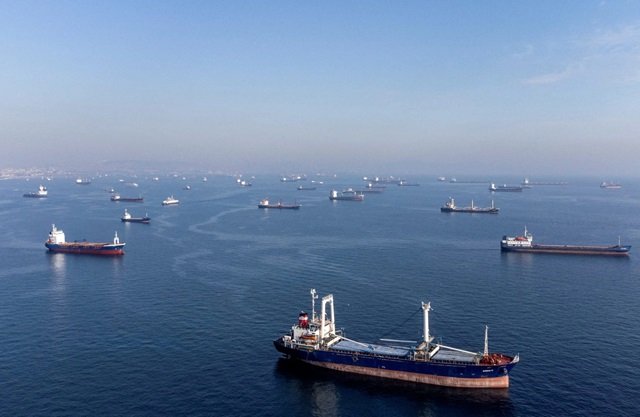
The escalating conflict around the Black Sea is threatening to create a new global food supply shock, with attacks on Russian and Ukrainian ports disrupting grain shipments and forcing buyers thousands of miles away to search for alternative sources. The disruption comes as markets are already facing higher energy and fuel costs linked to the war in Iran, raising concerns that food inflation could accelerate further.
For Tue Vuong, chief executive officer of Golden Wheat in Ho Chi Minh City, the crisis became immediate when four cargoes of wheat secured from the Black Sea failed to ship. The supplies represented roughly a fifth of the milling company’s annual requirements. “I was very panicked,” Vuong said. After securing replacements for two cargoes from Bulgaria, he spent weeks searching for additional supplies. “We were too exposed to a crisis in the Black Sea.”
The region is critical to global food markets. Russia and Ukraine account for more than a quarter of global wheat trade, as well as two-thirds of the sunflower oil trade and a tenth of corn shipping. Their grain supplies reach major markets across Europe, Asia, Africa and the Middle East, making the Black Sea a crucial conduit for some of the world’s most populous countries.
Since July, intensified attacks on each other’s ports have damaged grain terminals, silos and vessels. The escalation has also affected Russian energy infrastructure, pushing diesel prices to record levels. Because fuel is a major input into agriculture, higher diesel costs add another potential source of inflation throughout the food supply chain.
Egypt, the world’s biggest wheat buyer, has received no Black Sea grain for about a month. Russia’s exports have been disrupted by Ukrainian drone attacks, while Ukraine is struggling to move grain by land or river after its ports were blocked. As the new harvest accumulates, Ukraine is also running short of storage capacity.
Combined Russian and Ukrainian wheat exports are estimated to end up at roughly half their level from last year during the July to September harvesting period, according to researcher SovEcon. Wheat prices have climbed to three-year highs, while hopes for a revival of the 2022 shipping corridor brokered by Turkey remain uncertain.
Importers are increasingly turning elsewhere. France has shipped wheat to Sudan for the first time in 18 years, while Libya has used the port of Rouen for the first time in more than a decade. Turkey, the United Arab Emirates and others are looking towards the Baltic states, while Bangladesh is seeking supplies from Romania and Argentina. Buyers are also approaching Australia before its new harvest is collected.
William Reid, wheat trading manager at Australian grain merchant CBH Group, said inquiries were arriving from around the world. “It’s been extraordinarily busy,” he said, adding that demand had to be rationed because available wheat volumes could not replace all the disrupted supplies.
Alternative sources, however, face their own constraints. Drought has reduced wheat and corn yields in the United States, while heat waves have damaged Europe’s crop. The pressure is expected to intensify as countries use their reserves and increase purchases before Southern Hemisphere harvests begin.
Russia is attempting to redirect exports through Kazakhstan and the Baltic and Caspian seas, while also using the Far East. But alternative routes are more expensive or have limited capacity. More than 70% of Russia’s grain exports normally pass through the Black Sea, making a complete replacement difficult even if other routes are expanded.
Ukraine faces an even greater logistical challenge. Ports around Odesa, which have come under regular Russian missile and drone attacks, normally handle about 90% of the country’s grain exports. Agricultural shipments generate more than half of Ukraine’s export revenue, while the country is already under severe budget pressure. Its grain storage capacity could be full by early November, forcing some farmers to use plastic silo bags.
The consequences are already being felt in Egypt, where Russia and Ukraine account for about half of wheat imports and roughly two-thirds of households qualify for subsidised bread. Although a strong domestic harvest has provided reserves until February, flour prices have risen sharply, squeezing bakeries already facing high energy and labour costs.
The wider danger is that several shocks are converging at once. Food supplies are being disrupted by the Black Sea conflict, while fuel and fertiliser costs remain elevated and a powerful El Nino is adding further pressure. Kaja Kallas, the EU’s Foreign Affairs Chief, has warned of another “worldwide food security shock”.
For buyers such as Vuong, the uncertainty remains acute. His company has secured US wheat and Bulgarian supplies, but one cargo still depends on developments around Odesa. “The seller asked for a delivery extension to give them more time,” he said, “waiting for some miracle to happen in Odesa.”