by Our Defence Correspondent in Colombo
A military intelligence document dated 11 April 2019 records information linking Zahran Hashim’s network to the Vavunathivu police killings and describes further intelligence about weapons, extremist networks and the shooting of a Mawanella informant. The document raises a question now at the centre of renewed court proceedings. What happened to warnings that had already reached the authorities?
The most striking disclosure in last week’s hearing came from Additional Solicitor General Dileepa Peiris. According to the court submissions, Military Intelligence had passed information to the Criminal Investigation Department about the involvement of Zahran Hashim’s network in the Vavunathivu killings nine days before the Easter Sunday attacks. At the time, the CID was headed by Ravi Seneviratne, with Shani Abeysekara serving as its Director. The significance of the disclosure lies not simply in the existence of intelligence about Zahran, but in its timing. Information specifically connecting his network to the murder of two police officers had reached the country’s principal criminal investigative agency in the final days before 21 April 2019.
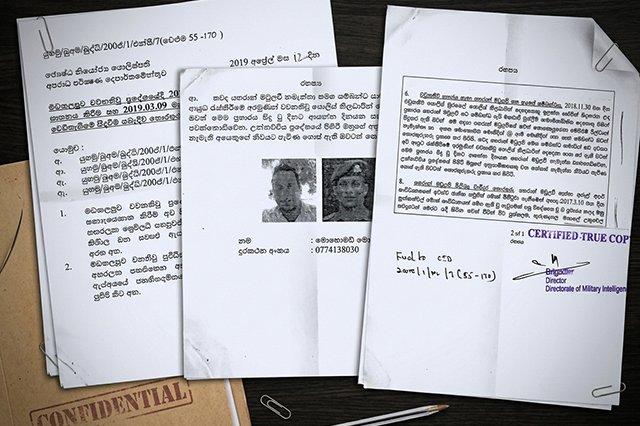
Peiris’s submissions have been interpreted in sharply different ways. The prosecution has raised allegations that sections of Military Intelligence possessed information about extremist activity but failed to share it adequately with other agencies. Yet the material supplied for examination presents a more complicated chronology than a simple claim that intelligence was absent. It includes a formal Military Intelligence communication dated 11 April 2019, signed by Brigadier Director of Military Intelligence A.K.C.R. Kodithuwakku, and an Armed Intelligence Report dated 11 April 2019 from the Special Intelligence & Security Group at Girithale Army Camp.
The first document is headed “Submission of Information Regarding the Murder of Two Police Officers in Vavunathivu, Batticaloa on 2018.11.30 and the Shooting Incident of a Muslim National Residing in Mawanella Area on 2019.03.09”. It states that information concerning the Vavunathivu killings had already been submitted through several earlier communications dated 5 December, 8 December and 14 December 2018 and 3 January 2019. The 11 April letter says that further information had subsequently been uncovered and was being supplied to assist the CID’s investigations.
Its account of Vavunathivu is explicit. The attack on two police officers at the Vavunathivu police checkpoint on 2018.11.30 was attributed to several extremist Muslim members connected to MCM Zahran Maulavi, described in the document as the former head of National Thowheeth Jama’ath operating in Kattankudy and currently absconding. It named another brother of Zahran, MCM Rilwan, and Mohomed Mohideen @ Army Mohideen as involved. The identification of Army Mohideen also raises a question that warrants clarification. Who exactly was he, under whose authority or direction was he operating, and was he at any point an informant, source or collaborator of the CID, police or any other law-enforcement or investigative agency? The document further stated that the officers had been killed to obtain weapons required by members connected to Zahran Maulavi.
The same report identified Army Mohideen by name and telephone number and stated that, around the date of the Vavunathivu attack, Zahran had visited the residence of one of his followers, Sattar, in Pavakkodichenai, Unnichchai. The document nevertheless carried a warning that the information was derived through intelligence and was not itself a final determination. In the Mawanella section, it expressly stated that the information had been obtained “purely through informants” and that the individuals concerned should be questioned and the information further analysed before conclusions were reached.
That caution is important because the documents do not present every intelligence lead as established fact. The Mawanella investigation concerned the shooting of Mohomed Rasik Mohomed Taslim, a 35-year-old livestock trader and Secretary of the UNP Development Committee. According to the report, Taslim had assisted security forces in identifying those responsible for destroying Buddha statues in Mawanella on 2018.12.22 and 2018.12.25. He had also provided information concerning heroin trafficking and had travelled to Puttalam to assist security forces in locating weapons hidden in the Wanathawilluwa area.
The intelligence report recorded a telephone conversation allegedly made by Mohomed Sharook Ahamed Rusdi to Mohomed Jibri Shaini, owner of Rajarata Hardware. According to the report, Rusdi questioned why Taslim had gone to Puttalam and why he was helping the Sinhalese, before saying, “Fine, fine, I will deal with him. I will talk to you later.” The report also described an abandoned house approximately 200 metres from Taslim’s residence where, for about four days before the shooting, approximately four youths on two motorcycles had allegedly stayed at night.
A separate internal Military Intelligence report dated 25 March 2019 recorded substantially similar information about the Mawanella incident. It concluded that questioning the named suspects and the person who had access to the abandoned house could provide information identifying the gunman. Again, however, the report was an intelligence document directing further investigation rather than a judicial finding.
The 11 April Armed Intelligence Report adds another crucial element. It said that Army Mohideen was attempting to raise LKR 400,000, allegedly on instructions from MCM Seini, a brother of Zahran Maulavi. The money, according to the informant, was intended to purchase six T-56 firearms from associates of the late Jihad Fowzer in Akkarepattu and transport them to Kattankudy. The proposed transaction was said to be planned for the night of 2019.04.13, the eve of the Sinhala & Tamil New Year, with boats identified as an alternative means of transportation if police patrols were greater than expected.
The report did not merely record the intelligence. It instructed the informant to obtain the exact venue, transport time and vehicle details, monitor assisting individuals and groups, and gather further intelligence on Zahran and his supporting networks. Its handler’s remarks said that the weapons stockpiling likely served a hidden future motive and that the individuals posed a significant threat to national security.
This creates the central tension now surrounding the court proceedings. The prosecution has alleged that intelligence about Zahran’s network was not adequately shared or acted upon and is examining whether information was deliberately withheld. The supplied documents, meanwhile, record that intelligence concerning Zahran, Army Mohideen, the Vavunathivu killings, weapons procurement and associated networks existed in the months and days preceding the Easter attacks.
The question is therefore no longer simply whether intelligence existed. The documentary trail raises a narrower and more consequential question. How was intelligence assessed, transmitted, investigated and acted upon between the first reports and the morning of 21 April 2019? That question is now being tested through court proceedings rather than settled by the documents alone.
The latest allegations should therefore be distinguished from established findings. The prosecution’s claims concerning deliberate withholding of intelligence remain allegations under investigation, not findings of guilt. What the supplied records establish more directly is that Military Intelligence had accumulated and transmitted a substantial body of information concerning Zahran’s network before Easter Sunday, including a communication to the CID nine days before the attacks.
That nine-day interval is now one of the most consequential pieces of the chronology. It places documented intelligence about Zahran’s alleged involvement in a previous terrorist-related killing inside the criminal investigative system immediately before the Easter bombings. Whether that information represented an opportunity that was missed, a warning that was inadequately acted upon, or evidence of something more deliberate remains a matter for the continuing investigation and the courts.