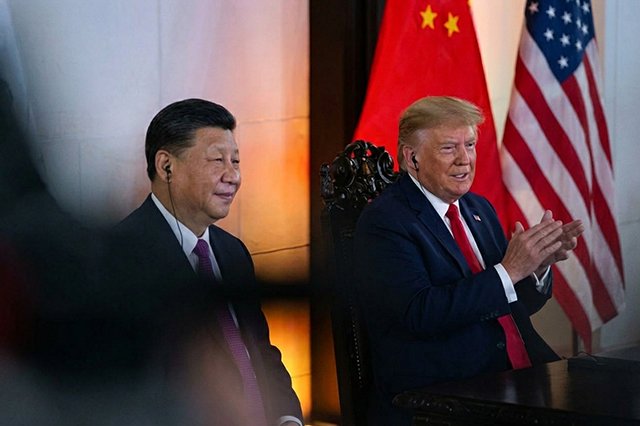
The Trump administration entered its October 2025 summit with Chinese leader Xi Jinping projecting confidence. Washington believed its position as the trade-deficit country in the bilateral relationship gave it leverage over Beijing. U.S. Treasury Secretary Scott Bessent captured that calculation bluntly, saying, “What do we lose by the Chinese raising tariffs on us? We export one-fifth to them of what they export to us, so that is a losing hand for them.”
The assumption was quickly challenged. As argued in Foreign Affairs, trade wars can be difficult to win when one country depends on an exporter for inputs that cannot easily be replaced, particularly when trade is viewed as a zero-sum contest. China’s control of critical supply chains means that its ability to impose economic costs on the United States can exceed Washington’s ability to impose equivalent costs on Beijing.
Rare earths provide the clearest example. China controls 80 to 90 percent of production, giving Beijing significant leverage over materials essential to modern industrial supply chains. Efforts to ease Chinese restrictions have therefore required Washington to make concessions involving tariffs, technology controls and visa policies during negotiations.
The lesson is not necessarily that the United States must abandon economic diplomacy. Rather, the experience exposes the limits of trying to use economic pressure without first reducing dependence on the targeted country. For centuries, countries with less economic power have managed relationships with stronger states by bargaining while avoiding direct confrontation. Economic relations have rarely been entirely cooperative or entirely adversarial.
That logic applies to Washington and Beijing despite their profound distrust and strategic rivalry. Both economies continue to derive benefits from trade and diversification, while China itself would suffer if an escalating dispute developed into a sustained tit-for-tat economic conflict. Beijing has an interest in maintaining the status quo, particularly given its persistent weak domestic demand and industrial overcapacity.
The argument presented in Foreign Affairs is therefore for a markedly different form of economic diplomacy. Instead of concentrating primarily on forcing China to buy more American exports, Washington should seek increased imports of strategically important Chinese goods and greater Chinese foreign direct investment in the United States. Such measures would not replace efforts to diversify supply chains or strengthen alliances. They would instead be intended to buy the United States time while those alternatives are developed.
That need for time is particularly apparent in the critical industries where Washington has spent years discussing decoupling without achieving meaningful separation. Despite policies pursued under both the Trump and Biden administrations, China remains deeply embedded in supply chains involving rare earths, specialised magnets and lower-end semiconductors used in automobiles and appliances.
Even when direct imports from China decline, the dependence can simply become harder to see. Supply chains become longer and less transparent, with intermediate production shifted through other countries. Pharmaceuticals illustrate the problem. The United States may import generic drugs from India, but India relies on China for feedstocks and components required to manufacture them.
For that reason, immediate industrial decoupling remains slow and costly. The proposed alternative is stockpiling. Rather than attempting to eliminate Chinese inputs overnight, Washington could build short-term inventories of strategic goods ultimately sourced from China while domestic and allied alternatives are developed.
The proposal would represent a significant departure from previous negotiations. At the October 2025 Trump-Xi meeting, Washington and Beijing reached an agreement temporarily reducing tariffs in exchange for a partial relaxation of Chinese restrictions on exports of critical materials. With that arrangement due to expire in November, Washington could simply renew it. The alternative outlined in Foreign Affairs would be a multiyear agreement involving large-scale purchases of strategically important goods whose production is heavily concentrated in China.
Government guarantees and purchases could be used to establish strategic reserves until alternative domestic or allied sources became reliable. In return, Washington could permit China greater access to selected technologies in which the United States retains an advantage.
The idea is not without risk. China could abandon such agreements, and Beijing has already structured rare-earth exports in ways that discourage resale and accumulation, preserving the leverage created by its dominant position. Yet the argument is that China’s ability to sustain a prolonged cutoff should not be overstated. Export restrictions can damage the country imposing them, provoke retaliation and encourage the development of alternative supply systems.
History provides examples of major rivals continuing to trade even when political relations were deteriorating. During the 1970s and 1980s, the United States and Soviet Union concluded grain agreements despite the broader Cold War confrontation. Before the Second World War, Japan continued obtaining substantial supplies from the United States until Washington banned trade with Tokyo in 1941. Germany and the Soviet Union also traded militarily useful technology and petroleum products through their respective invasions of Poland in 1939.
The same principle is extended to foreign direct investment. The article compares modern investment between potential adversaries with the ancient practice of exchanging hostages, arguing that companies established in rival countries create economic interests in maintaining stable relations. Cross-border investment can generate employment, research and development and greater diversification.
Yet US-China investment has moved sharply in the opposite direction. Bilateral foreign direct investment flows are down 90 percent from their previous highs in 2016, amid frustrated American companies, restrictions on market access and intellectual-property concerns, alongside a more hostile security environment.
The argument presented in Foreign Affairs is that Washington should reconsider this retreat. Chinese technological capabilities in areas such as batteries and electric vehicles have increased, while Chinese investment in the United States could bring employment, research and production expertise. The European Union has already begun using Chinese investment to develop its domestic electric-vehicle sector.
The broader argument is that economic interdependence can be used not as an admission of weakness but as a temporary strategic instrument. The United States still needs to diversify critical supply chains, strengthen cooperation with allies and develop domestic capacity. But attempting to force those changes through tariffs and restrictions alone has not eliminated American dependence on China.
The proposed strategy is therefore deliberately transactional: import critical goods while they remain available, build reserves, attract investment and exchange selected commercial benefits for greater supply security. Such an approach would not guarantee that China could never restrict exports or that economic rivalry could not become military confrontation.
What it would provide is time. And in the argument advanced by Foreign Affairs, time is precisely what Washington needs to rebuild resilience without pretending that an economy deeply intertwined with China can be separated by tariffs alone.
The central challenge is consequently not whether the United States should recognise its dependence on China. That dependence is already embedded across critical supply chains. The question is how Washington uses the remaining interdependence while developing alternatives. The proposed answer is a return to economic diplomacy based on bargaining from relative weakness, rather than assuming that tariffs alone can transform the balance of power.