Iran’s economy is under severe strain, but its military apparatus remains capable of continuing the war. That contradiction is central to the country’s current position, according to an analysis published by Die Zeit. The government is losing revenue, the currency is weakening and inflation has reached extreme levels, yet the Islamic Revolutionary Guard Corps retains economic resources and military structures that allow it to operate with a degree of independence from the civilian state.
The prospect of renewed fighting is already affecting ordinary life. As the new school year begins in Iran, many parents are uncertain whether their children will be able to return reliably to classrooms. Fears have grown that renewed hostilities could force schools back online. Those concerns were reinforced by Iran’s military leadership itself when the Khatam-al-Anbiya Central Headquarters, which directs the Iranian side of the war and is part of the Revolutionary Guard, warned on Sunday that the United States was preparing further action against Iran with the “green light from some countries in the region”.
The statement was notable because it publicly warned, for the first time, of a possible renewed US attack. Tasnim, an agency close to the Revolutionary Guard, linked the warning to an alleged secret meeting of military commanders from the United States, Israel and several Arab countries in Germany. According to Tasnim, representatives from Saudi Arabia, the United Arab Emirates, Bahrain, Kuwait, Qatar, Jordan and Egypt attended alongside the commander of US Central Command. The report said the meeting took place at a remote holiday resort or ski area, although the source material does not establish the allegation independently.
In Washington, meanwhile, President Donald Trump has said he faces a “big decision” on Iran. US media have reported three possibilities under consideration: renewed large-scale military strikes, continued economic pressure without immediately widening the war, or an agreement to end the conflict. Fox News reported that Trump was in “deciding mode” and that “big developments” were expected.
Diplomatic channels remain open. Iran says it has transmitted proposals to the United States through Qatar, while Pakistan has attempted to mediate. But Tehran’s demands have expanded since the death of Ayatollah Ali Khamenei in the opening hours of the war in February. The Islamic Republic has become less politically and militarily unified, while forces opposed to compromise with Washington have gained influence. The new Supreme Leader, Mojtaba Khamenei, whose voice has not yet been heard publicly and whose current image has not been shown, also appears to be aligned with that camp, according to the source.
Iran’s conditions for ending the war now include the “ending of the siege of Yemen”, added in September by the representative of the new Supreme Leader in the Supreme National Security Council. Earlier demands included a complete end to the war and new threats, an Israeli withdrawal from Lebanon, the release of $24 billion in frozen Iranian assets, and an agreement that would leave Iran’s nuclear and missile programmes untouched.
The situation in Yemen has strengthened Tehran’s bargaining position. Houthi rebels, described in the source as Iran’s last remaining regional ally, have recently achieved military successes, while neither Yemen’s central government nor Saudi Arabia has so far halted their advance. Washington has also held back from providing further support. Iran has meanwhile tested the limits of US restraint. In mid-September it attacked a US base in Kuwait. Unlike previous attacks, the source describes this as a pre-emptive strike rather than retaliation. The United States did not respond militarily.
The economic damage is nevertheless severe. The currency continues to lose value, inflation has reached extreme levels, and oil exports have largely stopped because of the naval blockade and closure of the Strait of Hormuz. President Masoud Pezeshkian has repeatedly warned that state revenues have effectively fallen to zero. Yet reports in US media cited by Die Zeit say Iran has resumed missile production, albeit at levels substantially below those before the war. Its ammunition stocks have not been exhausted, production has not stopped and the country continues offensive operations against US forces while maintaining effective control over the Strait of Hormuz.
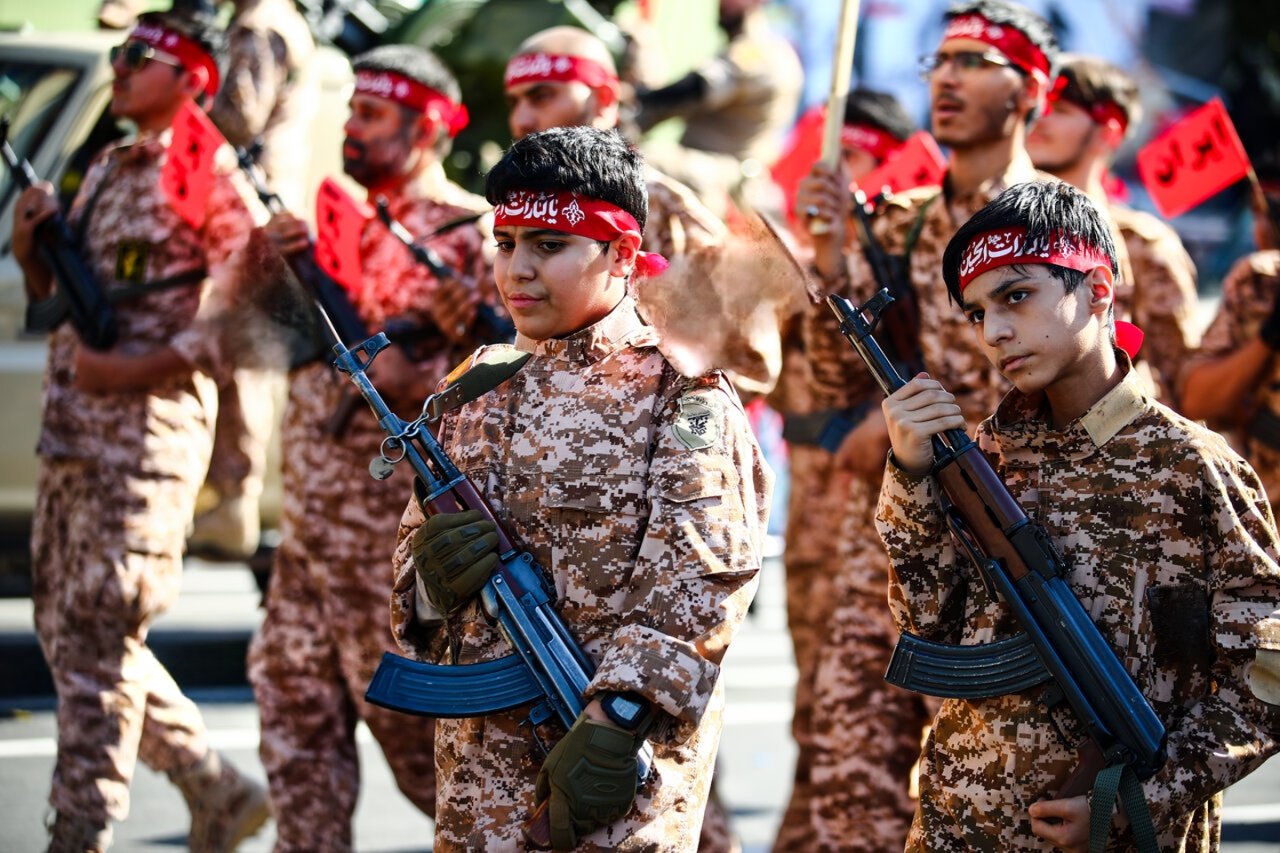
A major reason for that resilience is the structure of the Revolutionary Guard. It is not simply a military force but also a vast economic organisation. Estimates cited in the source suggest that it controls between 20 and 40 per cent of Iran’s economy, giving it access to resources that do not depend entirely on the formal state budget or civilian government decisions.
Aydin Akhavan, a political economist and Iran researcher in Istanbul, describes the Revolutionary Guard as “a huge, opaque conglomerate with an army”. He contrasts its decision-making structure with that of the US military, whose budgets require congressional approval. “With the Revolutionary Guard it is much faster,” he told Die Zeit. “As soon as it wants to implement a project, that project becomes the country’s highest priority, and all state institutions are aligned towards it.”
The organisation’s economic strength has also been shaped by sanctions. Since their substantial intensification around 2010, the Revolutionary Guard has become a central actor in circumventing US, European and international restrictions. As Iran became increasingly isolated from international financial and trading systems, networks capable of selling oil, importing goods and moving money through indirect channels became more important. The Revolutionary Guard consequently became larger and more independent, while resources could be directed towards military priorities even as the civilian economy deteriorated.
The political consequences are now increasingly significant. Akhavan argues that under Ali Khamenei, political, economic, intelligence and military institutions ultimately answered to a final authority. “During Ayatollah Khamenei’s lifetime, he was the final authority,” he said. “The current, invisible leader does not have this authority. Therefore these institutions are increasingly acting independently of one another and, in some cases, even against one another.”
That fragmentation complicates any decision to end the war. Pragmatists want to preserve the system through an accommodation with Washington, while harder-line forces regard continued resistance to the United States and Israel as central to the Islamic Republic. Any agreement would also have to be presented to their supporters as a victory. The result is a political system under mounting economic pressure in which the military apparatus retains enough autonomy and resources to keep fighting, even as the civilian economy continues to deteriorate.