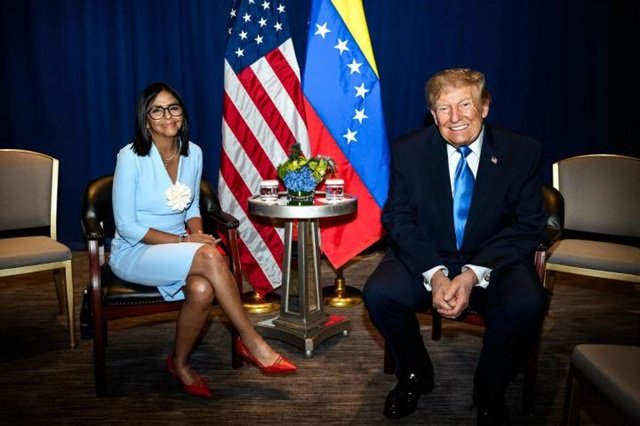
US President Donald Trump and Venezuelan President Delcy Rodríguez met in New York on Tuesday on the margins of the United Nations General Assembly, in a meeting confirmed by the White House that marked a significant change in relations between the two countries after almost three decades of hostility.
The meeting, held at the Lotte New York Palace during a reception hosted by Trump for foreign leaders, was the first formal encounter between a US president and a Chavista leader since then-President Bill Clinton met Hugo Chávez, who was president-elect of Venezuela, in 1999. It also followed a brief conversation between Barack Obama and Nicolás Maduro during a 2015 summit in Panama City. The meeting was held behind closed doors and without press access.
Trump and Rodríguez were joined by senior US officials including Secretary of State Marco Rubio, Treasury Secretary Scott Bessent, White House chief of staff Susie Wiles and deputy chief of staff Stephen Miller. The encounter came as Rodríguez, who previously served as Maduro’s vice-president, adopted a markedly conciliatory tone towards Washington during her visit to New York.
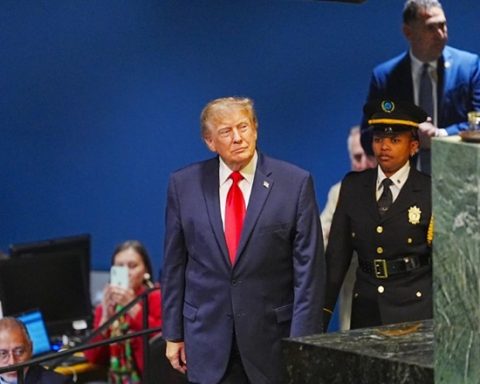
On arriving at the United States, Rodríguez said she had come “standing, walking, head held high”. At the United Nations, however, she sat through a speech in which Trump highlighted what he described as a “massive” military operation to stop Nicolás Maduro, whom he called an “outlaw dictator and genuine criminal”. Maduro was being held at a prison in Brooklyn, around 20 minutes by car from the location where Trump spoke, following his forced removal from power on 3 January, according to the source.
Trump also highlighted an agreement announced in September that would give the United States privileged access to more than 20% of Venezuela’s oil reserves. “If we add the United States and Venezuela, we have more than 60% of the world’s oil. So it is perhaps the biggest deal. It was a war, but it is perhaps the biggest deal ever made. To the victor belong the spoils,” Trump said.
The meeting took place at the same United Nations headquarters where Chávez delivered one of his most famous attacks on Washington in 2006. After George W. Bush addressed the General Assembly, Chávez said: “Yesterday the devil was here, in this very place, and it still smells of sulphur.” The remark became closely associated with the confrontational relationship between the Venezuelan government and the United States.
Maduro, who succeeded Chávez after his death in 2013, maintained the hostile rhetoric towards Washington, including during Trump’s first presidency. Rodríguez herself used similarly forceful language in a 2019 address to the United Nations. She described US sanctions as a form of “state terrorism” that used banks and insurers rather than bombs, accused Trump of extending his “imperial claws” towards Cuba and called on Washington to show less arrogance and greater tolerance towards free nations.
Her message in New York this week was markedly different. Writing after her arrival, Rodríguez said Venezuela had come with “the firmness and hope of a people that believes in encounter and unity among nations”. She said Venezuela would participate in the 81st UN General Assembly with an agenda based on “respect, cooperation and understanding”, adding that the country supported “peace, dialogue and the construction of common paths”.