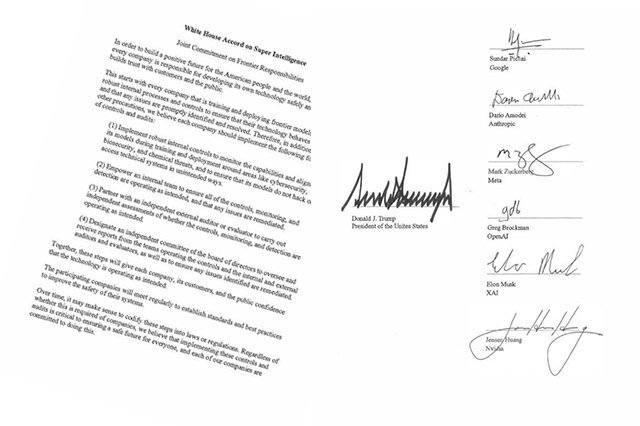
Google chief executive Sundar Pichai and other technology leaders have signed the White House Accord on Super Intelligence, committing participating companies to a four-layer framework of internal controls, monitoring, independent evaluation and board oversight for frontier artificial intelligence systems. The agreement was signed after Pichai met with US President Donald Trump, Vice-President JD Vance, House Speaker Mike Johnson and other administration and technology leaders.
Pichai announced the agreement in a statement, describing the meeting as an “important conversation” and saying that the White House Accord and Joint Commitment on Frontier Responsibilities provided a basis for moving forward. He said Google had invested “hundreds of billions” of dollars over the previous two years across the entire technology stack, with more investment to come, while seeking to develop products that deliver value for people and businesses, invest in local communities and build confidence in AI.
The accord places responsibility for the safe development of frontier models primarily on the companies building and deploying them. It states that every company has a responsibility to develop its technology safely and in a manner that builds trust with customers and the public. Companies training and deploying frontier models are expected to maintain robust internal processes and controls to ensure that their systems behave as intended and that problems are identified and resolved promptly.
The first of the four proposed layers requires companies to implement internal controls that monitor the capabilities and alignment of their models during both training and deployment. The framework specifically identifies cybersecurity, biosecurity and chemical threats as areas requiring monitoring. It also calls for controls to ensure that AI systems do not hack into or gain access to technical systems in unintended ways.
The second layer requires companies to empower an internal team responsible for ensuring that controls, monitoring and detection systems operate as intended. That team would also be responsible for ensuring that problems identified through the process are remediated. The arrangement therefore combines technical monitoring with an internal mechanism for responding to failures or potential risks.
The third layer introduces independent external scrutiny. Participating companies are expected to partner with an independent external auditor or evaluator to assess whether their controls, monitoring and detection systems are functioning properly. The fourth layer moves oversight to the corporate boardroom. Each participating company is expected to designate an independent committee of its board of directors to oversee the safety framework, receive reports from internal and external auditors and evaluators, and ensure that identified problems are addressed.
Pichai said Google was already pursuing measures including testing, evaluations, red-teaming and other safeguards against misuse and misalignment. He said the company would release models or products only after they had been thoroughly reviewed. “Industry also has to innovate responsibly,” Pichai said, adding that Google was committed to working with other technology companies to establish common norms and build public confidence.
The agreement also establishes a mechanism for continued cooperation among participating companies. They will meet regularly to develop standards and best practices intended to improve the safety of their systems. The document does not make the framework a permanent substitute for government regulation. Instead, it explicitly leaves open the possibility that the measures could eventually become legally binding.
“Over time, it may make sense to codify these steps into laws or regulations,” the accord states. Its signatories nevertheless say that the controls and audits should be implemented even if governments do not make them compulsory, describing them as critical to ensuring “a safe future for everyone”.
Pichai said the White House Accord and Joint Commitment on Frontier Responsibilities contained “real tangible steps to promote safe development, while delivering the economic and scientific benefits of this technology”. The document’s framework places the immediate responsibility for monitoring frontier AI systems within the companies developing them, while adding independent assessment and board-level oversight to the process.
Full text of the signed document:
White House Accord on Super Intelligence
Joint Commitment on Frontier Responsibilities
In order to build a positive future for the American people and the world, we believe every company is responsible for developing its own technology safely and in a way that builds trust with customers and the public.
This starts with every company that is training and deploying frontier models having robust internal processes and controls to ensure that their technology behaves as intended and that any issues are promptly identified and resolved. Therefore, in addition to any other precautions, we believe each company should implement the following four layers of controls and audits:
(1) Implement robust internal controls to monitor the capabilities and alignment of its models during training and deployment around areas like cybersecurity, biosecurity, and chemical threats, and to ensure that its models do not hack or access technical systems in unintended ways.
(2) Empower an internal team to ensure all of the controls, monitoring, and detection are operating as intended, and that any issues are remediated.
(3) Partner with an independent external auditor or evaluator to carry out independent assessments of whether the controls, monitoring, and detection are operating as intended.
(4) Designate an independent committee of the board of directors to oversee and receive reports from the teams operating the controls and the internal and external auditors and evaluators, as well as to ensure any issues identified are remediated.
Together, these steps will give each company, its customers, and the public confidence that the technology is operating as intended.
The participating companies will meet regularly to establish standards and best practices to improve the safety of their systems.
Over time, it may make sense to codify these steps into laws or regulations. Regardless of whether this is required of companies, we believe that implementing these controls and audits is critical to ensuring a safe future for everyone, and each of our companies are committed to doing this.