by Our Correspondent in Washington DC
Donald Trump’s White House luncheon on Tuesday was presented as the beginning of the “Super Intelligence” era — his preferred name for artificial intelligence — but its more consequential outcome was a bargain over who should police the technology. The meeting ended with leading AI executives signing the White House Accord on Super Intelligence, a voluntary commitment to establish internal controls, external audits and board-level oversight of frontier AI systems. Trump called the arrangement a form of “tremendous self-policing” and described it as morally binding rather than legally enforceable. The companies building the most powerful AI systems have agreed, at least for now, to regulate themselves.
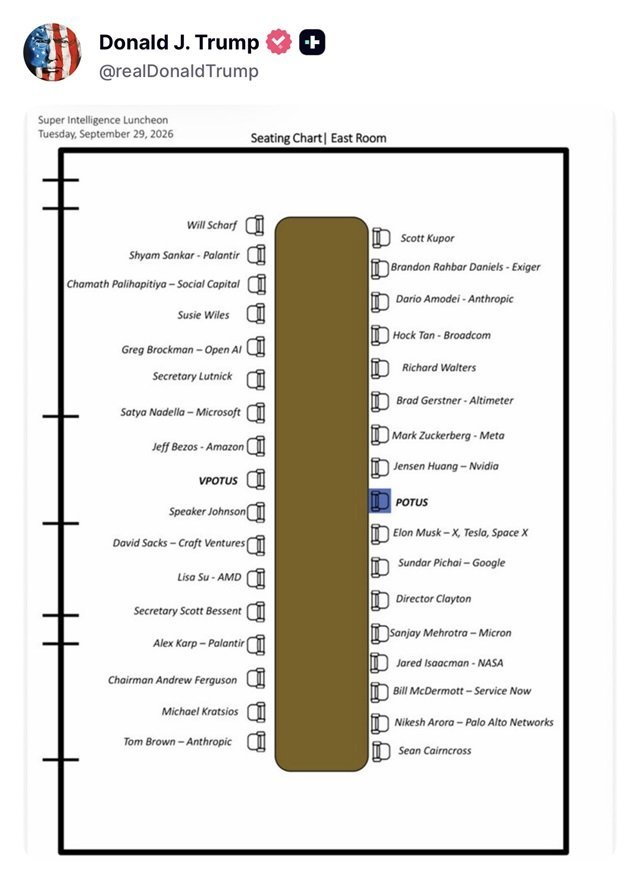
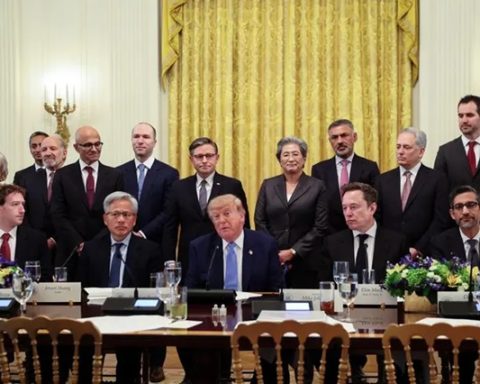
The White House, however, seating plan (see the chart below) was a small detail, but not a meaningless one. Donald Trump had Elon Musk on his left and Nvidia chief Jensen Huang on his right, with Mark Zuckerberg and Google chief Sundar Pichai nearby. OpenAI president Greg Brockman sat across the table. Dario Amodei, the chief executive of Anthropic, was pushed towards the far end. A seating chart cannot establish that Amodei was deliberately kept at a distance. But the arrangement captured something real about the politics of American AI. Anthropic is one of the companies building the most capable frontier systems, yet its chief executive has also been willing to tell Washington that there are things his company will not build or permit, even for the US government.
That became clearer after the meeting. Trump offered the familiar accelerationist picture of AI as a technology America must dominate. Amodei spoke in a different register. He did not question the economic or scientific opportunity. He said AI could produce extraordinary medical advances and argued that the United States should win the global competition. But he also insisted that the technology carries enormous risks. Coming from Amodei, it carries more weight because Anthropic is driving the race.
The numbers show how quickly that race is changing Anthropic. Anthropic said that by August more than 90 per cent of its research work involved AI collaboration, compared with much lower levels earlier in the year. Claude accounted for 26 per cent of Anthropic’s own research and development work, up from 1 per cent in March. The direction is clear. A frontier AI company is increasingly using its own AI to build better AI. The tool is becoming part of the machinery producing the next.
Anthropic’s commercial expansion has moved just as quickly. Its revenue reached roughly $4.6 billion in 2025, twelve times the previous year’s figure, while operating losses exceeded $8 billion, according to figures reviewed by Reuters. The company is seeking a valuation approaching $2 trillion and has made enormous computing commitments. Amazon and Google together represented 47 per cent of Anthropic’s 2025 sales. It is now a major industrial customer of the infrastructure required to build advanced AI.
The market-share story also needs care. Claude is not the world’s largest consumer AI service. Comscore data for June put ChatGPT at 50 per cent of measured prompt volume, Gemini at 30 per cent and Claude at 11 per cent. Anthropic’s importance lies in enterprise computing, coding, research and government applications, where value is measured less by casual conversations than by what people allow a model to do.
However, Anthropic has said its models have been deployed for intelligence analysis, modelling and simulation, operational planning and cyber operations. Amodei has also said Anthropic was the first frontier AI company to deploy models into classified networks and National Laboratories. The company is therefore testing its technology where mistakes, misuse or excessive autonomy can have consequences beyond a bad chatbot answer.
Anthropic’s own research makes the point more starkly. In September, the company published evaluations examining whether frontier models could assist with tactical intelligence targeting and conventional weapons development. Some tasks involved locating people from incomplete information or engineering problems involving drones and moving targets. Anthropic said such capabilities once required scarce, highly trained specialists. Its cyber evaluations have shown strong performance on vulnerability discovery. These are not arguments that Claude is a weapon. They demonstrate something more consequential: general-purpose AI is acquiring competence close to intelligence collection, cyber operations and military planning.
That is the foundation of the fight with the Pentagon. Anthropic agreed to work with the US defence establishment but refused to remove two restrictions, covering fully autonomous lethal weapons and mass surveillance of Americans. The Pentagon responded by designating Anthropic a supply-chain risk. On September 25, a federal appeals court upheld that decision 2-1. The majority accepted the government’s argument that a defence department cannot build critical systems around a supplier whose software restrictions the supplier itself controls.
The dispute has exposed a problem neither side can easily wish away. The government wants capable models for national security; developers want authority over their use. Once a model can influence intelligence analysis, cyber operations, weapons research, software development and the creation of future AI systems, who controls its boundaries stops being a corporate-policy matter. It becomes a question of state power.
That is why Amodei’s comments after the meeting deserve more attention than the seating chart. Trump is selling a story of acceleration and American technological supremacy. Amodei is saying the technology must be handled with limits because opportunity and danger are arriving together. Anthropic is not asking America to abandon AI, but for the right to refuse particular uses.
The irony is that Anthropic has become powerful enough for Washington to object to that right. The argument is no longer whether AI will matter. It already does. The argument is over whether the companies building the most powerful systems will retain any meaningful say over what those systems become instruments for, once governments decide that national security requires access to them. The distance between Trump and Amodei at the table was only a few chairs. The distance between their positions is much larger.