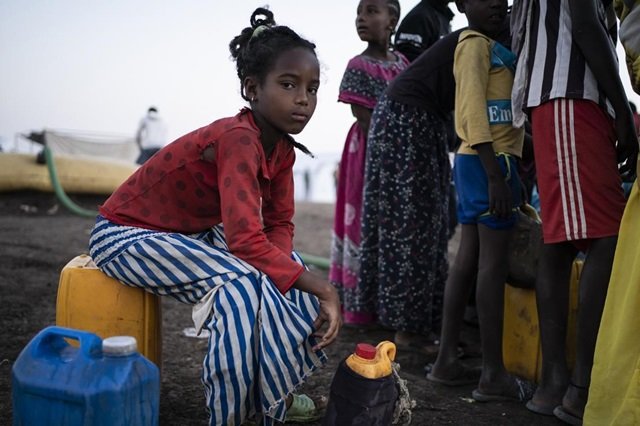
In Moroni, the capital of the Comoros, access to water has become a daily struggle for residents who increasingly depend on private sellers, long queues and costly deliveries as the city’s ageing supply network fails to meet demand.
At Garage Mrikawi, north of the capital, a public square is largely deserted. Ibrahim, who lives nearby with his wife and two children, says there is not even a public tap in the neighbourhood. Each evening after work, he collects water containers and leaves Moroni to find supplies, returning around 9pm. He said buses selling water had not visited the area for five days.
“Everyone knows there is no water. Even if we raise our voices, nothing will change. On the contrary, they will come and arrest us. So there is no point speaking,” Ibrahim told journalists, adding that the crisis was worsening. His account reflects the dependence on informal water distribution that has developed in parts of the capital.
According to a 2023 survey published by Comoros’ National Institute of Statistics and UNICEF, 34.1 per cent of Moroni residents depend on public sources, while 75.3 per cent of those collecting water take more than 30 minutes to reach their supply point. In rural areas, 29.6 per cent of households collect rainwater to meet their needs. The pressure is particularly significant in a country where the minimum wage is around €100.
Residents in several parts of Moroni describe increasingly long periods without running water. One resident of Irugundjani said his home had been without running water for almost two months, forcing his uncle to leave at 1am to queue at a public source in a neighbouring district. Another resident said taps that previously supplied water for a few minutes at around 5am had remained dry for weeks, leaving him to buy 200 litres every 10 days.
Private water sellers have become key suppliers to the capital. Their association says it has 390 members operating 120 water tankers and 270 buses. In Sahara, north of Moroni, residents depend heavily on private tankers. Papa Nawad, a 60-year-old builder, said obtaining water required knowing a tanker driver and waiting at least three days after making contact.
The shortages are also affecting businesses. A hotel manager said that in neighbourhoods with taps, some have been dry for six years, forcing hotels to stop tanker trucks in the street and pay more to secure deliveries. Water costs the hotel about €2,200 a month, making it its largest expense after wages. In the south of the capital, Mariam, a telecommunications executive, said she had been buying water from resellers for three years. She purchases 400 litres every three days and spends about €120 a month on water.
The situation has been attributed partly to the condition of the public infrastructure. At a press conference in early September, Sonede, the national company responsible for water supply and distribution, said the network was 40 years old and losing almost 60 per cent of its flow through leaks, particularly because of blocked and corroded valves that need replacement.
Sonede director Najda Said Abdallah said Moroni is supplied by three pumping stations producing almost 15,000 cubic metres a day. A Sonede technician warned that the capital would continue to face shortages without a complete renewal of the network.
Storage capacity is another constraint, Said Abdallah said, as the population has more than doubled. Sonede plans to build 5,000-cubic-metre reservoirs with support from a World Bank-funded project worth $20 million. The director, who was appointed on 21 May, said the investment would accompany rehabilitation of the existing network.
The Comoros consists of three islands — Grande Comore, Anjouan and Mohéli — covering only 2,612 square kilometres, with no location more than seven kilometres from the sea. Coastal communities therefore depend on groundwater sources that are rarely fresh and remain vulnerable to climate change.
International funding is supporting efforts to improve resilience. The Green Climate Fund and UNDP are providing $61 million for the ER2C project, launched in 2019 with the aim of increasing national access to water from 15 per cent to 60 per cent by next year. ER2C reported that access reached 48 per cent in 2025, calling the figure a turning point for thousands of families.
But Moudjib Mohamed Saïd, president of the social and environmental NGO Ngo’shawo, disputes the figure. “I’m not a statistician, but that figure is incorrect,” he said, arguing that the reality observed by NGOs in affected communities did not match the reported level of access. The account was published by El País as part of its reporting on the water crisis in the Comoros.