For two months this summer, Iraqi investigators dug beneath the ground around Baidischi, a small town three hours north of Baghdad, searching for what they believed was the proceeds of a vast corruption operation. At depths of up to four metres, they broke through cement-sealed tunnels and found plastic bags packed with cash, gold bars and large containers normally used for pickling vegetables. The haul amounted to more than $100 million and 375 kilograms of gold.
The target was Adnan al-Jumaili, a former refinery official who had risen rapidly to become deputy oil minister before his arrest at the end of May. Iraqi television repeatedly showed him in chains and a yellow prison uniform, surrounded by a large weapons cache, while footage of investigators recovering sacks of money and gold was broadcast across the country. The operation was intended to demonstrate that Prime Minister Ali al-Zaidi, a businessman and previously little-known compromise candidate of the governing Shia alliance, was prepared to confront corruption. Several MPs, senior officials and numerous associates of the main suspect were also arrested.
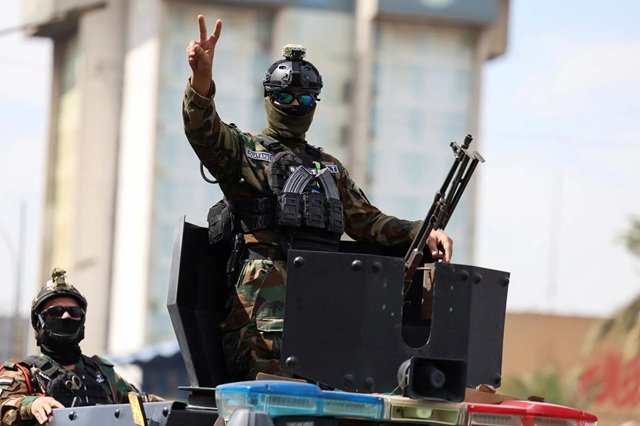
The campaign came at a politically significant moment. By 30 September, the last US military units had left Iraq after 23 years. The withdrawal was accompanied by a demand from US President Donald Trump that the country’s Shia militias surrender their weapons and come under government authority. Among those groups are thousands of fighters who continue to take orders from Tehran, operate what amounts to a mini-state on an area of more than 50 square kilometres south of Baghdad, and whose leaders have remained beyond the effective reach of Iraqi justice.
The deadline passed without the militias disarming. As US transport aircraft departed the last American base in Erbil in late September, Prime Minister Zaidi announced a new deadline of 30 June 2027. Militarily, the American departure was less dramatic than the symbolism suggested: only a few thousand US personnel remained, mainly providing training and air support. Politically, however, the withdrawal removed a counterweight to Iranian influence.
The crisis reflects three problems that have become closely connected: corruption, the power of armed groups outside effective state control and the legacy of the US-designed political system established after Saddam Hussein was overthrown in 2003. The Americans removed the dictator within weeks but never fully controlled the country. At the end of 2007, US troop numbers reached 172,000, yet years of civil war followed. Most American ground forces left in 2011, while Washington retained bases and later assisted Iraq in defeating Islamic State, which controlled about a third of the country in 2014.
The political system created after Saddam’s fall was based on communal allocation, or “Muhasasa”. The presidency went to a Kurd, the premiership to a Shia and the speakership of parliament to a Sunni, with similar arrangements extending through the administration. It was intended to prevent another dictatorship and provide stability. Instead, according to the account published by Der Spiegel, it became a system in which parties compete for ministries, senior posts, licences and state contracts, using government institutions to sustain political networks. Manipulated tenders, fictitious employees and other mechanisms have helped turn public resources into political patronage.
The scale of alleged losses is immense. Cases have included $2.5 billion disappearing from tax authority accounts and $1 billion from the defence budget. Hundreds of billions of dollars are believed to have gone missing since 2003, while investigations frequently fail to reach those at the top.
Former prime minister Haider al-Abadi told the SPIEGEL team in Baghdad that this was precisely why confronting corruption was so difficult. “Of course I am against corruption. But you are not fighting a mafia here, you are fighting the system. You cannot arrest everyone.” He also questioned whether Jumaili had acted alone: “Who put Jumaili in office? Did he act alone, or was he only a tool?”
Jumaili’s rise has intensified those suspicions. Former refinery employees and people close to investigators described him as a “Simmitsch” — a small fish — who allegedly advanced by serving more powerful political interests. He had worked as a warehouse manager and accountant at the Baidischi refinery before cultivating relationships with officials and organising political campaigns. A relative, Abu Haschim, said Jumaili was subsequently appointed head of the refinery and then deputy oil minister in his mid-30s. Former employees and investigators’ confidants allege that he helped organise fictitious construction, procurement and renovation projects and payments to phantom employees.
The allegations have also exposed the overlap between corruption and militia power. Kazem al-Fartousi, spokesman for the pro-Iranian militia Kataib Sajjid al-Schuhada, rejected any attempt to link disarmament with corruption. “We are absolutely against combining the fight against corruption and our disarmament,” he told Der Spiegel. His group, which the US designated a terrorist organisation in 2023, says it will surrender its weapons “once Iraq is truly sovereign”. Fartousi argued that US, Saudi and Israeli attacks, Turkish and Kurdish PKK bases, and continued US control over Iraqi oil-export revenues mean that sovereignty has not been achieved.
At the same time, Iraq’s economic vulnerability is deepening. More than 95 per cent of export revenue comes from oil, while the country has neither diversified its economy nor established the promised sovereign wealth fund. Since the war blocked tanker traffic through the Strait of Hormuz, Iraqi oil exports have fallen by about half. Inflation is rising and imported consumer goods are becoming more expensive. Western diplomats say the central bank has been drawing on foreign-currency reserves to meet the salaries of a state apparatus swollen to as many as six million employees, including large sections of the militias.
In Baghdad’s Shorja market, traders reported a dramatic collapse in business. One fan seller estimated that customers had fallen by 70 per cent; a shoe-shop owner put the decline at 90 per cent. Customs duties and transport costs had nearly doubled while consumers had less money to spend. For Iraq’s new government, the corruption arrests may have offered a visible demonstration of action. But the unresolved question is whether the campaign can move beyond figures such as Jumaili while the political system that produced his rapid rise remains intact. As the tribal leader of Jumaili’s home district put it after his own brief detention: “It simply stopped. No one has been arrested for weeks. Why? No idea.”