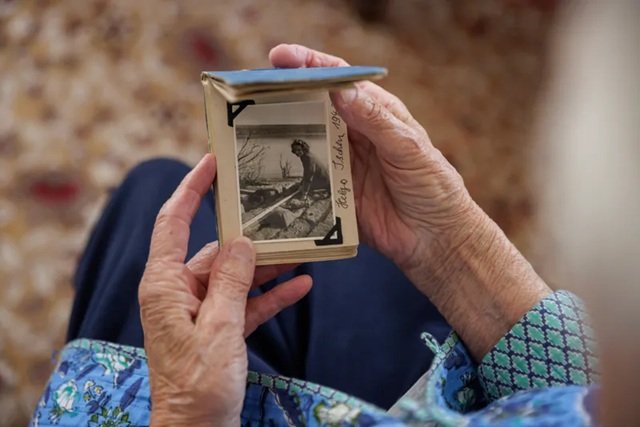
At 98, Renate Seifert still keeps a photograph of herself in the uniform of the League of German Girls, the Nazi organisation for girls aged 14 to 18. Taken in 1944, when she was 15, the image shows a neatly dressed teenager with dark-blonde hair and a solemn expression. Its edges are scorched, a reminder of an incendiary bomb that penetrated her family home in Berlin during the Allied air raids. For Seifert, the photograph captures the contradiction of her childhood: the attraction of belonging to a powerful movement and the destruction brought by the regime that shaped her generation.
Seifert’s experience is among those examined by German magazine Der Spiegel in an account of children raised within Nazi Germany’s militarised youth organisations. Through the recollections of Seifert and 94-year-old Lutz Rackow, the report explores how propaganda reached into family life, cultivated loyalty to Adolf Hitler and prepared young people for persecution and war. Their stories also raise a difficult question: when children are manipulated by a murderous dictatorship, where does victimhood end and personal responsibility begin?
Seifert grew up in a house built by her parents in Berlin-Altglienicke in 1934. Her father, a municipal official, belonged to the Nazi Party and supported the regime. A radio receiver known as the Volksempfänger stood in the family living room, carrying the speeches and propaganda that helped shape public opinion. Seifert remembers the excitement generated by Germany’s early military victories and the broadcasts of propaganda minister Joseph Goebbels. As a child, she says, she could not understand the political purposes behind the enthusiasm surrounding her.
The Nazi leadership had recognised the importance of young people well before the outbreak of the Second World War. Following Adolf Hitler’s failed coup attempt in 1923, the party increasingly pursued power through political organisation and mass mobilisation. The Hitler Youth was established in 1926 for boys aged 14 and above, while the League of German Girls followed in 1930. After the Nazis seized power in 1933, competing youth organisations were progressively banned, leaving the regime’s own structures with little legal competition.
Younger boys joined the German Young Folk and girls the Young Girls’ League from the age of ten. The organisations offered sport, camping, music, outdoor activities and a strong sense of collective identity. Their appeal was reinforced by a hierarchy in which children and teenagers exercised authority over younger members. The result was a system that made obedience, competition and military discipline part of everyday social life.
The regime eventually removed much of the remaining choice. The 1936 Hitler Youth Law and the introduction of compulsory youth service in 1939 helped drive membership sharply upwards. The Hitler Youth grew from around 100,000 members in 1932 to 8.7 million in 1939. Many young people joined because they were attracted by the activities and camaraderie; others feared exclusion. Some were swept up by the cult surrounding Hitler, whose appearances could provoke intense emotional reactions among young supporters.
Rackow’s childhood illustrates how powerful that appeal could be, even in a family opposed to the Nazis. His father, an architect, privately warned friends about Hitler’s intentions and encouraged Rackow to read Mein Kampf. Yet when Rackow joined the German Young Folk in 1942, aged ten, he was captivated by marching columns, songs and sporting competitions. He recalls throwing a ball long distances and participating in military-style field games in which children competed to collect strips of material from opponents’ clothing.
The enthusiasm was not always confined to harmless displays of loyalty. Young people participated in harassment, assaults and attacks on Jewish communities. Nazi youth members vandalised Jewish cemeteries, bullied Jewish pupils, damaged businesses and took part in the destruction of synagogues and shops. During the November 1938 pogroms, members of the Hitler Youth were involved in looting and vandalism. In some cases, adults exploited children’s limited criminal liability by encouraging them to attack Jewish property.
Historian Frank Bajohr, whose 2026 research is discussed in the Der Spiegel report, challenges the tendency to portray all children under Nazism solely as victims of dictatorship. Drawing on investigation files, official reports, diaries and the testimony of Jewish victims, Bajohr argues that some young people acted independently in committing violence. The evidence does not erase the coercion and manipulation to which they were subjected, but it complicates any assumption that age alone removes responsibility.
Seifert remembers glimpses of the persecution that surrounded her. As a child, she once helped pick up apples dropped by a man wearing the compulsory Jewish star. Her parents told her never to do so again. She was also prohibited from entering a Jewish grocery shop in her neighbourhood after its windows were smashed during the November 1938 pogroms. Nobody explained why these restrictions existed. At the time, she recalls, she did not understand that she was growing up in a dictatorship.
As the war progressed, the regime increasingly sacrificed the young people it had indoctrinated. Following Germany’s defeat at Stalingrad in 1943, Nazi authorities intensified efforts to recruit teenagers for military service. Around 16,000 members of the Hitler Youth born in 1926 were drafted into the 12th SS Panzer Division, known as the Hitler Youth Division. The unit later became notorious for atrocities against civilians and prisoners of war. In the final months of the conflict, inadequately trained and ideologically conditioned teenagers were sent into a collapsing military campaign, with many killed.
Rackow avoided frontline combat and eventually distanced himself from the organisation. He secretly listened to the BBC’s German-language broadcasts on a homemade receiver, keeping notes about the worsening military situation. After Germany’s defeat, those notes helped him demonstrate to Soviet military authorities that his father had not been an unquestioning supporter of the regime. Seifert, meanwhile, remembers the hunger and deprivation that followed the war. In Bavaria in 1945, she and others scavenged discarded food, sometimes recovering scraps from a military waste pit. The experience, she says, forced her to recognise how thoroughly the regime had deceived her generation.
Both survivors now fear that political propaganda can again exploit young people’s desire for identity, belonging and purpose. Seifert has joined the German movement Omas gegen Rechts—Grandmothers Against the Far Right—to oppose hatred and warn against a return to fascism. Her concern has acquired renewed political significance following remarks in 2025 by Björn Höcke, parliamentary leader of the Alternative for Germany in Thuringia, who praised the Nazi youth slogan “Youth must be led by youth” as a successful concept for a new AfD youth organisation, without mentioning the Hitler Youth in that context.
The essential lesson of these recollections is not that every child raised under dictatorship bears the same responsibility, nor that indoctrination excuses every act. It is that propaganda becomes especially dangerous when it combines ideological conditioning with social pressure, attractive activities, unquestioning loyalty and the normalisation of cruelty. Seifert’s surviving photograph, marked by the fire that nearly destroyed her home, remains a personal record of that deception—and a warning about the consequences when a state turns childhood into an instrument of political power.