by Luxman Aravind
Rajapaksas are in trouble. As our columnist Durga Velayudham noted in yesterday’s column, a confrontation is unfolding between politically motivated Buddhist monk groups and the Janatha Vimukthi Peramuna (JVP), now the dominant force within the governing National People’s Power (NPP) coalition. Both have sought to shape the state according to their political interests, although their ideological foundations and methods differ sharply. In 2024, the NPP secured a landslide parliamentary majority after Anura Kumara Dissanayake won the presidency, receiving an unprecedented level of support from voters in the Northern and Eastern provinces as well. As this confrontation intensifies, the Rajapaksas are facing a steady erosion of their political standing. Their politics has long revolved around family power and patronage. When that structure begins to fracture, power inevitably disperses.
If Namal Rajapaksa were eventually convicted and sentenced to a lengthy prison term, and Mahinda Rajapaksa’s health deteriorated, the family would face a crisis deeper than electoral defeat. This is hypothetical, not a verdict. Allegations must be proved in court. Yet a dynasty built around a few dominant personalities has an obvious weakness. It cannot easily transfer authority to a generation that has neither the founders’ charisma nor their networks.
The Rajapaksa project was never simply a family contesting elections. It fused executive power, patronage, Sinhala-Buddhist nationalism, security politics and a story of national rescue after the military defeat of the LTTE in 2009. Mahinda became more than a president to supporters. He was presented as the leader who had restored sovereignty and ended a war. That achievement gave the family enormous political capital. It also made criticism easier to portray as disloyalty. The 18th Amendment, which removed presidential term limits and weakened constitutional checks, expressed the deeper ambition to make power personal and enduring.
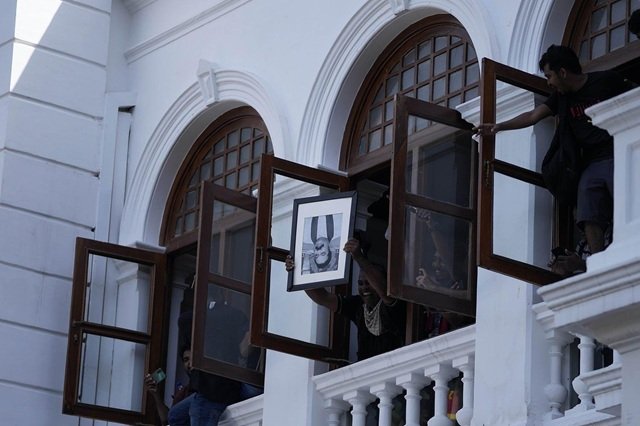
The system’s failure became unmistakable in 2022, when economic collapse drove people into the streets and forced Gotabaya Rajapaksa from office. The crisis grew from tax cuts, depleted reserves, debt exposure, policy failures and delayed corrective action, compounded by external shocks. In November 2023, the Supreme Court found that Gotabaya, Mahinda, Basil Rajapaksa and other officials had breached public trust and the constitutional guarantee of equal protection through conduct that contributed to the crisis. This was a grave constitutional finding, not a criminal conviction for every alleged act of corruption. It nevertheless destroyed the claim that the family’s record could be judged only by its wartime legacy.
Ranil Wickremesinghe’s accidental presidency exposed another weakness in Sri Lankan political culture. After Gotabaya resigned, Parliament elected Wickremesinghe with decisive support from the SLPP, the party built around the Rajapaksa family. This does not prove a secret pact or criminal complicity. But the arrangement demonstrated how established elites could change the person at the top without surrendering the networks that protected their influence. The presidency changed hands while much of the old parliamentary order remained in place. For many protesters, this looked less like democratic renewal than a rescue operation for a discredited establishment.
Anura Kumara Dissanayake’s rise changed that calculation. His presidential victory in September 2024 was followed by a parliamentary election in which the National People’s Power won 159 of 225 seats. The SLPP, once dominant in Parliament, was reduced to three. This was a rejection of inherited authority and the idea that past victories could justify power indefinitely. The Rajapaksa name, once an electoral asset, had become a burden for many voters.
Dissanayake’s government appears to be giving greater priority to dismantling the protection mechanisms that allowed political impunity to become normalised among a handful of powerful families, while simultaneously strengthening its own party machinery. The danger is that a campaign against the old order could become a new instrument of partisan power. Arrests, investigations and allegations involving Rajapaksa family members must be assessed individually. The recent detention of Shiranthi Rajapaksa over alleged misuse of charitable donations, like the reported bribery allegations involving Namal, is not proof of guilt. A state that prosecutes its enemies selectively has not ended impunity. It has merely changed its beneficiaries.
The political consequences may still be severe for the Rajapaksas. A family whose authority depended on loyalty, access to state resources and a carefully managed image of strength can be weakened when former allies begin to distance themselves, cooperate with investigators or protect their own interests. Such shifts are politically significant, but claims that insiders have become state witnesses should be treated as established fact only when supported by court records or reliable reporting.
Dissanayake has crossed a political Rubicon, as attorney-at-law Saliya Peiris has argued, if the government is now prepared to pursue cases that previous administrations allowed to stagnate. Yet the Rubicon is not crossed merely by arresting prominent people. It is crossed when evidence is disclosed, cases proceed without interference, prosecutors remain independent and judgments are respected even when they are inconvenient. The test is not how many Rajapaksas face investigation. It is whether the law can reach powerful people without becoming a weapon in the hands of whoever governs.
Nor should Sri Lanka mistake the Rajapaksas’ decline for the disappearance of Rajapaksa-era politics. Majoritarian mobilisation, patronage, personality cults, political dynasties and the use of national security to silence scrutiny did not begin with one family. Other parties have practised versions of the same politics. A post-Rajapaksa future requires more than a new leadership group. It requires institutions that can withstand pressure, transparent public spending, credible procurement, independent policing, a free press and equal citizenship across ethnic and religious lines.
The family may eventually rebrand. It may promote younger faces, distance itself from unpopular decisions and revive the language of patriotism, stability and economic recovery. But branding cannot erase lived experience. People remember queues, shortages, lost savings, family members leaving the country and the humiliating discovery that the state could not provide essentials. Still, a return to national dominance in the near future looks difficult. Recovery, if it comes, may take years. It may take decades. No political decline is irreversible, but nostalgia alone cannot rebuild trust.
Sri Lanka is approaching a post-Rajapaksa moment, not yet a post-Rajapaksa system. The distinction matters. A family can lose office while the political habits that sustained it survive under different names. Dissanayake’s challenge is to turn public anger into durable rules rather than a cycle of punishment and revenge. The opposition must offer more than restoration. Citizens must not treat one leader as a saviour after rejecting another. Democracy matures when no family, party or president can claim ownership of the state.
The Rajapaksas are not finished because history has declared them villains. They are vulnerable because the conditions that once made them appear indispensable have collapsed. Whether Sri Lanka is ready for what comes after them will depend on whether accountability becomes ordinary, power becomes limited and political defeat becomes survivable without communal scapegoating or manufactured enemies. The final question is not whether the family can return. It is whether the country can stop reproducing the system that made its return possible.
The old order is falling. Whether the country builds something better from its ruins remains unresolved. For now, the soundtrack is Adele’s “Skyfall”.