by Durga Velayudham
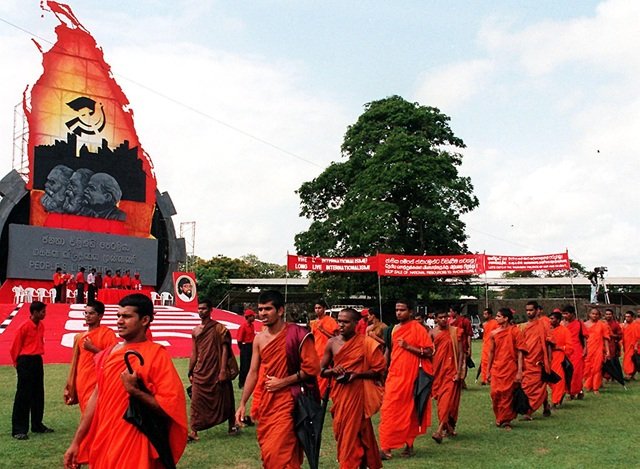
Monks have begun marching from Kandy towards Colombo, where they are expected to arrive on October 15. The question is not simply why they are marching, but why Sri Lanka has waited so long for a confrontation between two forces that have obstructed political renewal: the JVP and politically influential sections of the Buddhist monastic establishment. Both have helped damage public life. Their conflict may be dangerous, but it may also be necessary. The country needs this reckoning, provided it is settled through law rather than intimidation.
The immediate dispute concerns Galagoda Aththe Gnanasara Thera’s treatment in prison and demands for his release or pardon. Supporters argue that removing a monk’s robes insults the Sangha. Yet a robe cannot erase a conviction, and religious standing cannot create a separate law for influential figures. Equally, imprisonment must not excuse degrading treatment or selective punishment. The government must apply consistent rules and protect due process, not yield to a crowd or settle scores. The question is whether any institution can demand exemption from scrutiny.
For decades, the JVP presented itself as the enemy of a corrupt order. Yet its record includes insurrection, coercive mobilisation and confrontational politics that contributed to national trauma and weakened democratic life. This history cannot be dismissed because the party now governs. Protest and strikes can defend rights; they can also become instruments for accumulating power while treating institutions as obstacles. A movement does not become constructive simply by winning an election. It must prove it can govern without reproducing the destructive habits through which it once sought to transform the state.
The National People’s Power brought the JVP’s project to office under a broader electoral identity. That gave the party a vehicle to present itself as a national alternative beyond its own history. Now the NPP’s promise faces its hardest test: can it become more than a public label for an organisation whose old instincts still shape its conduct? Palawatta, the JVP’s headquarters, is viewed by critics as a decisive source of influence over the government. If public institutions become extensions of party organisation, Sri Lanka will have changed personnel and slogans while preserving the old logic of control.
The JVP is trying to present itself as constructive after decades in which its political behaviour often made the state less governable. That transformation is possible, but speeches about clean government cannot prove it. Transparent appointments, independent institutions, fair procurement, accountability for abuses and limits on party power can. The party cannot ask the public to judge it by new promises while forgetting the methods and consequences of its past. If it wants to build a new political order, it must stop treating its organisation as the measure of the state.
The monastic political establishment faces a different but equally serious reckoning. Some influential monks have used religious prestige to mobilise nationalism, pressure governments and shape political agendas. Their authority differs from an elected mandate, yet it can exert influence. When used to shield individuals from legal accountability or obstruct reforms that challenge privilege, it becomes a force against democratic renewal. A monk who intervenes in state affairs cannot reasonably insist that his own conduct remain beyond public examination.
This criticism is not directed at Buddhism, the Sangha as a whole, or monks who sincerely practise and teach the Dhamma. Precisely because religious life has ethical significance, its political exploitation deserves scrutiny. A temple should offer space to examine greed, hatred and delusion, not become a stage where political ambition is dressed as patriotism. The robe should not function as protective clothing for public influence. When religious prestige becomes political capital, spiritual authority is reduced to a bargaining instrument and the wider institution’s credibility is endangered.
The confrontation brings two destructive forces into collision. The JVP’s history does not excuse political monks from accountability; their influence does not absolve the JVP of its record. Each may claim to defend the nation against the other, but neither can claim its conduct has been harmless. One is fighting to preserve influence that reform may threaten; the other is trying to establish itself as constructive after a long history of destructive political practice. The question is whether either can change, or whether both will use the conflict to protect power.
A Sinhala saying captures the spectacle: “ගලේ පැහැරූ බළලුන් මෙන්”—like cats that have fouled a rock. Each has dirtied the ground beneath it, then turns against the other, trying to escape blame or cover the mess. The rock is Sri Lanka: its institutions, social trust, economy and shared common future. Neither cat can clean it by pointing at the other’s waste. It describes powerful actors who damage public life and then present themselves as its only rescuers.
The confrontation should not be mistaken for reform itself. Conflict can expose entrenched interests, but it can also harden them. Gramsci’s description of an interregnum, when the old order is dying and the new struggles to be born, fits Sri Lanka’s predicament. A change of government is not a change of political culture. Patronage, selective accountability, institutional dependence and the treatment of public office as partisan property can survive a new mandate. The test is not whether the old order is criticised, but whether the structures sustaining it are changed.
Slavoj Žižek helps explain why people remain attached to political ideals even when organisations claiming to represent them betray those ideals. Supporters may begin by defending justice, national identity or religious tradition, then defend the party or institution itself, treating criticism as an attack on the ideal. This helps explain the loyalty that movements and establishments retain despite visible contradictions. The JVP’s promise of clean government must not be confused with its interests; devotion to Buddhism must not be confused with unquestioning support for monks pursuing political power. Ideals need protection from those who exploit them.
The practical test is material, not theatrical. Who receives appointments? How are contracts awarded? Are public funds and institutional finances transparent? Can journalists, courts and citizens scrutinise powerful figures without intimidation? Are reforms designed to strengthen the state or make it obedient to the party in office? These questions matter more than slogans about revolution, patriotism or religious dignity. If the JVP builds new networks of loyalty around state resources, it will replace one patronage system with another. If monks use their status to preserve privilege or frustrate accountability, they defend influence rather than spiritual principle.
Sri Lanka needs this confrontation, though it has come far too late. Political leaders have treated organised religious influence as something to bargain with rather than examine; religious figures have intervened in public affairs without always facing the scrutiny expected of other power brokers. The JVP could condemn the old establishment without proving it could govern better. Now the two confront each other in public. This creates an opening to clarify the boundaries between elected authority, religious freedom and the rule of law.
But confrontation is useful only if it leads somewhere. If the government capitulates because the robe is invoked, it teaches pressure groups that religious status can overrule legal process. If it responds vindictively, reform will look like another excuse to use state power against opponents. Monks must be free to protest, but their demands are not automatically just. The government must enforce the law, but enforcement must not be selective or humiliating. Both sides must accept the same principles they demand from others.
The danger is that the fight ends in a bargain rather than reform. If the JVP loses power, old political networks may return, while some who promised renewal quietly seek accommodation with the system they denounced, now with new alliances and ambitions. If the JVP prevails without changing its habits, it may create a new centre of control instead of an accountable state. If both sides treat defeat as intolerable, institutions may weaken further and instability deepen. Ordinary people will pay through economic uncertainty, lost trust and another diversion from rebuilding the country.
Sri Lanka does not need one force to defeat the other so it can rule without restraint. It needs both to lose the power to obstruct reform or escape accountability. The JVP must build institutions rather than command them. Politically influential monks must accept that religious prestige confers no veto over courts, legislation or public scrutiny. Citizens must not mistake a battle between powerful actors for national rescue.
The rock belongs to the people, not to the cats fighting over it. Sri Lanka may perish if this confrontation becomes another contest for dominance. It may begin to be reborn if the struggle establishes that no party, religious establishment or public figure stands above the law. The opportunity is real, but not guaranteed. The cats have started fighting; the country must now insist that the rock be cleaned. How? Use your brain to see beyond the pathetic propaganda designed to manipulate your thinking through social media and other channels. Question, investigate, and think for yourself. That is precisely what the Buddha taught in the Kalama Sutta: do not blindly believe; think critically and discover the truth for yourself.