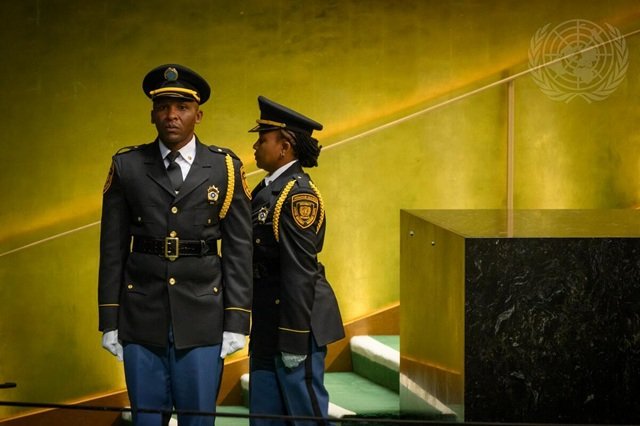
The United Nations is approaching a leadership change at a time when its effectiveness in maintaining international peace and security is under growing scrutiny. António Guterres will step down after ten years as Secretary-General, with his successor due to take office on 1 January 2027. Seven candidates are competing for the position, and the selection process is entering its final weeks without a date yet set for the Security Council’s formal vote.
The contest, detailed in an analysis by The Soufan Center, comes as the 81-year-old institution faces criticism over the gap between its founding objectives and its capacity to address current international crises. Established after the Second World War, the UN declared in the opening sentence of its Charter that its purpose was “to save succeeding generations from the scourge of war”. Its principal activities include peacemaking, protecting human rights, promoting development and upholding international law. Yet wars in Ukraine, Iran and Gaza continue, while severe humanitarian crises persist in Gaza, Sudan, Yemen and elsewhere. Climate change, artificial intelligence, displacement and rising geopolitical tensions add to the demands confronting the organisation.
The perceived distance between the UN’s founding mission and its present performance has prompted criticism of its “impotence” and “irrelevance”. Richard Haass, former president of the Council on Foreign Relations, described the institution’s position succinctly: “The UN reflects the world much more than leads the world.” The next Secretary-General will therefore inherit an organisation whose international standing is being reassessed both by its member states and by observers of the multilateral system.
The selection process begins with nominations by one or more UN member countries. Candidates must submit a vision statement outlining their priorities. Before the formal decision, the Security Council conducts a series of anonymous, closed-door straw polls in which its 15 members indicate whether they “encourage”, “discourage” or have “no opinion” on each contender. The formal vote requires at least nine affirmative votes and no veto from any of the Council’s five permanent members. The successful candidate must then receive approval from the General Assembly; if that approval is not secured, the process returns to the Security Council.
The seven candidates bring diplomatic, governmental and international administrative experience to the contest. Four are from Latin American countries and three from African countries. Five have previously held positions within the UN system. Four candidates are women and three are men; the election of a woman would make her the organisation’s first female Secretary-General. All have presented proposals for reform, although their priorities and approaches differ.
Rebeca Grynspan Mayufis, 70, the former Vice-President of Costa Rica, has emerged as the leading candidate in the preliminary voting. She previously headed the UN Trade and Development office, known as UNCTAD, and served as Secretary-General of the Ibero-American General Secretariat. Her campaign centres on restoring public confidence in the organisation through creative and courageous diplomacy, greater accountability and transparency, and the use of new tools provided by artificial intelligence. She also advocates renewed attention to weapons of mass destruction and emerging technologies, alongside a firm commitment to collective security.
Five straw polls have been held, the latest on 7 October. Grynspan received nine “encourage” votes, six “discourage” votes and no “no opinion” votes, placing her first for the fourth time. Her result was weaker than in the preceding poll, however, and the identities of those voting against her remain undisclosed. It is not known whether any of the six negative votes came from a permanent Security Council member, which could use its veto to block her appointment.
Other candidates have placed different emphases on reform and the UN’s international role. Ivonne A-Baki, 75, an Ecuadorian politician and diplomat who has served as ambassador to the United States, France and Qatar, argues that the organisation must escape its “frozen” state and act as a “peacemaker” rather than a “caretaker”. She advocates prevention, conservation and sustainable development, while criticising the “unfair imbalance” created by the exclusion of entire regions from permanent membership of the Security Council.
María Fernanda Espinosa Garcés, 62, also from Ecuador, was the first Latin American woman to become President of the UN General Assembly. A former foreign and defence minister, she proposes five pillars for institutional transformation: “peace and security, development, digital and energy transformation, closing the delivery gap, and rebuilding credibility”. She also wants to strengthen the UN’s “universal legitimacy, political neutrality, and convening power to bring every relevant voice to the same table”, through discussions that are “global, inclusive, and consequential”.
Argentina’s Rafael Mariano Grossi, 65, has served as director-general of the International Atomic Energy Agency since 2019 and previously represented Argentina at the UN office in Geneva. He pledges to restore the organisation’s focus on peace and security, integrate human rights into wider peace and development efforts, and pursue realistic solutions through international partnerships. “The world still needs the United Nations but it must be a United Nations that works,” he said.
Carolyn Rodrigues Birkett, 53, the youngest contender, has been Guyana’s permanent representative to the UN since 2020 and previously headed the Food and Agriculture Organization’s branch at the organisation. A former Guyanese minister, she calls for the UN to reaffirm the indispensability of multilateralism and place human rights and human dignity at the centre of its work.
Macky Sall, 64, Senegal’s former president and a former chairperson of the African Union, has identified restoring the UN’s “confidence” and “relevance” as central objectives. His proposed priorities include integrating peace, security, development and prosperity, strengthening multilateralism and modernising the organisation’s governance structures.
Olara Otunnu, 76, the oldest candidate, previously served as Uganda’s foreign minister, permanent representative to the UN and president of the Security Council in 1981. He later became a UN under-secretary-general and special representative for children and armed conflict. His programme gives immediate priority to ending major conflicts and includes protecting women and children, addressing climate change and artificial intelligence, linking the global and local levels, and strengthening cooperation between the UN and regional organisations. He describes the transition as an opportunity to “reinvent and to renew and to give the United Nations a new lease on life”.
The Security Council has yet to announce a date for its formal vote, leaving the outcome unresolved as the candidates seek to secure sufficient support for a position that will place its holder at the centre of international diplomacy from the beginning of 2027.