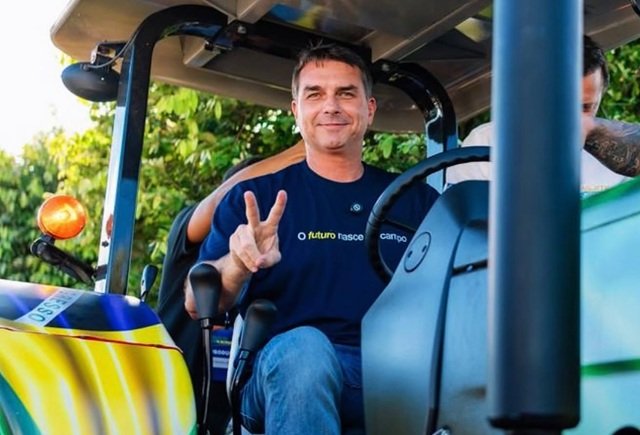
Brazil’s presidential election has strengthened the political movement founded by former far-right president Jair Bolsonaro, with his son Flávio entering the run-off against incumbent Luiz Inácio Lula da Silva after securing 47 per cent of the first-round vote. The result, accompanied by gains for Bolsonaro’s allies in Congress and at state level, has raised the prospect of a more consolidated right-wing government and renewed pressure on the country’s democratic institutions.
In an interview with Der Spiegel, German-Brazilian political scientist Oliver Stuenkel said he had expected Flávio Bolsonaro to perform strongly but had not anticipated that he would approach an absolute majority. Stuenkel, a senior fellow at the Carnegie Endowment for International Peace in Washington, where he works on democracy, conflict and governance, said the scale of the right-wing advance was considerable. A victory for Flávio, he argued, would create opportunities for major policy changes while increasing the risks to Brazilian democracy.
Stuenkel attributed the Bolsonaro movement’s strength less to enthusiasm for Flávio personally than to widespread opposition to Lula. During conversations with nearly a dozen voters in the state of Goiás in the week before the election, he said, none identified Flávio as the principal reason for their vote. Instead, they repeatedly said they did not want Lula to remain in power. One voter told him he would even vote for a horse if it stood against the incumbent.
The result, Stuenkel said, reflected failures by Lula’s government to address voters’ concerns and offer a convincing political vision. He compared Lula’s approach to that of former US president Joe Biden, arguing that both relied too heavily on positive economic indicators and past achievements rather than explaining how their political programmes addressed people’s present circumstances.
Lula won the presidency in 2022 with 50.09 per cent of the vote, supported by a broad coalition ranging from the far left to the centre-right. That coalition had formed in opposition to Jair Bolsonaro, whose handling of the Covid-19 pandemic and threats to overturn an election defeat had helped unite otherwise divergent political forces. According to Stuenkel, the promise of a government capable of accommodating Brazil’s democratic spectrum was not fulfilled.
He also criticised Lula for failing to develop a successor or present a sufficiently compelling new programme. The Bolsa Família social assistance scheme, which helped protect millions of people from hunger, remained an important achievement, he said, but its past success did not necessarily persuade younger voters. For those born after 2005, he argued, repeatedly invoking earlier social programmes was no substitute for a new political vision.
The strength of the Bolsonaro camp is particularly significant because Jair Bolsonaro was sentenced to 27 years in prison for his attempted coup, according to the interview. Stuenkel said the conviction had not prevented the movement from consolidating its support. He also argued that the Bolsonaro family’s proximity to organised crime made Brazil’s situation, in some respects, more extreme than that of the United States.
Flávio Bolsonaro faces corruption allegations, but Stuenkel said supporters of the movement often respond to revelations about him by circulating lists of scandals involving Lula’s government. This reflects what he described as political hyper-cynicism: the belief that all politicians are corrupt and that allegations against one side cancel out those against the other. The fragmentation of information sources further reinforces this attitude, he said, allowing voters to dismiss concerns about their preferred candidate because they fear the alternative more.
Stuenkel warned that a second Bolsonaro presidency could pose a greater threat to democratic institutions than the first. “I see difficult times ahead for the country. It is an epochal turning point,” he told Der Spiegel. When Jair Bolsonaro came to power in 2019, voters could regard the outcome as a mistake, he said. A renewed victory for the movement would instead demonstrate that it had secured lasting popular support.
He cited the experiences of Turkey under Recep Tayyip Erdoğan, Venezuela under Hugo Chávez and Hungary under Viktor Orbán to argue that democratic deterioration can deepen when leaders or movements win a second mandate. In Brazil, a stronger Bolsonaro presence in the Senate could enable allies to initiate impeachment proceedings against Supreme Court judges, including Alexandre de Moraes, who presided over proceedings against Jair Bolsonaro. Moraes is a central adversary in the eyes of many Bolsonaro supporters and is himself involved in a major corruption scandal, Stuenkel noted.
A second Bolsonaro administration could also use its experience of government to place more technically capable allies in key institutional positions, Stuenkel argued. He warned that corruption investigators could face pressure, minority protections could weaken, and environmental enforcement against deforestation could come under attack. Research and education programmes could also be targeted. He considered it possible that Brazil might withdraw from international climate agreements or the World Health Organization, following a course similar to that taken by the United States.
Flávio has attempted to distinguish himself from his father by presenting himself as a more moderate politician. He has described himself as the “vaccinated Bolsonaro”, a formulation Stuenkel said was politically astute because his father’s refusal to be vaccinated against Covid-19 alienated some conservative voters. Flávio might also avoid his father’s tendency to dismiss climate change as a Marxist conspiracy theory. However, Stuenkel said, he had not unequivocally acknowledged that his father lost the election. Granting pardons to generals involved in the attempted coup, he warned, would strengthen authoritarian forces.
The election could also affect Brazil’s foreign relations. Stuenkel expects closer cooperation between a Flávio Bolsonaro government and Donald Trump’s administration on security and drug trafficking. He cautioned, however, that some US operations against alleged drug boats were partly performative, noting that many of those identified among the dead were ordinary fishermen.
China, Brazil’s largest trading partner, would remain important despite any shift towards Washington. Stuenkel said officials in Brazilian ministries were unlikely to support a complete break with Beijing, particularly because the agricultural business sector had little interest in such a move. Flávio could nevertheless favour the United States in selected areas, making his election strategically advantageous for Trump.
Stuenkel also described US efforts under Trump to weaken Lula’s government through tariffs intended to secure Bolsonaro’s release and sanctions against the judge who oversaw the former president’s case. He attributed much of the pressure to US Secretary of State Marco Rubio, who had portrayed Brazil alongside Venezuela and Cuba as countries unfriendly to Washington. Stuenkel said there had been no direct US intervention in the election campaign, suggesting that Washington may have recognised that an aggressive approach could instead benefit Lula.