by Durga Velayudham
Sri Lanka is not Myanmar, and the Colombo protest is not yet a Saffron Revolution. But whether Buddhist monks could face a Myanmar-style crackdown has become a test of the government’s judgement, judicial independence and the boundary between public order and suppression of dissent. The danger is that a dispute over one monk could become a confrontation over the state’s legitimacy at this stage.
The protest demanding the release of Galagoda Aththe Gnanasara Thera moved from Kandy to Colombo and, after a court order restricted demonstrators near the Presidential Secretariat, continued at Viharamahadevi Park. On 20 October, reports said the satyagraha had entered its fifth day. Protest leaders have warned they could seek to elect a new president if their demand is rejected, while President Anura Kumara Dissanayake has said his government will abide by court decisions. This does not yet prove a systematic campaign against Buddhist clergy.
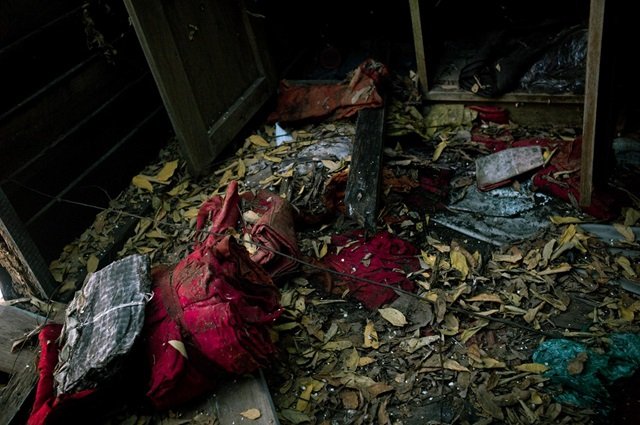
Myanmar offers a warning because its 2007 Saffron Revolution began with grievances the military government could have treated politically. Monks took to the streets amid economic hardship and public anger. The military response included monastery raids, beatings, arrests and lethal force. Human Rights Watch documented serious abuses, although the number of monks killed remains uncertain. Overall death estimates refer to protesters and civilians, not a verified monk-only total. The lesson is not that Sri Lanka must repeat Myanmar, but that coercion against religious figures can turn protest into a crisis of national legitimacy.
Sri Lanka’s circumstances differ. The current dispute centres on a demand for a presidential pardon for Gnanasara, whose imprisonment followed a court process involving contempt of court. The demand therefore collides with a constitutional principle: neither religious standing nor political influence should place anyone beyond judicial authority. Yet the state must enforce court orders lawfully and proportionately, without humiliating or indiscriminately treating monks. A government that treats every protest as a security threat could widen the conflict; a movement that treats every adverse judgment as an attack on Buddhism could do likewise.
An allegation that police assaulted Balangoda Kassapa Thera has heightened tensions. Police dispute the claim, saying he fell during a confrontation over a loudspeaker and temporary shelter. Until the facts are independently established, neither account should be presented as proven. The allegation requires transparent investigation. In Sri Lanka, where Buddhist clergy hold a distinctive public status, even a local confrontation can acquire national symbolism. Images of monks being struck or arrested could shape opinion before an inquiry is complete.
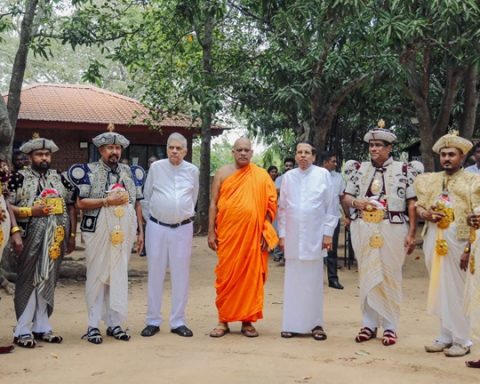
A consequential political intervention came from former president Ranil Wickremesinghe. At Mihintale in Anuradhapura, speaking at the unveiling of the pinnacle of the Mihindu Maha Seya, he described Sri Lanka as a central source of Theravada Buddhist heritage and emphasised its historical links with Thailand, Myanmar and other Buddhist societies. Presented as history and regional cultural ties, the speech was also brutally political. By placing Anuradhapura within a wider Buddhist world and invoking the state’s duty to protect the Buddha Sasana, Wickremesinghe reminded his audience that Buddhism is not merely cultural inheritance; it is a source of public authority, national identity and political mobilisation.
This does not prove the speech was designed as direct intervention; its significance lies in timing. With monks demanding a pardon and the government defending the courts, a former president’s emphasis on Buddhist heritage entered the debate over who can credibly claim to protect the faith. Wickremesinghe has also defended the earlier pardon, arguing that it followed appeals from senior monks and was intended to prevent a dispute over monastic discipline from escalating. Critics can reasonably ask whether religious sensitivities justify overriding the consequences of a judicial process.
The following day, Maithripala Sirisena, Wickremesinghe’s predecessor and former political ally, said there had been a procedural error in the pardon he granted Gnanasara and that he respected the court’s decision. He apologised to the Maha Sangha, attributing the failure to officials who had not obtained the required ministerial approval. The timing weakened Wickremesinghe’s intervention and refocused attention on the pardon’s legal defect. It would be speculative to say Sirisena acted to sabotage Wickremesinghe or foresaw a crackdown. Given their history of rivalry, however, some may interpret the statement as an effort to distance Sirisena from the failed pardon and deny Wickremesinghe sole ownership of the Buddhist question.
That remains interpretation, not fact. Sirisena may have been answering legitimate questions about his own decision; he may also have underestimated how the timing would be perceived. Timing alone does not prove motive. The episode exposes a recurring weakness in Sri Lankan politics: leaders invoke Buddhist heritage when it strengthens their position, then retreat to technical explanations when consequences become inconvenient.
If the government mishandles the protest, the consequences could extend beyond Gnanasara. A violent dispersal, particularly if credible evidence of disproportionate force emerges, could unite sections of the Sangha, draw opposition parties into the campaign and provide a rallying point for Sinhala Buddhist nationalism. The government might be portrayed as hostile to the religious institution the Constitution requires it to protect and foster. That narrative could be potent even if ministers maintained that court decisions must be respected.
Yet a crackdown is not the only path to political damage. A concession extracted through street pressure could weaken confidence in judicial independence and encourage others to demand exceptions from court rulings. The government must protect peaceful protest, investigate alleged police abuse, communicate with religious leaders and enforce lawful restrictions proportionately, while refusing to promise a pardon simply to end an uncomfortable demonstration. Respect for monks cannot mean immunity from law, just as respect for law cannot excuse abuse of monks.
Myanmar should be a warning, not a prediction. Sri Lanka has a different political system, institutional history and relationship between the military, religion and protest. No verified evidence establishes a Myanmar-scale campaign of lethal repression against Sri Lankan monks. The question is whether officials can prevent escalation before claims of religious authority and legal sovereignty become irreconcilable.
Political actors may benefit from polarisation even when the country does not. Wickremesinghe’s heritage speech, Sirisena’s clarification and the government’s defence of judicial authority now form part of a contest over who speaks for Buddhism and who defines the limits of state power. If authorities answer dissent with force, they could create the martyrdom narrative they wish to avoid. If protest leaders demand that courts yield to religious pressure, they risk turning faith into a test of political obedience. Sri Lanka’s future depends less on repeating Myanmar’s history than on learning its central lesson: coercion may silence a crowd for a day, but it can transform a dispute into a national crisis.