Moktar is 21, a university student from a modest Tunisian family, and one of thousands of young people who feel that France has closed the door on their future. He lives with five other family members in a 50-square-metre apartment in L’Abreuvoir, one of the poorest neighbourhoods of Bobigny, in Seine-Saint-Denis, north of Paris. His father drives a private-hire vehicle, and Moktar helps him at weekends. Despite achieving one of the highest marks in his second year studying international trade at Nanterre, he has been unable to secure a place at another university to continue his degree. His education has stalled.
Moktar is among 126,652 students still awaiting university placements this year after delays involving Parcoursup, the software system that guides applicants towards courses through algorithms whose decisions are often difficult to understand. Students have demanded its abolition as part of their protests. His 19-year-old friend Medhi offers another example of the system’s apparent disconnect from students’ ambitions: after studying theatre, he says, the software directed him towards economics.
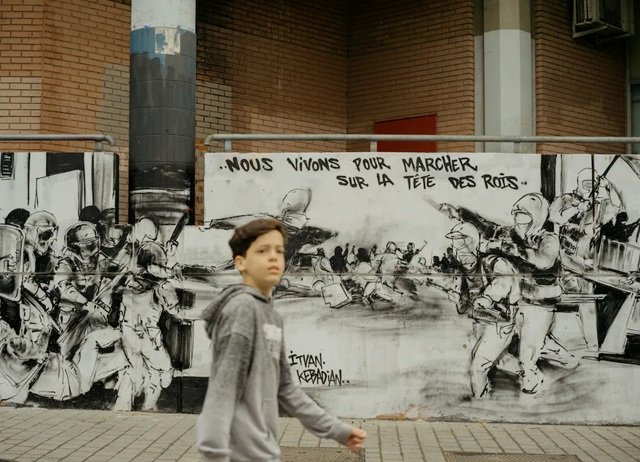
For the group of childhood friends, the dispute is about more than university admissions. They see the delays as evidence of a system that excludes people from disadvantaged backgrounds and undermines the promise that education can provide social mobility. After participating in a demonstration on 17 October, they are preparing to return to the streets. Their videos from the earlier protest show smoke, running crowds and damaged shopfronts. They expect further demonstrations to draw young people from across the banlieues, the suburbs surrounding Paris and other French cities.
The unrest has also exposed the depth of hostility towards the police and the sense of entrapment felt by some residents. Rayan, another member of the group, says young people organise through TikTok and Snapchat, platforms that police struggle to monitor effectively. The centre-right politician and former prime minister Gabriel Attal has proposed blocking such platforms during protests. Bitchat, a newer messaging network that uses Bluetooth rather than conventional mobile coverage, has also gained popularity.
Seine-Saint-Denis, commonly identified by the postal code 93, is France’s poorest department and has one of the country’s highest concentrations of immigrants, who account for roughly a third of its population. With 1.68 million residents, it is also among the youngest parts of the country. For many, the area’s reputation has become a stigma that follows them into education, employment and personal life. At the same time, redevelopment and rising property interest in places such as Bobigny, Saint-Ouen and Saint-Denis have raised concerns that poorer residents could be pushed further from the capital.
The department’s deprivation is visible in L’Abreuvoir, where the poverty rate is 47%, roughly three times the French average, and average household income is €1,180, according to the national statistics institute INSEE. Moktar’s former home is undergoing renovation, leaving him and his friends in temporary social housing. For them, the physical deterioration of their neighbourhood reflects a wider failure to provide stable opportunities.
Timeo, 24, who has Algerian roots, acknowledges taking part in vandalism during the protests, including damage to shops in central Paris and the offices of CNews, a television channel he accuses of racist coverage. He says further demonstrations are inevitable. Moktar argues that the damage was what finally forced the authorities to pay attention after student protests had gone unanswered. His position reflects the anger of some demonstrators, but the destruction has also devastated shopkeepers, many of whom come from similarly disadvantaged backgrounds.
The scale of the unrest has been substantial. The protests of 17 October were followed by the vandalism of around 2,500 businesses across France and more than 2,000 arrests, many involving minors. Reports from subsequent days put the total number of detainees above 3,000. Yet the violence cannot be explained solely as political protest or as the actions of young people from immigrant communities.
Proceedings at the Paris criminal court have illustrated the variety of people involved. A 19-year-old accused of taking sweets and ice cream worth €30 from a looted Monoprix supermarket said he had been hungry. Another defendant, a university student, was accused of theft and property damage at a clothing shop. Two men were found inside the Printemps department store with clothing and handbags, including items from Louis Vuitton. Such cases sit alongside the political grievances expressed in the streets.
Sébastien Roché, a researcher at France’s National Centre for Scientific Research and a specialist in police sociology, argues that looting can reflect the relationship between disadvantaged young people and consumer society. People who lack access to basic goods nevertheless live in a culture where possessions help determine social status, he says. Theft can become an illegal attempt to acquire that status, attaching itself to a political movement without necessarily being political in itself.
Saint-Denis, the department’s capital, has become one of the principal centres of the protests. Its contrasting landmarks include the basilica where French monarchs are buried, halal shops, mosques and streets bearing reminders of its industrial and working-class past. Didi, a 27-year-old lawyer of African origin, supports the demonstrations but rejects violence and looting. Having studied at Paul Éluard secondary school, one of the places where the student unrest began, she says it is possible to grow up in the banlieue and succeed professionally. She plans to attend another demonstration, arguing that the government’s response has relied too heavily on force.
The political stakes are growing as France approaches crucial elections in six months. The far-right National Rally, led by Marine Le Pen, has gained support amid disputes over immigration, national identity and integration. Meanwhile, the left-wing France Unbowed party has established a strong electoral base in Seine-Saint-Denis. Jean-Luc Mélenchon received 49.09% of the vote in the department in the first round of the 2022 presidential election, finishing first in 36 of its 40 municipalities.
The protests have unfolded against a backdrop of worsening racial tensions. During the same period, a 39-year-old Frenchman, identified as Kevin T., allegedly carried out a racist attack that killed one person and injured four others, including a 12-year-old girl. Investigators said he had targeted Black and Arab people and found a copy of Adolf Hitler’s Mein Kampf at his home. President Emmanuel Macron condemned the atmosphere created by divisive rhetoric, while France’s Muslim community warned of the dangers of ideologies that turn citizens against one another.
For many residents of Seine-Saint-Denis, the present crisis has roots in the failures of post-colonial integration. After Algeria gained independence in 1962, large-scale social housing construction helped accommodate returning French residents and later generations of immigrant families. About 90% of the department’s social housing was built between 1962 and 1975, often in vast complexes that subsequently deteriorated. The original model, residents and analysts argue, has struggled to meet the needs of successive generations.
The contrast with 1998, when France won the football World Cup and players such as Zinedine Zidane became symbols of a multicultural national identity, is striking. Sociologist Stéphane Beaud argues that some young people with immigrant backgrounds increasingly feel rejected by the country in which they were born. Their identification with their grandparents’ countries, he suggests, reflects a growing sense of exclusion.
Seine-Saint-Denis also represents a possible future for France: it has the highest birth rate and lowest mortality rate in the Île-de-France region, and 28.9% of its population is under 20. Its demographic importance makes the question of belonging difficult to avoid.
For Moktar, the central issue remains education. He believes hard work and academic achievement were once supposed to offer a route out of poverty, but says the system has obstructed rather than advanced his prospects. “I don’t see the equality the Republic proclaims anywhere,” he says.
That loss of confidence is at the heart of the unrest. The violence has damaged businesses and harmed communities, but suppressing the demonstrations alone will not resolve the grievances that have brought young people onto the streets. In Seine-Saint-Denis, the argument is about whether France can offer its youngest citizens a future in which they are recognised not as outsiders, but as equal members of the republic.