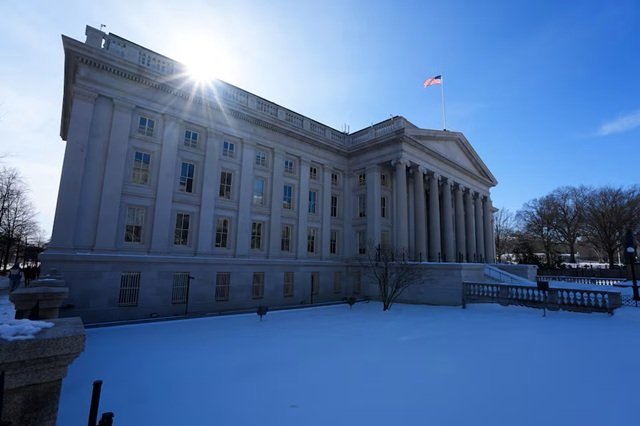
The US Treasury Department expects to borrow $618 billion during the fourth quarter, $10 billion less than its previous estimate announced in August, as a higher-than-anticipated starting cash balance provides additional financial flexibility. However, the revised projection also reflects lower expected net cash flows, indicating that the government’s underlying borrowing requirements remain higher than previously anticipated.
Excluding the benefit of the larger starting cash balance, the increase in borrowing requirements stands at $24 billion compared with the August forecast. The Treasury’s latest estimate assumes that the government will maintain a cash balance of $850 billion at the end of December, providing a reserve to meet federal spending obligations and manage fluctuations in government revenues.
For the first quarter of 2027, the Treasury projected borrowing of $800 billion, based on an expected cash balance of $1 trillion at the end of March. The forecast suggests that the government will continue relying heavily on debt issuance to finance its spending requirements and maintain sufficient liquidity as it enters the new year.
During the third quarter, the Treasury borrowed $742 billion, slightly above its August projection of $739 billion. The government ended September with a cash balance of $984 billion. However, after adjusting for the higher-than-expected ending cash balance, actual borrowing requirements were $30 billion lower than previously anticipated.
Investors and financial market participants are now focusing on the Treasury’s upcoming quarterly refunding announcement, scheduled for Wednesday, which will provide further details about its borrowing strategy and planned debt issuance. Particular attention will be given to whether the department intends to adjust the size of government bond auctions in the coming quarters, as changes could influence Treasury yields, bond prices and broader financial market conditions.
In its August announcement, the Treasury indicated that it continued to evaluate potential future adjustments to the size of its coupon and floating-rate note auctions. The language represented a shift from its May statement, which had referred to the possibility of increasing future debt sales. The change prompted speculation that the government could eventually reduce the size of certain longer-term bond auctions while relying more heavily on Treasury bills and short- to medium-term securities to meet its financing needs.
If the Treasury moves towards such a strategy, analysts believe the 20-year and 30-year bond auctions would be the most likely candidates for reductions. Potential increases in debt issuance could instead be concentrated in securities with maturities ranging from two to seven years. Market participants remain divided over whether the benchmark 10-year Treasury note auctions could also be expanded as part of any adjustment.
Changes in the maturity structure of government borrowing are closely monitored because they can influence demand across different segments of the bond market. A greater supply of longer-dated securities can place upward pressure on long-term yields, while a shift towards shorter maturities could alter the balance of demand and borrowing costs across the Treasury market.
Investors will also examine whether the Treasury plans to modify its bond buyback programme, which is designed to support market liquidity and improve trading conditions, particularly for less actively traded securities. The department has already increased the maximum size of its longer-dated buyback operations to $6 billion per operation, compared with the previous limit of $2 billion.
The upcoming refunding announcement is therefore expected to provide important guidance on the government’s debt management priorities, the maturity composition of future borrowing and its approach to maintaining liquidity in the Treasury market. With borrowing requirements remaining substantial, even modest adjustments to auction sizes and buyback operations could have significant implications for government bond investors and wider financial markets.