In lecturing about the state of liberal democracy over the past couple of years, I have been frequently asked whether the authoritarian tide taking place around the world can be stopped, and whether American democracy is strong enough to hold up under the weight of Trumpian authoritarianism.
My answer has been yes, that democratic backsliding is not inevitable, and that American institutions in particular are holding up reasonably well. My degree of measured optimism may well prove wrong, but it is based on several recent events.
A democracy becomes a liberal democracy when popular choice is linked to institutions that prevent the concentration of power in the executive, through a rule of law and a system of institutional checks and balances. In the United States, several of these checks have been weakened under Trump: Congress, which is supposed to jealously guard its privileges, has largely rubber-stamped Trump’s agenda, and parts of the executive branch like the Justice Department have become instruments of the president’s will. Many civil society organizations like corporations, law firms, and universities have sought accommodation with the administration.
There are, however, two critical checking institutions that have remained effective.
The first is the judiciary, the lower branches of which have regularly overturned Trump’s various assertions of executive authority. It is true that the current Supreme Court has allowed many Trump decisions to stand in its shadow docket, and given him a big win in its 2024 decision granting him broad presidential immunity. But even this conservative court has blocked several of his most egregious initiatives, like the attempt to overturn birthright citizenship and the authority claimed to impose arbitrary tariffs. There are still, however, some important decisions yet to come, such as whether Trump will have the authority to remove “inferior officers” and bring the entire civil service under his control. So the courts have been effective—but only up to a point.
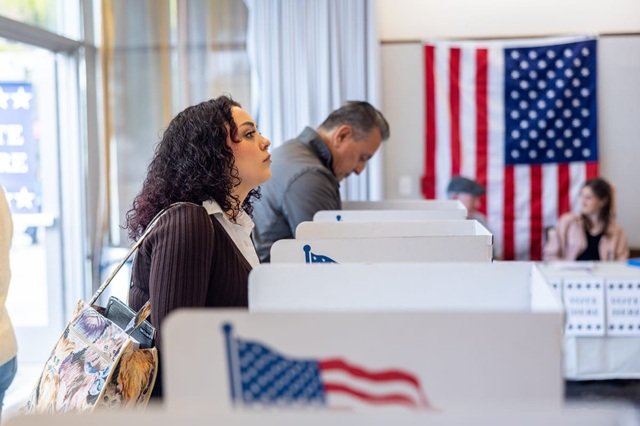
The most important check on executive power, of course, is not the judiciary, but elections—at least, in countries that can still hold reasonably free and fair elections. Authoritarian strongmen have been stopped in many countries around the world by voters: this happened in Poland in 2023, Hungary last April, and most recently in Serbia and Brazil.
The biggest authoritarian setback, however, is the one that is likely to occur in the United States tomorrow as a result of our midterm elections. By all accounts, the Democrats will gain control of the House of Representatives, and have a decent shot at retaking the Senate. Poll data and the behavior of candidates all over the country (many of whom are running as fast as they can away from Donald Trump) point in the direction of a major repudiation of the administration and its failures with regard to inflation and the war with Iran.
Trump and his Republican allies have been working hard to manipulate the elections in their favor, and will continue to do so even after the polls close. But it is hard to do this on a mass basis, particularly if a “blue wave” emerges that gives Democrats a strong majority. Trump’s various efforts at electoral manipulation—like the SAVE Act and using the Postal Service to discard potential Democratic ballots—have all been blocked.
The new Congress that will be seated in January will not be able to check the administration in many areas, particularly in foreign policy. But it will have control of the budget, and control of committees that can begin to hold Trump and his cronies accountable for their actions over the past two years. If the election goes as badly for Trump’s party as predicted, the Trump spell will be broken: Republican lawmakers will be liberated to criticize their president openly as the president becomes a lame duck.
The international effect of a Republican loss will be large, given the role that the United States continues to play in global politics. This is not to say that Trump himself will become more moderate. Indeed, an enraged and humiliated Trump is likely to try to recapture the spotlight by undertaking new adventures abroad. But the spectacle of voters rejecting a toxic presidency will nonetheless be a powerful one in advance of the European elections coming up next year.
The end of the Trump era is signaled by something else as well. Donald Trump the man is deteriorating before our eyes. He has closed the midterm campaign boasting at rallies of the “hundreds of billions of dollars” that oil companies have taken in under his presidency, even as ordinary people are suffering at the pump. He has attached himself to the unpopular cause of runaway data center construction, and has found time to comment on the physique of various men in his orbit. He does not look well, and we cannot take for granted that he will make it to the end of his presidency.
The vote tomorrow will be a major test of the strength of American institutions, and whether citizens have the agency to affect the future course of their country. Let’s hope we pass with flying colors.