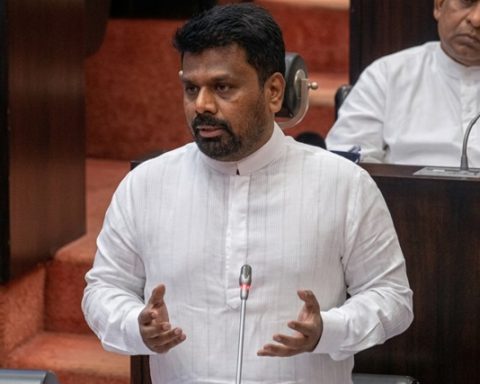
Sri Lanka’s public debt is projected to decline to 87% of Gross Domestic Product (GDP) by 2032, better than the 95% target initially set under the International Monetary Fund’s (IMF) Extended Fund Facility (EFF) programme, President Anura Kumara Dissanayake announced in Parliament on 12 November while presenting the 2027 Budget.
The President, presenting the third Budget of the National People’s Power (NPP)-led Government, said the improved projection reflected progress in public financial management and was included in the IMF’s Sixth Review of the programme.
“The target of the IMF-Extended Fund Facility programme was to bring public debt down to a level of 95% by 2032. But based on the progress in public financial management, the IMF’s Sixth Review has forecast that this will decline to 87%,” he said.
Dissanayake said the Government was pursuing further reforms to strengthen public finances, including broadening the tax base, streamlining tax exemptions and digitising tax administration. These measures, he said, were intended to maintain fiscal discipline and sustainable public finances in accordance with the Public Financial Management Act.
The President also outlined the Government’s fiscal targets, including maintaining a primary budget surplus of 2.3% while containing the overall budget deficit at 5%. Government expenditure is expected to reach 13.6%, while public investment is projected at 4% of GDP.
He identified public sector reform as another priority, arguing that the existing state administration required structural changes to meet the country’s future development needs. “The existing state machinery needed to be transformed to meet the country’s future development requirements, for a stronger, more efficient and effective public administration,” he said.
Addressing concerns about Sri Lanka’s capacity to meet its external debt obligations, Dissanayake said the Government had sufficient liquidity and financial capacity to service foreign debt over the next two years. He provided figures for repayments made and projected obligations to support the Government’s position.
Sri Lanka serviced $3,707 million in foreign debt in 2025, while payments due in 2026 amount to $3,591 million, according to the President. The country’s foreign debt servicing requirements are projected to reach $2,986 million in 2027 before rising to $3,674 million in 2028.
His remarks came amid concerns raised by certain parties over the Government’s ability to fulfil its external debt commitments. However, Dissanayake maintained that the country had the financial capacity to meet the obligations falling due during the coming two years.
The President also disclosed that the Government had appointed a committee to examine Sri Lanka’s options for engaging with the IMF after the current EFF programme ends in March 2027.
The committee will assess whether the country requires another IMF arrangement following the conclusion of the existing programme and, if so, identify the type of agreement best suited to Sri Lanka’s circumstances.
Dissanayake said the Government remained committed to completing the current IMF programme successfully while continuing efforts to strengthen the country’s foreign exchange reserves.