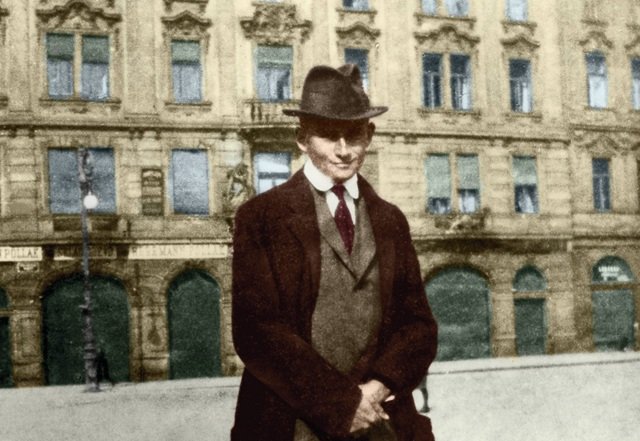
One hundred years after the publication of Franz Kafka’s celebrated novel The Castle, six contemporary writers have revisited the work through original literary contributions that explore its continuing significance. Published by German newspaper Die Zeit, the collection brings together Son Lewandowski, Elias Hirschl, Marius Goldhorn, Nora Osagiobare, Timon Karl Kaleyta and Valeria Gordeev, each approaching Kafka’s fictional world from a different perspective. Rather than offering conventional literary criticism, their contributions use fiction, personal recollection and contemporary social concerns to examine themes that have remained central to interpretations of Kafka: inaccessible authority, bureaucratic obstruction, alienation, powerlessness and the struggle to establish one’s place within an unfamiliar system.
For Son Lewandowski, the world of The Castle becomes a setting for an account of exploitation, secrecy and the protection of powerful men. Her contribution centres on Freida, a woman working as a masseuse on an island frequented by wealthy businessmen. She encounters men who arrive under abbreviated names, accompanied by assistants, while their identities and activities remain concealed behind layers of digital security and institutional protection. Her employer, identified only as C., dismisses her complaints about the men and advises her to ignore what is happening. When Freida attempts to understand the circumstances surrounding the island, she finds that her own experiences carry little weight against the inaccessible records and carefully protected communications of the powerful.
Lewandowski’s narrative develops the idea of the castle through the mechanisms that prevent information from becoming evidence. Emails are secured behind digital barriers, names are concealed, and accounts of wrongdoing disappear into administrative processes. Freida remembers women who had previously worked on the island, including Amalia, but cannot locate them because none of the women had been given surnames. Those who attempt to move beyond their assigned positions risk disappearing from the story altogether. The narrative presents a system in which wealth and influence determine whose experiences are recognised and whose accounts can be dismissed. Freida’s relationship with the powerful men is defined not by professional equality but by ownership and control.
Elias Hirschl takes a different approach, using absurdist humour to reinterpret the experience of encountering an inaccessible authority. His contribution follows a narrator travelling to Liechtenstein to visit Vaduz Castle because he needs to write about a castle. Almost immediately, his journey becomes a sequence of contradictory rules and increasingly unreasonable encounters. At a bakery, he is unable to obtain a coffee without violating one of several contradictory instructions. He is told that he cannot take the drink away from the machine, cannot approach the cashier with it and cannot pay using the available methods. When he attempts to explain that he is not a Liechtenstein citizen, he is informed that his identity cannot be verified because of a cyberattack that has allegedly compromised the country’s financial data.
The difficulties continue when the narrator reaches the celebrations of the Prince’s Day. Attempting to enter the castle grounds, he pretends to be the hereditary prince Julius V and is admitted after the security personnel become uncertain about his identity. Later, after climbing over a wall and breaking his ankle, he is told that a helicopter rescue will cost 100,000 Swiss francs. Unable to pay, he is threatened with imprisonment, although the police explain that Liechtenstein has no prison and that he must provide his own cell. The absurdity of the situation echoes Kafka’s recurring depiction of individuals trapped in systems whose rules appear impossible to understand or satisfy.
Marius Goldhorn approaches the novel through the experience of reading Kafka alongside contemporary anxieties about environmental destruction and personal existence. His contribution moves between reflections on his family, memories of alienation and observations of rising temperatures. He recalls previously identifying with the loneliness expressed in Kafka’s diaries and letters but says that his interests have changed. Now a father, he finds himself increasingly concerned with extinction. His mother’s difficulties breathing during periods of heat and dust become part of a wider meditation on the fragility of life.
Goldhorn describes The Castle as an odyssey through a swamp of interpretations, in which the reader moves not simply through the fictional village but through successive attempts to explain what the castle represents. He suggests that the novel resists definitive interpretation because it is always greater than the commentary written about it. His own imagined version of Kafka’s village becomes a place where historical memory has been abandoned, social structures have disintegrated and even the bureaucrats who exercise authority are themselves losing their power. The contribution ends with a reflection on the possibility of continuing to live and love in the face of environmental decline.
Nora Osagiobare relocates the question of access and authority to the world of social media and commercial influence. Her narrative follows Kim, a businesswoman who visits a dying woman, Frau Gerstäcker, while the encounter is broadcast live on Instagram. Kim attempts to present the scene as reassuring and controlled, but the dying woman’s inability to complete her explanation of the castle leaves her uncertain about whether she will ever be permitted to enter it. Although Kim has paid for the woman’s children’s education and seeks her recommendation, she increasingly considers bypassing the established process and entering the castle without permission. The presence of cameras, followers and employees turns a private encounter into a public performance, while the woman’s deteriorating condition exposes the limits of Kim’s carefully managed image.
Timon Karl Kaleyta explores another form of inaccessible authority through a fictional writer whose ability to work has become dependent on an elusive editor. Initially, the editor is a professional adviser, but gradually becomes the writer’s most important and eventually only friend. Every sentence requires approval, and the writer becomes unable to think or write independently. When asked to produce a literary miniature about Kafka, he seeks guidance but receives warnings that he will either imitate others or become lost in excessive metaphor. The editor eventually asks him: “Are you a writer or a recipient of assignments?” The question exposes the writer’s dependence, particularly when the editor disappears and the writer is left unable to complete the task.
Valeria Gordeev returns most directly to the experience of reading Kafka. She recalls how school examinations, constant assessment and institutional rules shaped her understanding of authority and personal identity. At 16, she encountered Kafka’s The Metamorphosis and recognised in its atmosphere of confinement and alienation something that reflected her own experience. Reading Kafka offered an unexpected sense of connection, particularly when she discovered that other pupils also felt drawn to his writing. She relates this experience to the character K. in The Castle, whose attempts to establish his identity and gain access to the authorities repeatedly fail. For Gordeev, Kafka’s work offers a form of companionship to those who feel excluded or misunderstood.
Together, the six contributions published by Die Zeit present The Castle not as a novel confined to its historical period but as a work that continues to provide material for examining contemporary experiences of authority, exclusion and uncertainty. Their different interpretations move from concealed power and bureaucratic absurdity to environmental anxiety, digital performance, creative dependence and the lasting psychological effects of institutional judgement.