


A decade after an international tribunal rejected China’s sweeping claims in the South China Sea, the waters remain defined less by the 2016 legal ruling than by an expanding network of islands, infrastructure and military facilities that have transformed the disputed region. According to a report by the South China Morning Post, Beijing’s long-running island-building campaign has fundamentally altered the strategic landscape, creating what observers describe as a widening gap between international law and realities on the ground.
The anniversary of the Permanent Court of Arbitration’s landmark ruling comes as China’s presence across contested waters has become increasingly entrenched through land reclamation, civilian administration and military expansion. Analysts interviewed by the South China Morning Post say Beijing’s sustained physical control has diminished the practical impact of the tribunal’s decision, despite its continuing legal significance.
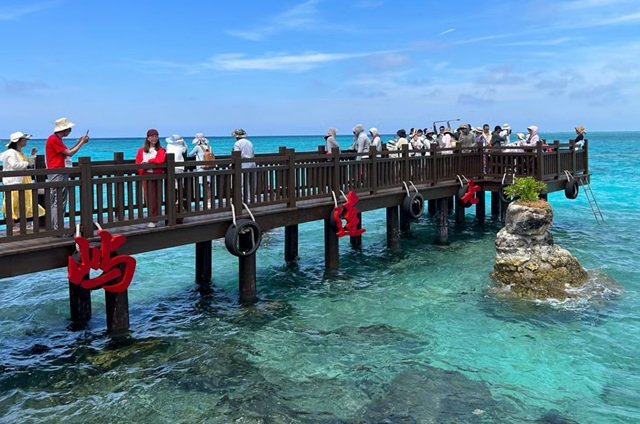
The transformation is visible on Tree Island, known as Zhaoshu in China and Dao Cay in Vietnam, in the disputed Paracel Islands. Once a remote outpost, the island has undergone extensive development since 2016, with reclaimed land supporting government offices, residential housing, gardens, supermarkets, power stations, a wastewater treatment facility, a helicopter pad and even a prison. Smooth roads now carry electric sightseeing vehicles, while modern facilities serve both residents and an increasing number of visitors.
The island has also emerged as the furthest point in the South China Sea accessible to Chinese civilians. Tourists travelling aboard the cruise ship Nanhai Dream arrive to experience what guides describe as China’s southern frontier. Visitors range from schoolchildren and retired teachers to businesspeople and families, reflecting a growing emphasis on civilian presence alongside government administration.
According to local guides cited by the South China Morning Post, around 200 fishermen now live in newly built housing on the island. Most come from Tanmen in China’s Hainan province, where generations have depended on fishing in the South China Sea. Residents are reportedly required to spend at least 180 days each year on the island while continuing fishing activities when directed by authorities.
A short distance from Tree Island lies Woody Island, or Yongxing Island, the administrative centre of Sansha City, established by Beijing in 2012 to oversee its claims across large parts of the South China Sea. The settlement now includes an airport, banks, hospitals, a cinema, a stadium, post offices and a recently opened shopping centre, supporting a population of about 2,200 residents.
Farther south, Beijing has pursued a much larger programme in the Spratly Islands, where artificial islands have been constructed on at least seven occupied reefs. Among the most significant are Fiery Cross Reef, Mischief Reef and Subi Reef, collectively known as the “Big Three.” These installations now include military-grade airstrips, missile batteries, naval berths and extensive support infrastructure, significantly extending China’s operational reach across the disputed waters.
The South China Morning Post reports that Beijing’s reclamation campaign began around 2013, shortly after the Philippines initiated arbitration proceedings challenging China’s maritime claims. Massive dredging operations created more than 10 square kilometres of new land before the tribunal issued its July 12, 2016 ruling, which found that China’s expansive claims lacked legal basis under international law and concluded that its artificial island construction had violated international obligations while damaging the marine environment.
By the time the tribunal delivered its decision, however, construction on many of the major outposts had already been completed. Analysts interviewed in the report argue that the rapid pace of development effectively presented a new strategic reality that could not easily be reversed through legal mechanisms alone.
Collin Koh, a senior fellow at Singapore’s Institute of Defence and Strategic Studies, told the South China Morning Post that the ruling’s binding nature was undermined by the absence of enforcement mechanisms. He said China’s exercise of physical control had become the most consequential development in the region, illustrating the challenge of translating international legal decisions into practical outcomes.
Alexander Vuving, a professor at the Daniel K. Inouye Asia-Pacific Centre for Security Studies in Honolulu, described China’s artificial island programme as a turning point that reshaped both geography and geopolitics in the South China Sea. According to the report, he said the expanded infrastructure had provided Beijing with substantial geopolitical leverage while significantly strengthening its maritime control.
The growing network of facilities has also demonstrated operational value during regional confrontations. The report notes that in 2019, China’s base on Fiery Cross Reef enabled survey vessels and escort ships to sustain an extended deployment during a prolonged standoff with Vietnam at Vanguard Bank by providing nearby resupply and logistical support.
At the same time, experts cautioned that these forward positions face strategic limitations. Carlyle Thayer, an emeritus professor specialising in Southeast Asia, pointed to the considerable distance between the artificial islands and mainland China, as well as the vulnerability of facilities to corrosive saltwater, extreme heat and frequent typhoons that require continuous maintenance. In the event of a high-intensity conflict, he noted, the islands would also be exposed to military capabilities operating from locations much closer to the disputed waters.
China is not the only claimant reshaping the region. Since 2021, Vietnam has accelerated its own land reclamation programme in the Spratly Islands, expanding reefs into larger outposts capable of accommodating larger vessels and military runways. A report by the Centre for Strategic and International Studies’ Asia Maritime Transparency Initiative, cited by the South China Morning Post, found that Vietnam had added hundreds of hectares of reclaimed land, with Barque Canada Reef becoming its largest base in the area.
Meanwhile, Beijing has continued reclamation work elsewhere. Construction is advancing at Antelope Reef in the Paracel Islands, where a new artificial island is taking shape approximately 90 kilometres southwest of Tree Island. Both China and Vietnam have maintained that newly developed facilities are intended for civilian purposes.
Attention has also focused on Scarborough Shoal, where Philippine officials recently reported detecting a floating platform near the entrance to the lagoon. Beijing described the structure as a temporary scientific research installation following an expedition in the area. Wu Shicun, founding president of the National Institute for South China Sea Studies, told the South China Morning Post that any future decision to establish permanent facilities at the shoal would depend on Beijing’s assessment of security conditions and maritime law enforcement requirements.
As regional governments and international observers continue monitoring developments across the South China Sea, the anniversary of the 2016 arbitration ruling highlights how extensive island construction, expanding civilian settlements and growing military infrastructure have become defining features of one of the world’s most contested maritime regions, underscoring the continuing divergence between legal decisions and the evolving situation on the water.









