In a city that might have hosted a rival to Cambridge 800 years ago, a small but ambitious institution is challenging the traditional model of UK higher education. The New Model Institute for Technology and Engineering (NMITE) in Hereford opened its doors in 2021 with a mission to produce work-ready engineering graduates while addressing regional skills shortages and rethinking how students learn.
Jesse Norman, MP for Hereford and chair of NMITE, recalls the apocryphal story: scholars leaving Oxford could have founded a university in Hereford but instead went on to establish Cambridge. “It’s a fun ‘what if’,” he says. Today, NMITE seeks to realize that alternative vision, focusing on students’ practical skills rather than chasing international rankings.
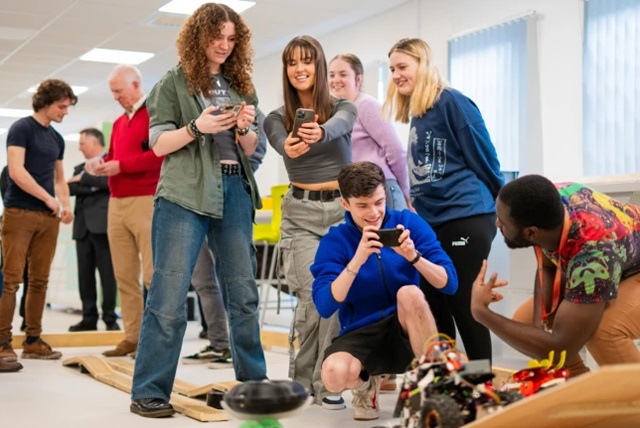
Unlike traditional research-intensive universities, NMITE emphasizes hands-on learning, industry-led projects, and accelerated integrated bachelor’s and master’s programs. Students spend their days in studios rather than lecture halls, working in small teams under the guidance of educators who act as mentors rather than lecturers. The curriculum, co-designed with over 80 industry partners, reflects real-world challenges in sectors including defence, energy, construction, and technology.
James Newby, NMITE’s chief executive, highlights the institution’s response to a national crisis in UK skills. The Department for Education’s Employer Skills Survey 2022 found that skill shortages account for 36% of vacancies, yet many graduates occupy roles that do not require a degree. NMITE’s approach aims to bridge this gap, producing graduates who are ready to contribute from day one.
Elena Rodríguez-Falcón, NMITE’s first chief executive and president, shaped the institute’s ethos based on her own experience as the only female engineer in a factory of 200 blue-collar workers. She emphasizes “authentic learning, experiential learning” as the best way to prepare students for professional life. NMITE drew inspiration from Olin College of Engineering in the United States, where students learn by designing, building, and testing real products in short, intensive projects.
NMITE’s admissions process seeks students with drive, resilience, and passion rather than relying solely on academic grades. The university does not require A-levels in maths or physics, opening engineering to a wider and more diverse cohort, including women. While the current student body is small, female enrollment is expected to exceed 20% in the next intake.
Students graduate ready for employment: 23 of the first 25 graduates secured engineering roles immediately, including positions at major companies like Balfour Beatty, Heineken, Microsoft, and Virgin Media. Elise Cummings, one of the first graduates, praises the focus on practical skills and teamwork, which she says prepared her for work on the Sizewell C nuclear project.
Despite its successes, NMITE faces challenges. The UK higher-education system is dominated by historic institutions with deep resources and reputations. Hereford is a rural city with limited transport links, and NMITE must persuade students and staff to join a small, new institution. Yet the university’s agility, hands-on pedagogy, and strong industry links offer a distinct advantage in a sector struggling with declining financial performance and outdated teaching models.
NMITE’s approach has broader implications for the UK and beyond. David Helfand, an astrophysicist and advocate of block learning, says that many students thrive under NMITE’s intensive, project-focused structure. Rhys Morgan of the Royal Academy of Engineering adds that the model could be applied to other applied STEM disciplines, such as chemistry, construction, and architecture.
As highlighted by Nature, NMITE represents a rare experiment in UK higher education: a university designed from scratch to address skill gaps, regional inequality, and the limitations of conventional teaching. Its success could offer a blueprint for innovation in a sector long criticized for resisting change.