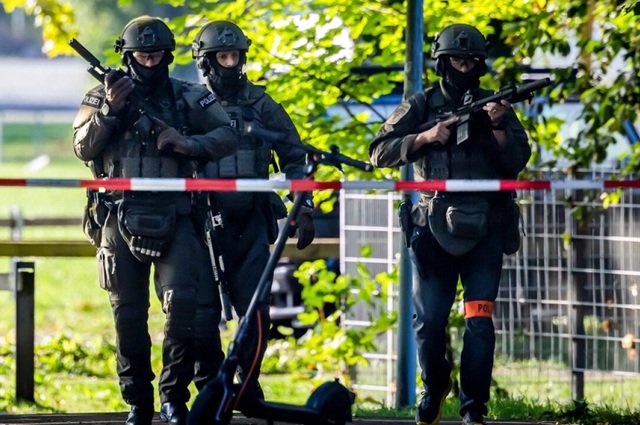
The poster still hangs outside the Migrolino kiosk at the railway station, as if the event were about to begin. Beside it stand heavily armed members of the cantonal police, an unmistakable sign that something has gone badly wrong. The occasion was the seventh edition of the “Aarau Rave”, a techno party held at the local horse-racing track, next to the sports ground. From Saturday afternoon, about 2500 mostly young people gathered to celebrate, with nine DJs scheduled to perform. By the end of the night, one person was dead and five others were injured.
At 2.33am, the first emergency call reached police. More followed within minutes. Unknown assailants had apparently fired at people leaving the party at what investigators believe were two locations. Exactly where the shooting began, how many shots were fired and how the events unfolded remain unclear. So does the number of perpetrators. Their escape route is also unknown.
Aarau, the cantonal capital of Aargau, has about 22,300 inhabitants and lies roughly 46 kilometres west of Zurich. Known as the “City of Beautiful Gables”, it was once the first capital of Switzerland. According to the major bank UBS, it is even more attractive to families than Zurich. Now the city has become the scene of a crime that investigators have yet to explain.
Michael Leopold, the police commander leading the operation in Aarau, said on Sunday evening that he had already been on duty for 15 hours. He lives not far from the scene. “I myself was woken by the shots,” he said.
His colleagues, he explained at a hastily arranged press conference in a stuffy hall in a neighbouring town, remained “in the middle of an ongoing major operation”. The exhaustion of investigators was visible as they faced more than a dozen cameras and considerably more journalists. Yet the most important questions remained unanswered, not only by Leopold but also by his superiors in the canton and other officials.
Police said they would remain in the “phase of averting danger” until the perpetrator or perpetrators were arrested. The authorities also described the situation as a “national manhunt” across Switzerland. But the central difficulty was stark: how could the shooters be found when investigators did not even know how many there were?
Swiss media reported two perpetrators. Some eyewitnesses said they had seen closer to four suspects. Their appearance remained unknown, as did the reason they might have opened fire.
Investigators could identify three possible hypotheses. The shooting might have been a terrorist attack, a rampage, or an unknown criminal activity, “such as a settling of accounts in the milieu”, as Leopold put it. Police did not say which possibility they considered most likely. More than half an hour after the press conference began, the uncertainty remained striking. Some information may still have been withheld; alternatively, investigators themselves may simply have had little to disclose.
At least the weapons could be narrowed down. At the car park beside the horse-racing track, investigators found cartridge cases from a 9mm weapon, probably a pistol. They also found “more than a dozen” rounds in 5.45×39 millimetres, believed by investigators to have come from an assault rifle. The combination immediately raised questions about whether a single individual could have used both weapons. It would be difficult to imagine, although not impossible with a semi-automatic weapon.
Across Aarau, the physical signs of the investigation were impossible to miss. On a police map, officers marked the locations where shots had been fired and people injured. There appeared to be at least two: one at the car park and another at an entrance to the site. Whether the shots had been fired from a vehicle was another question to which investigators offered no answer.
The investigation also crossed Switzerland’s borders. Because Germany and France are not far away, colleagues from both countries were brought into the operation. Witnesses were asked not to publish videos from the party grounds online, but instead to send them to police. After the press conference, investigators said it remained unclear how many people had complied. The number was described as relatively small — “probably not yet sufficient for a public manhunt”.
The heavy police presence offered a strange form of reassurance amid the uncertainty. The party grounds at the horse-racing track remained cordoned off for hundreds of metres. Officers, some heavily armed, stood behind red-and-white police tape. At times, an olive-green armoured vehicle could be seen on the streets. Traffic police were checking the city’s lanes.
Yet ordinary life continued alongside the investigation. Ice-cream cafés were full. The sun was shining. In the distance, the Gösgen nuclear power plant operated quietly. According to the cantonal police, the “abstract danger” in the city was, almost a day after the shooting, no greater than elsewhere in Switzerland.
Near the sports hall, where more than 100 partygoers had been taken during the night and questioned, people were now meeting at an Italian restaurant. Many of those brought there required psychological follow-up. The DJs were also in shock. Several expressed their sympathy on Instagram, and some apparently knew the woman who died.
She has since been identified as Maria S., a 22-year-old Italian woman who lived in Switzerland. Italy’s Prime Minister Giorgia Meloni has remembered her. Swiss and Italian media reported that Maria came from Abruzzo. She had worked in Switzerland’s hospitality industry and had “tanti amici in quel mondo” — many friends in the world of partying.
A former neighbour told the Swiss newspaper “Blick” that he had helped her find work. Maria, he said, loved children. “She loved such parties,” he was quoted as saying. “Normally she went everywhere if she had the opportunity to attend a rave.”
Why she, in particular, had to die remains unknown.
The party’s security chief, Nico H., had overseen the event for several years. Nothing, he said, had appeared unusual before the shooting. “We checked everyone.” There had been body and bag searches. “There were no weapons on the party grounds.”
The distinction is central to what happened next. The event at the horse-racing track was not a small gathering but a long-running celebration attended by thousands. At the same time, people were also out celebrating in central Aarau on that late-summer evening.
Nico H. said he had been at the site for half an hour at around 1am. By then, after a long day, the party was already coming to an end. Then suddenly, he said, it became loud. “The shots came from outside, from beyond the party grounds.”
His employees responded by opening emergency exits, alerting police and beginning to move young people to safety. “We tried to save as many lives as possible,” the security chief said. “And did our job in this extreme situation.”
The party had ended. But the questions had not. One woman was dead, five people were injured, and somewhere beyond the cordons and police checkpoints, those responsible remained unidentified. For investigators in Aarau, the night was therefore far from over.