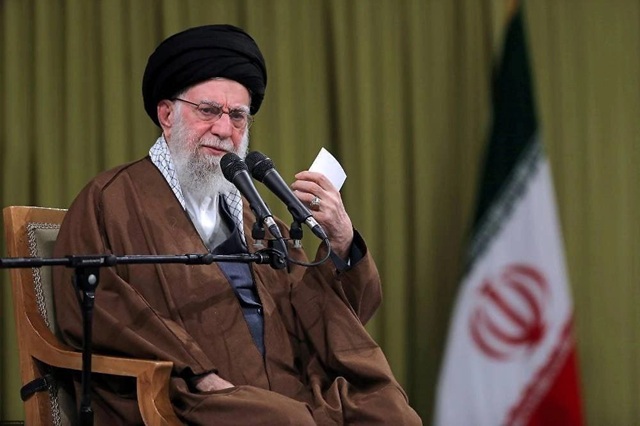
The burial of Ayatollah Ali Khamenei in Iran’s holy city of Mashhad marks the formal end of a nearly four-decade era dominated by a leader who shaped the Islamic republic’s institutions, foreign policy and domestic order. But as his son Mojtaba Khamenei assumes the role of supreme leader, the country faces a series of challenges that could test the durability of the system his father built.
The transition follows the death of the 86-year-old Khamenei, who was killed in February during the opening stages of the US-Israeli war on Iran. Supporters of the late leader portrayed his death as the fulfilment of the revolutionary ideal he had described only months earlier, when he said the ideal life involved education, service to Islam, longevity and ultimately martyrdom.
According to a report by the Financial Times, Khamenei’s burial ceremony represents more than the conclusion of a lengthy mourning period. It marks the symbolic close of almost 37 years in which he served as the central figure holding together Iran’s political and religious establishment.
During his leadership, Khamenei reshaped major institutions, strengthened the influence of Shia religious organisations, expanded the role of the Islamic Revolutionary Guard Corps (IRGC), supported regional allies and suppressed repeated waves of domestic opposition. In his later years, he became a focal point of public anger among critics of the regime.
His successor, Mojtaba Khamenei, now inherits a country facing the consequences of war, economic pressure and declining public confidence. Yet unlike his father, who had decades of revolutionary credentials and a highly visible public presence, Mojtaba remains a largely unknown figure to many Iranians.
Mojtaba has not appeared publicly since being appointed supreme leader in March and has not issued video or audio messages. Officials, regime politicians and some foreign diplomats have said his absence is due to security concerns and that he remains in control. They have also said he recovered from injuries suffered during strikes that killed his father and several members of his family, including his wife, sister, brother-in-law and young niece, who will also be buried in Mashhad.
His limited public profile has fuelled speculation among some Iranians who were accustomed to regular public speeches from the elder Khamenei, whose communication style was a key part of his rule.
Analysts and officials expect Mojtaba’s leadership to rely more heavily on powerful institutions, particularly the IRGC. Under its new commander Ahmad Vahidi, the organisation has influence over security policy, foreign affairs and significant parts of the economy, and its role has expanded during the conflict.
Mojtba is also expected to depend on religious organisations, wealthy patronage networks and regional allies such as Hizbollah in Lebanon, although those networks have also been weakened by recent events.
“The networks built under Ali Khamenei helped the state survive the war,” Iranian analyst Saeed Laylaz said. “Now, Mojtaba Khamenei will have the final say in all major decisions, but institutions will play an even greater role than before.”
The leadership transition comes after years of pressure on the Islamic republic. Sanctions, international isolation and economic stagnation contributed to widespread dissatisfaction, which intensified during mass anti-government protests in January. The government responded with a crackdown that killed thousands, further damaging the regime’s standing among sections of society.
The funeral procession that followed Khamenei’s death was used by authorities as a demonstration of political resilience. The six-day ceremony, during which his coffin travelled across Iran and into neighbouring Iraq, was presented by officials as evidence that the Islamic republic had survived the war and maintained a committed support base.
The event also provided an opportunity for senior figures to appear publicly after months of uncertainty. IRGC commander Ahmad Vahidi was seen beside Khamenei’s coffin for the first time since the conflict, while parliamentary speaker Mohammad Bagher Ghalibaf appeared alongside President Masoud Pezeshkian and judiciary chief Gholam-Hossein Mohseni-Ejei.
Former president Mahmoud Ahmadi-Nejad, who had fallen out with the leadership, also appeared after months of speculation about his situation.
Mojtaba, however, remained absent.
His first major political decision suggested a cautious approach to governing. Last month, he authorised President Pezeshkian to sign a memorandum of understanding to reopen the Strait of Hormuz and begin negotiations with the United States over a possible agreement to end the war.
Although Mojtaba stated that he opposed the agreement “in principle”, he allowed it to proceed because it had been approved by the Supreme National Security Council, which includes senior military commanders and is chaired by the president. He also placed responsibility for securing economic benefits, including the release of frozen Iranian assets, on Pezeshkian’s government.
The move reflected the balancing strategy used by his father, who managed competing factions within the political system. Mojtaba has allowed space for figures such as Ghalibaf, who argue that negotiations with Washington are necessary to obtain sanctions relief and address economic problems.
However, negotiations face opposition from hardline supporters who view engagement with the United States as a departure from the ideology associated with Ali Khamenei’s leadership. Some funeral attendees expressed anger at the possibility of talks with Washington, chanting “Death to America” and calling for retaliation.
At the same time, a stronger reliance on conservative supporters risks increasing tensions with other sections of Iranian society, including younger and more secular citizens who oppose religious restrictions and seek greater engagement with the outside world.
Hardline politician Hamid-Reza Taraghi said the new leadership would likely show less tolerance towards opposition forces and that institutions led by the IRGC would help Mojtaba exercise greater control.
A former senior reformist official, however, said Iran was likely to become more politically closed while allowing some greater openness on social issues, adding that major changes to the Islamic republic appeared unlikely.
Mojtaba has already signalled continuity by reappointing judiciary chief Mohseni-Ejei for another five-year term. But observers say the defining challenge ahead will be whether Iran can reach a lasting agreement with Washington, particularly over its nuclear programme.
Any agreement would require significant concessions and faces major obstacles. The United States and Iran have continued exchanging strikes after Washington accused Tehran of attacking commercial shipping in the Strait of Hormuz, while Iran has insisted control of the waterway must be part of any deal.
As Mojtaba Khamenei begins his leadership, the Islamic republic is entering a period shaped by uncertainty over whether the new supreme leader will preserve his father’s model of rule or adjust it to address the pressures confronting Iran at home and abroad.