Just one week after a deadly attack disrupted Berlin’s Christopher Street Day celebrations, tens of thousands of people gathered in Hamburg for what became the largest Pride parade in the city’s history. Rather than allowing fear to define the moment, participants chose to respond with visibility, remembrance and solidarity, turning the annual demonstration into a powerful affirmation of resilience. Based on reporting by Die Zeit, the event reflected not only grief over the recent violence but also broader concerns about the safety of LGBTQ+ communities in Germany.
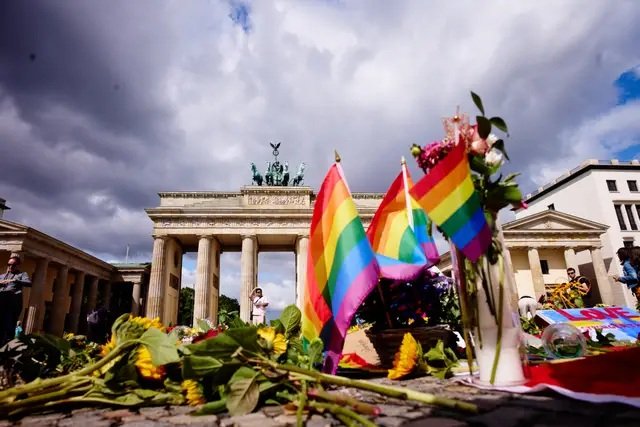
The decision to proceed with Hamburg Pride came in the shadow of the attack in Berlin, where a driver identified as Abdul B. drove a vehicle into crowds attending Christopher Street Day celebrations, killing one person and injuring 31 others, some seriously. The attack prompted immediate questions about whether subsequent Pride events across Germany should continue as planned or be cancelled because of security concerns.
Organisers in Hamburg chose a different path. Instead of postponing the march, they strengthened security measures while insisting that withdrawing from public space would hand victory to those seeking to intimidate the LGBTQ+ community. According to police and organisers, around 300,000 people attended the parade, making it the largest Christopher Street Day celebration ever held in Hamburg. Sixty decorated trucks carried community organisations, businesses, churches and advocacy groups through the city.
Although the atmosphere featured music, colourful costumes and celebration, participants repeatedly stressed that Christopher Street Day has always been more than a festival. Its origins lie in protest, commemorating the resistance of LGBTQ+ people against police raids in New York’s Christopher Street in 1969. For many marchers, the Hamburg event therefore represented both remembrance and political demonstration.
One of the most visible delegations travelled from Berlin. Around 100 members of CSD Berlin arrived wearing black clothing as a sign of mourning for those affected by the previous week’s attack. Their banners carried messages calling for courage and a future free from fear, while participants embraced one another and reflected on an emotionally exhausting week.
Thomas Hoffmann, a board member of CSD Berlin, recalled the confusion during the attack, describing how organisers first focused on emergency procedures before the emotional impact became fully apparent. Speaking to Die Zeit, he said the community had experienced days of grief but remained determined to stay visible. “We mourn, but we mourn loudly,” he said, expressing a sentiment that echoed throughout the parade.
The heightened emotions also reflected wider concerns about violence directed at LGBTQ+ people. Die Zeit reported that Hamburg records attacks against gay, lesbian and transgender people on a regular basis. Authorities have identified suspects from different extremist backgrounds in previous incidents, contributing to ongoing concerns about both far-right violence and Islamist extremism.
These concerns were particularly relevant because part of the parade passed through the St. Georg district near Hamburg’s central railway station, where LGBTQ+ venues and businesses exist alongside a neighbourhood with a large Muslim population. Police significantly expanded security arrangements for the event, reportedly doubling the number of officers deployed compared with previous years.
Hamburg Pride organisers acknowledged that the days following the Berlin attack had initially been dominated by fear. Yet that mood gradually shifted towards determination. According to spokesperson Manuel Opitz, cancelling the event was never considered a realistic option once organisers concluded that continuing the march itself would send an important message. Support from the Hamburg police and hundreds of messages from members of the public, including many people who had never previously attended a Pride event, reinforced that decision.
Not every public reaction was supportive. Online discussions following the Berlin attack included hostile comments blaming LGBTQ+ people themselves for becoming targets. Some participants admitted that those responses made them reconsider whether they should attend Hamburg Pride, particularly families travelling from outside the city. Ultimately, many concluded that remaining visible was more important than allowing intimidation to shape their decisions.
The parade also highlighted the personal calculations many LGBTQ+ people routinely make about their safety. One participant, Jonas, attended wearing large handmade angel wings that had become his trademark at Pride events across Germany. He revealed that he now routinely carries pepper spray while travelling in public because of concerns about possible attacks, explaining that the journey to and from such events often feels more dangerous than the events themselves.
Alongside expressions of grief and resilience, the demonstration also became a platform for voices seeking dialogue across communities.
Among those marching was Saleh Almaqadma, an Arab participant who carried signs reading “Love is Halal” and “Queer is Fitrah”. He argued that homosexuality has existed across cultures and throughout history, rejecting suggestions that LGBTQ+ identity is exclusively a Western concept. Speaking to Die Zeit, he also warned that Islamist extremism, like the broader rise of political extremism, represents a genuine threat that should be confronted openly while encouraging more people from Arab communities to express solidarity with LGBTQ+ citizens.
A similar message came from Fatih Yildiz, chairman of the Shura Council of Islamic Communities in Hamburg. After attending a memorial event organised by Hamburg Pride, Yildiz emphasised the importance of avoiding collective blame against Muslims following the Berlin attack. He argued that communities should not be turned against one another and said Muslim leaders had reminded worshippers that disagreement over sexuality or gender identity could never justify hatred or violence. Respect, he suggested, must be mutual if diverse communities are to coexist peacefully.
The route through the Steindamm district illustrated those complexities. While many local businesses experienced reduced trade because of road closures, numerous residents watched the parade with curiosity, filming the procession or sharing it with relatives through video calls. Some had not realised the event was taking place until traffic restrictions left them unexpectedly surrounded by the celebration. Others simply enjoyed the festive atmosphere despite the disruption to daily routines.
By the time the final trucks completed their journey, the event had become something more significant than an annual Pride parade. It stood as a collective response to violence that refused to allow grief to erase visibility or fear to replace public participation.
As Die Zeit observes, the significance of Hamburg Pride this year extended beyond colourful displays or musical performances. The parade became a demonstration that remembrance and celebration need not be contradictory. For many participants, openly expressing grief while continuing to occupy public space represented its own form of resistance. One week after tragedy struck Berlin, Hamburg’s response suggested that resilience can sometimes be measured not by the absence of fear, but by the determination to continue marching despite it.