



Pavan K. Varma’s The Lady Who Carried the Monk Across the River presents itself as a parable “for ordinary people,” but that description is almost aggressively misleading. This is not a gentle fable about balance or moderation; it is a sustained provocation aimed at the moral authority of renunciation, the sanctity of celibacy, and the monopoly that organised spirituality claims over truth. Beneath its calm, almost courtly prose, the book is quietly incendiary. It does not argue against asceticism from the outside. It corrodes it from within, using its own language, symbols, and revered texts until the edifice begins to buckle.
The story opens in apparent deference to tradition. Guru Brihaspati lectures on “all the philosophical intricacies that he could think of in explaining Hindu philosophy,” while his disciples sit “dutifully at his feet.” Yet from the beginning, the narrative signals fatigue with abstraction. Philosophy is described as “complex,” life as “so little,” and the pleasure of tea midway through the lecture as a “huge relief.” Even before the central incident, Varma plants the suggestion that spiritual discourse is already divorced from lived reality. Wisdom is endless; life is finite. The imbalance is never resolved.
The incident itself—Kevala carrying Mandakini across a river—has the deceptive simplicity of a Zen koan. Yet Varma refuses metaphorical distance. The act is physical, impulsive, and ethically untidy. Kevala admits there was “no thinking behind it,” that it was done “on the spur of the moment.” More unsettlingly, he confesses that he “had quite enjoyed the sensation of her young, supple body in his arms.” This is not a fall from grace described in euphemism. It is a frank admission of embodied pleasure, and it becomes the book’s moral fault line. Spirituality does not collapse because Kevala is weak; it collapses because it cannot accommodate honesty.
From here, the novel launches its most subversive move: it refuses to treat desire as contamination. Kevala does not believe what he did was “wrong,” nor that it constituted “a breach of his vow of celibacy.” This is a direct challenge to the architecture of monastic ethics, which depends on intention being policed retroactively. The body, Varma suggests, does not wait for permission from doctrine. Meaning arrives after the fact, and often too late.
The philosophical debate with Brihaspati—ostensibly the book’s intellectual centrepiece—is where Varma sharpens the blade. Brihaspati insists on “an immutable dharma, law, custom and usage,” declaring that “some things were right, and some things not.” Kevala responds not with rebellion but with cosmology. He reminds his teacher that the universe is vast, expanding, indifferent, that “we go about generalizing about right and wrong as though we are the centre of the universe.” The move is audacious: morality is relativised not through modern scepticism but through cosmic scale. Ethics shrinks when placed next to infinity.
Brihaspati’s defence is revealingly anxious. He accuses Kevala of becoming “a moral anarchist, a law unto yourself.” The fear is not that Kevala is wrong, but that he is uncontainable. Orthodoxy senses the threat: once morality is no longer singular, authority loses its leverage. When Brihaspati demands, “Do you think what you did was right?” he frames the question as a trap. Yet Kevala postpones the answer, asserting control over the rhythm of judgment itself. Even temporality becomes contested.
Varma compounds the provocation by exposing the hypocrisy embedded within renunciation. Gyan, the other monk, is no spiritual aspirant at all. He is candidly transactional: a monk “because this seemed to be the only thing he could do to get three meals a day, shelter and respect in society.” He performs holiness with theatrical precision, “sporting a red tilak,” quoting memorised passages, loosening “the purse strings of those who wanted to spend money to appease god.” Here, Varma is merciless. Asceticism is not only unattainable; it is routinely faked. The system survives not through purity but through performance.
Brihaspati himself is eventually exposed as compromised. His insistence on celibacy is rooted in repression, not transcendence. His own past—a buried incident involving desire—returns unbidden, triggered by the sight of Kevala carrying a woman. Renunciation, Varma suggests, is often not chosen freely but as penance, as escape, as damage control. Brihaspati became a monk to “erase forever the sordid, dirty and sinful weakness he had displayed.” Monkhood emerges not as enlightenment but as laundering.
The book’s most dangerous moment comes when Kevala invokes Adi Shankaracharya. He reminds Brihaspati that the great sage did not merely tolerate kama but studied it, inhabiting another body to do so. “The purpose,” Kevala insists, “is not to say that Adi Shankaracharya betrayed his commitments as a sanyasin, but to understand that even the great Guru did not shun kama, but learnt it.” This is theological dynamite. Varma uses orthodoxy against itself, suggesting that desire is not the enemy of enlightenment but one of its instruments. Celibacy is no longer heroic; it becomes optional.
Mandakini herself complicates the moral landscape further. She is neither temptress nor passive symbol. When Kevala apologises for carrying her “without asking your permission,” she responds without outrage or absolution. “I don’t blame you. I don’t hold it against you.” Forgiveness here is not moral endorsement; it is emotional autonomy. Later, it is she who carries Kevala across the river, fulfilling the book’s title with devastating symmetry. The monk who once bore a woman is now helpless, drifting, struck by a rock, reduced to “an inanimate play-thing in the grasp of the waters.” Salvation arrives not through doctrine but through love, endurance, and a woman’s resolve.
The river crossing scene is deliberately eroticised and sanctified at once. As Mandakini pulls Kevala to shore, Varma writes of “a strange sense of total calm,” of surrender, of peace. When she kisses him, the imagery fuses tantra and transcendence. She becomes “Draupadi wreathed in mysteries… Rati personified… a goddess on fire.” This is not subtle. Varma is rewriting the spiritual hierarchy: woman as Shakti, flesh as sacred, union as cosmological alignment. Renunciation, by contrast, is sterile.
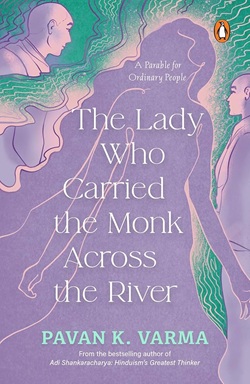
The ending offers no apology. Kevala marries, works, meditates, loves, has a child named Moksha. Liberation is not renounced; it is domesticated. He remains spiritual, but not celibate; reflective, but not withdrawn. Brihaspati, meanwhile, retreats into silence, taking a lifelong vow of maun vrat. Authority’s final gesture is muteness. Gyan, the hypocrite, disappears into rumour. The system dissolves, not in catastrophe, but in irrelevance.
What makes The Lady Who Carried the Monk Across the River controversial is not that it critiques asceticism, but that it refuses tragedy. Desire does not destroy Kevala; it clarifies him. Love does not derail spirituality; it completes it. Varma’s most radical claim is implicit: that enlightenment pursued through denial may be less honest than fulfilment pursued with awareness. The book dares to suggest that holiness without joy is suspect, and that doctrines demanding the mutilation of the self deserve disobedience.
This is a dangerous book precisely because it is polite. It quotes scripture, reveres tradition, and speaks softly. But by the final page, the reader is left with a disquieting thought: that the river was never the obstacle. The real crossing was away from fear—fear of the body, fear of love, fear of being fully alive.









