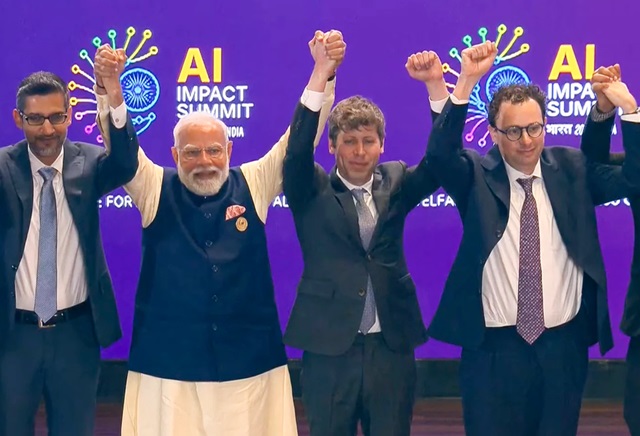
At the AI Impact Summit, a highly anticipated event aimed at promoting the democratization of AI, a fleeting but telling moment occurred as OpenAI CEO Sam Altman and Anthropic CEO Dario Amodei stood side by side on stage. When asked to join hands with other leaders, the two executives hesitated, ultimately raising their fists instead. The awkward pause highlighted a deeper divide: a history of contrasting visions that has driven the two companies along different paths in the AI arms race.
Amodei, who left OpenAI in 2020 after disagreements over the company’s approach to AI safety, co-founded Anthropic in 2021 with a focus on developing AI with security and ethical safeguards at its core. Altman’s OpenAI, in contrast, has prioritized rapid development and broad commercialization of its ChatGPT products. The ideological split has fueled public rivalry, including high-profile advertising campaigns by Anthropic during the 2025 Super Bowl that mocked OpenAI’s ad strategy. Altman responded with measured criticism on social media, defending OpenAI’s commitment to free access and transparency.
The tension between the two companies reflects a broader reality in AI research: a small, interconnected group of scientists and entrepreneurs dominate the field. OpenAI itself was founded by Altman, Elon Musk, Ilya Sutskever, and others, with early backing from Peter Thiel. Many former OpenAI employees, including Amodei, have gone on to establish competing ventures, mirroring patterns seen in Silicon Valley’s “PayPal Mafia” era, where founders of early tech firms created a cascade of influential companies. Google DeepMind has similarly produced a significant number of AI spin-offs.
Internal conflicts at OpenAI further underscore the stakes. Ilya Sutskever’s 2024 departure following a failed internal challenge to Altman, and subsequent launches of Safe Superintelligence and Thinking Machines Lab by former OpenAI leaders, illustrate ongoing tensions over safety and development priorities. These overlapping networks of former colleagues and competing startups reveal that the global AI race is not just about technology—it is a battle of vision, control, and influence among a surprisingly small circle of elite innovators.
The New Delhi summit, intended as a moment of unity for AI governance, inadvertently exposed the fragility of cooperation at the highest levels of the industry. As Altman and Amodei raised their fists instead of joining hands, it became clear that the AI “cold war” is no longer theoretical—it is on full display for the world to see.