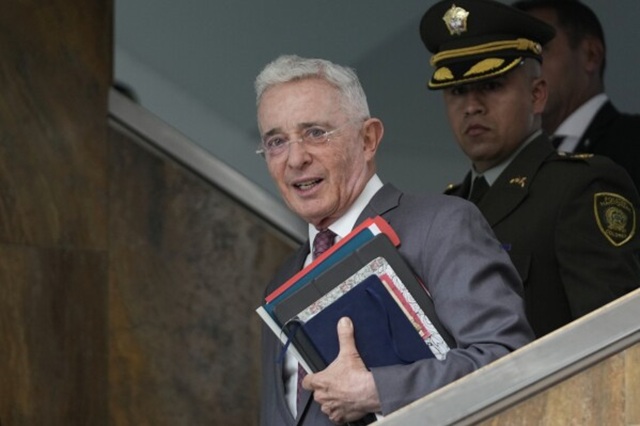
In a historic ruling that has shaken Colombia’s political landscape, former President Álvaro Uribe has been found guilty of bribery and witness tampering — making him the first ex-head of state in the nation’s history to be criminally convicted.
The verdict, handed down on Monday after a marathon 10-hour reading by Judge Sandra Liliana Heredia, concluded a nearly 13-year-long judicial saga that centered on Uribe’s alleged efforts to manipulate testimony related to paramilitary activity during Colombia’s decades-long internal conflict.
Uribe, 73, was convicted of attempting to bribe a former paramilitary member to retract claims that the then-president had helped create and fund a paramilitary group in the 1990s — a period marked by widespread violence between the state, guerrillas, and illegal armed factions.
Appearing virtually from his rural estate near Medellín, Uribe visibly shook his head as the verdict was read. Judge Heredia emphasized the independence of the judiciary, stating, “Justice does not kneel before power. It is at the service of the Colombian people.”
Although sentencing has not yet been issued, the crimes carry a potential prison term of six to 12 years. Uribe’s legal team has announced plans to appeal the decision. “This is not the end of this process,” said Juan Felipe Amaya, one of Uribe’s lawyers. “We respect the ruling, but we believe it is wrong and we will demonstrate that in the appeal.”
Uribe governed Colombia from 2002 to 2010 and remains one of the most influential — and polarizing — figures in modern Colombian history. He is credited with weakening the leftist guerrilla group Revolutionary Armed Forces of Colombia (FARC), opening the country to foreign investment, and improving security. Yet his presidency was also marred by serious human rights violations.
One of the most notorious episodes under his leadership, the so-called “false positives” scandal, involved military forces executing thousands of civilians and falsely reporting them as enemy combatants to inflate success metrics in the war against insurgents. Critics also accuse Uribe of enabling right-wing paramilitaries to operate with impunity alongside the military.
Supporters, however, view Uribe as a patriot who rescued the nation from chaos. His military campaign against FARC was widely seen as instrumental in pushing the group toward the peace process eventually completed by his successor, Juan Manuel Santos, in 2016 — a deal Uribe fiercely opposed.
The conviction comes at a time of rising unrest in Colombia. Armed groups are regrouping as peace talks with the government of President Gustavo Petro, a former rebel himself, falter. Tensions have been further exacerbated by recent political violence, including a June 7 assassination attempt on conservative Senator Miguel Uribe Turbay.
International reactions to the verdict have been mixed. U.S. Senator Marco Rubio defended Uribe, claiming on X (formerly Twitter) that “Uribe’s only crime has been to tirelessly fight and defend his homeland.” Rubio accused Colombian courts of being weaponized by “radical judges,” warning of a dangerous precedent.
But analysts push back against the idea of politically motivated justice. “This isn’t about Uribe being a good or bad president,” said Sergio Guzmán, director of Colombia Risk Analysis. “It’s about whether he orchestrated a plan to manipulate judicial testimony in his favor.”
As Colombia braces for national elections next year, the ruling adds another layer of complexity to an already fraught political environment — and signals that even the country’s most powerful figures are not immune from accountability.