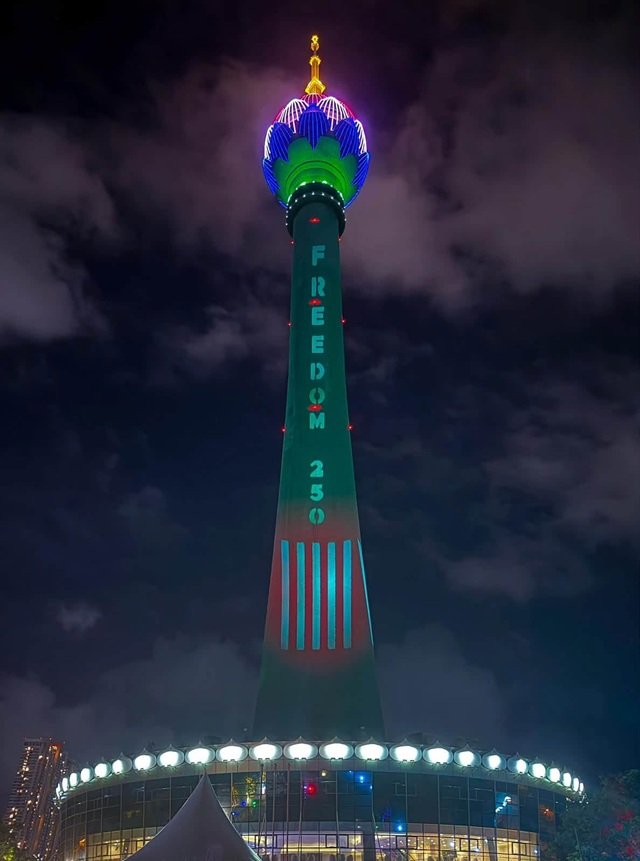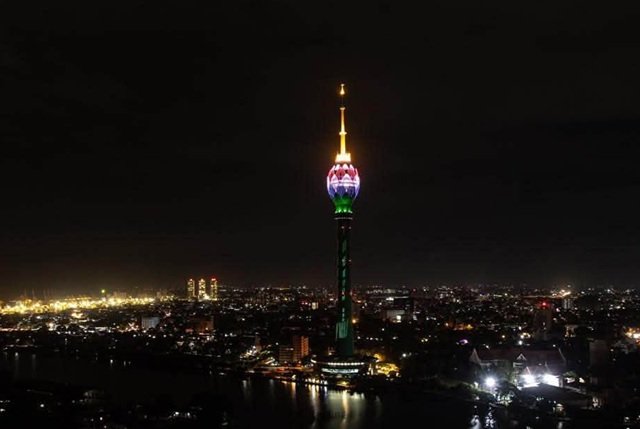
The U.S. Embassy in Colombo decided to celebrate America’s 250th Independence anniversary by projecting red, white, and blue lights onto the Lotus Tower, while quoting President Trump on freedom and declaring that “the story of America makes everyone free.” It was meant as a simple act of public diplomacy. It did not stay simple for long.
The structure chosen for the display, the Lotus Tower, is not just another landmark in Colombo’s skyline. It is also one of Sri Lanka’s most visible symbols of Chinese-financed infrastructure, long folded into regional debates about influence, debt exposure, and strategic dependency. So when American patriotic colors lit up its surface, the image carried more than celebration. It carried irony so dense it almost did the interpretation work itself.
The official message from the U.S. Embassy Colombo was straightforward enough: a call to “look to the Lotus Tower tonight as it shines in red, white & blue,” paired with Trump’s line that “the story of America makes everyone free,” and a toast to 250 years of freedom and democracy. It read like standard Independence Day language, exported across borders as usual.
But Colombo has its own memory of American messaging, and it is not limited to fireworks and anniversary captions. Over the years, U.S. officials and visiting diplomats have repeatedly warned Sri Lanka about the risks of overdependence on Chinese financing. The language has ranged from cautious diplomacy to sharper strategic framing: debt sustainability concerns, warnings about sovereignty erosion, and broader critiques of Beijing’s infrastructure diplomacy across the region. In more explicit moments, senior figures have described China’s overseas economic model as “predatory” and urged Sri Lanka to choose “transparent” alternatives.
Those warnings, notably, were never really about a tower. They were about ports, loans, leverage, and long-term strategic positioning. Still, in the public imagination, projects like the Lotus Tower inevitably got pulled into the same narrative ecosystem, even when they were not the central focus of official critique.
Which is why the optics of this particular celebration feel unusually layered. A structure often discussed in the context of Chinese state-backed development becomes the surface for an American freedom message quoting a president known for reshaping that very discourse into something more theatrical. The result is not contradiction in the academic sense. It is contradiction in the visual sense: immediate, unavoidable, and slightly absurd.
There is something almost too neat about it. The same infrastructure that once sat inside warnings about influence and dependency is now illuminated in the colors of the country issuing those warnings, wrapped in language about liberty that travels well across borders even when the political realities beneath it do not always cooperate.
None of this suggests a shift in policy or an escalation in rivalry. The embassy event was not a diplomatic statement aimed at China, and no official link was made between the celebration and Sri Lanka’s infrastructure choices. But symbolism does not always wait for instructions. It assembles itself when context is crowded enough.
Sri Lanka has become one of those places where multiple external narratives overlap without fully cancelling each other out. Chinese financing builds the skyline. Western diplomacy comments on the risks of that financing. And occasionally, as in this case, American celebration briefly lights up the very structures that sit inside those debates.
The Lotus Tower kept shining after the message ended, indifferent to the interpretations projected onto it. Which is perhaps the most accurate part of the entire scene: infrastructure does not argue back. It just holds whatever meaning the moment decides to place on it, even when those meanings were never designed to share the same frame.